Riyadh forum call to formulate sustainable policies for a better future

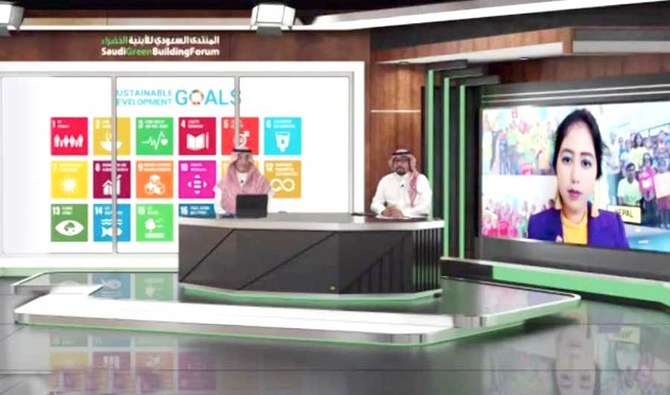
A virtual UN event hosted from Riyadh on Monday discussed how the world could best recover from the coronavirus disease (COVID-19) pandemic. (Supplied)
Short Url
Updated 14 July 2021
Follow

Riyadh forum call to formulate sustainable policies for a better future

  • UN Human Rights Champion Kehkashan Basu said that the recovery process presents a unique opportunity to rebuild a better environment and restore the balance between humanity and “Mother Earth,” to help foster “a culture of peace”

JEDDAH: A virtual UN event hosted from Riyadh on Monday discussed how the world could best recover from the coronavirus disease (COVID-19) pandemic.
Speakers covered topics including the preservation of natural resources and ensuring social inclusion and equal participation in a post-COVID-19 world.
The event was hosted by the Saudi Green Building Forum, a Saudi nongovernmental organization, alongside the UN’s High-Level Political Forum on Sustainable Development, which was held between July 6-15.
The forum raises awareness about the SDGs and their application, and is one of the few established Saudi NGOs in consultative status with the UN.
This event sparked debate on how to bridge the gap between public and private sector roles to achieve the UN’s Sustainable Development Goals (SDGs).
“Holding this meeting from the Saudi capital as part of this prestigious event is an outstanding achievement, and represents a statement of Saudi civil society toward SDGs,” the secretary-general of the Saudi Green Building Forum, Faisal Al-Fadl, told Arab News.
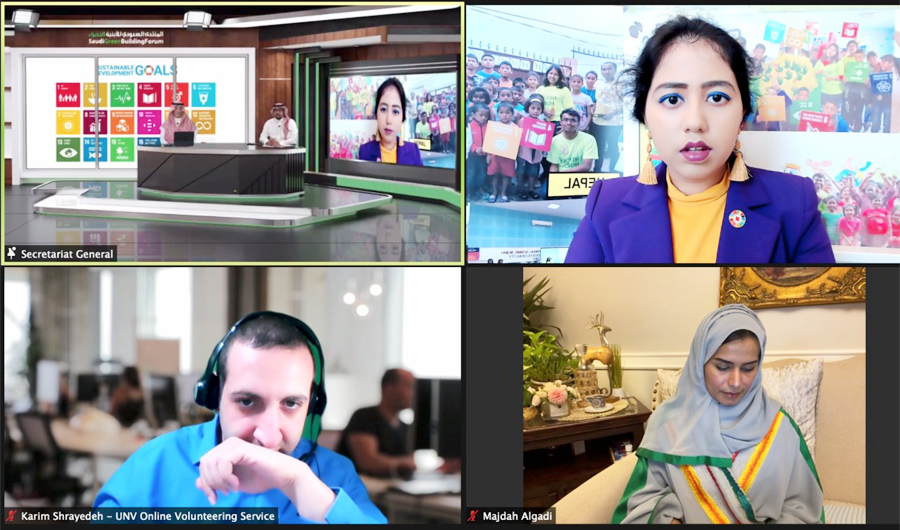
Experts, academics, youth, and representatives of NGOs from all over the world volunteered to take part at the discussion under the title “The honest voice, bridging the gap: Climate, sustainability and resource efficiency; ensuring health, safety & the environment; sustainable and resilient recovery from the COVID-19.”
Clara Rowe, CEO of Restore — an open data platform that supports the global restoration movement — told the event: “The COVID-19 crisis has made clear the connection between human health and the health of our natural ecosystems.”

Holding this meeting from the Saudi capital as part of this prestigious event is an outstanding achievement, and represents a statement of the Saudi civil society toward SDGs.

Faisal Al-Fadl

In her speech during the first session on climate, sustainability and resource efficiency, Rowe added: “June 5 marked the launch of the UN Decade on Ecosystem Restoration, a crucial moment to focus collaboration across sectors and between nations, in order to restore our planet — for local resilience and for our collective fight against global climate change.”
UN Human Rights Champion Kehkashan Basu said that the recovery process presents a unique opportunity to rebuild a better environment and restore the balance between humanity and “Mother Earth,” to help foster “a culture of peace.”
Speakers also included the former secretary-general of the Riyadh-based International Energy Forum, Aldo Flores-Quiroga, who addressed the circular carbon economy and sustainability.
Omhani Ambre Naija, a writer and founder of Sparklink Agency — which specializes in designing sustainable business models — said: “COVID-19 is an unprecedented crisis that hit the whole world and transformed drastically the way we live, work together and do business. It is now essential to embrace the paradigm shift toward a new reality.”
Majdah Al-Qadi, a consultant and a human development planning specialist, told the discussion that there should be more support given to civil societies to enhance their participation in economic growth and national transformation.
The concluding recommendations by the speakers highlighted some long-term priorities for the future, including directing attention to natural resources, providing an infrastructure for an inclusive society, strengthening the link between policy and science, and building civil society resilience.
The speakers said that these goals should be achieved by enabling independent learning, ensuring health and safety, supporting local communities, and empowering fair systems supported by multisectoral and multidisciplinary procedures.


Threat to Kingdom’s security is ‘red line’ that will be ‘addressed and neutralized,’ Saudi envoy says

Updated 14 January 2026
Follow

Threat to Kingdom’s security is ‘red line’ that will be ‘addressed and neutralized,’ Saudi envoy says

  • Abdulaziz Alwasil tells UN Security Council the situation in southern Yemen is ‘a just cause with social and historic dimensions’ that can only be resolved through dialogue
  • Recent military activity in the south was unilateral, resulting in an escalation that harms the interests of Yemeni people and undermines efforts to address issues in the south, he said

NEW YORK CITY: Any attempt to threaten Saudi Arabia’s national security is a “red line” and will be met with decisive action, the Kingdom’s ambassador to the UN told the Security Council on Wednesday.

Speaking during a meeting of the council to discuss Yemen, Abdulaziz Alwasil said the situation in the south of the country is “a just cause with social and historic dimensions” that can only be resolved through dialogue.

“We stress that any attempt to threaten our national security is a red line, and we will not hesitate to take the necessary actions and steps to address it and neutralize it,” he added.

Alwasil reaffirmed Saudi Arabia’s support for Yemeni President Rashad Al-Alimi, the Presidential Leadership Council, and the Yemeni government in their efforts to achieve security, stability, development and peace while preserving national unity.

He said military activity by Southern Transitional Council forces in Hadramout and Al-Mahra on Dec. 2, 2025, was unilateral, did not have the approval of the Presidential Leadership Council, and was not carried out in coordination with the Coalition to Restore Legitimacy in Yemen.

It had resulted in an unjustified escalation that harmed the interests of the Yemeni people, undermined efforts to address the issues in the south, and ran counter to the coalition’s objectives, Alwasil added.

The Kingdom, working with its coalition partners, the Presidential Leadership Council and the Yemeni government, had moved to contain the situation by dispatching a military force to coordinate arrangements with the Southern Transitional Council in Aden, he said.

The aim was to ensure the return of the southern council’s forces to their previous positions outside of Hadramout and Al-Mahra, and the handover of camps to legitimate government forces and local authorities in line with agreed procedures, Alwasil added.

He expressed regret over the military operations that took place in Hadramout and Al-Mahra, close to Saudi Arabia’s southern border, which he said posed a direct threat to the Kingdom’s national security, as well as the security of Yemen and regional stability. Such steps were extremely dangerous, he added, and contradicted the principles on which the Coalition to Restore Legitimacy in Yemen had been founded.

Alwasil welcomed a prisoner and detainee exchange agreement signed in Muscat on Dec. 23, which he described as an important humanitarian measure to alleviate suffering and build confidence.

He praised Oman for hosting and sponsoring the consultations and supporting negotiations, and commended the efforts of UN’s special envoy for Yemen, Hans Grundberg, the International Committee of the Red Cross and all others that has played a part.

Regarding the political efforts to resolve the crisis, Alwasil said Saudi Arabia welcomed President Al-Alimi’s call for an inclusive conference in Riyadh to bring together all stakeholders to discuss just solutions to the situation in southern Yemen.

Preparations for the conference have begun, he added, in cooperation with the Yemeni government and southern representatives, reflecting the close ties between the two countries and their shared interests in stabilizing Yemen.

He urged all southern stakeholders to participate actively and constructively in the talks, to help find comprehensive and just solutions that meet the legitimate aspirations of the people of southern Yemen.

Alwasil called on all Yemeni forces and stakeholders to cooperate and intensify their efforts to reach a lasting political settlement that would ensure security and stability.

He described the southern issue as “a just cause with social and historic dimensions,” adding that “the only way to address it is through dialogue that leads to a comprehensive political solution” based on nationally and internationally agreed terms of reference.