Stung by Lebanon currency loss, UNICEF gives aid handouts in dollars

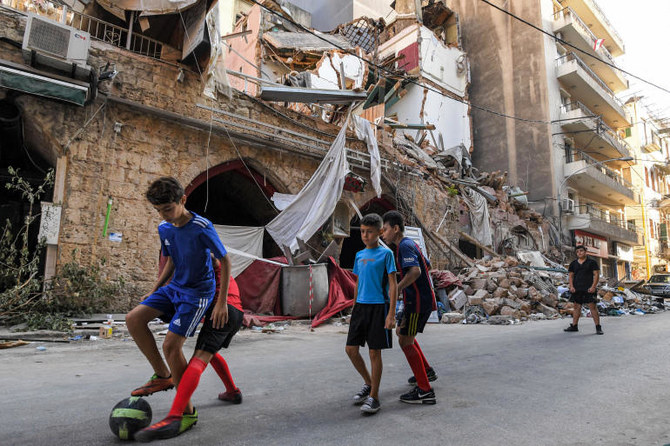
Children play on a street in the Gemmayzeh district of Lebanon’s capital Beirut after the monster blast at the nearby port that devastated the city, August 2020. (AFP)
Short Url
Updated 13 July 2021
Follow

Stung by Lebanon currency loss, UNICEF gives aid handouts in dollars

  • The new initiative, named Haddi, or ‘next to me’ in Arabic, provides cash aid to 70,000 Lebanese, Syrian and Palestinian children
  • Families with one child will receive monthly assistance of $40, rising to $60 for those with two children and $80 for larger families

BEIRUT: The families of vulnerable children in Lebanon have started receiving UNICEF cash handouts in US dollars as the UN children’s fund seeks to put a stop to hefty losses in aid due to unfavorable exchange rates at Lebanese banks.
The new initiative, named Haddi, or “next to me” in Arabic, provides cash aid to 70,000 Lebanese, Syrian and Palestinian children at risk of child labor, early marriage or exclusion from schooling during Lebanon’s deep economic crisis.
“UNICEF chose to explore the risks and feasibility aspects related to switching to USD disbursements ... we assessed that the benefits were important and made the decision to switch to USD,” the fund told the Thomson Reuters Foundation by email.
To get the full value of aid to those who need it, UNICEF’s Haddi program includes a new cash disbursal mechanism that cuts out private banks and instead channels aid in greenbacks to beneficiaries via money transfer services.
Families with one child will receive monthly assistance of $40, rising to $60 for those with two children and $80 for larger families, allowing them to choose how to spend it “to ensure people retain some dignity in the current situation.”
UK-based charity Save the Children said on Tuesday it had documented a “dramatic increase” in child labor in Lebanon this year, identifying 306 cases so far compared to 346 in all of 2020.
Children as young as five are selling fuel on the streets and collecting scrap metal or plastic, and more than one million minors — Lebanese and refugees — now need support, it said.
Lebanon’s outgoing deputy prime minister, who has been involved in aid talks, could not immediately be reached for comment on the new UNICEF strategy, nor could the caretaker ministers of finance or social affairs.
UNICEF has now effectively left a program known as LOUISE, which also involves the UN refugee agency (UNHCR) and the World Food Programme (WFP), to disburse aid via the Banque Libano-Francaise (BLF) bank.
A Thomson Reuters Foundation investigation in June found unfavorable conversion rates used by the bank had led to losses in aid of about $250 million via the program since 2019. The bank has declined to comment on the rates used.
The foreign exchange losses stemmed from a plunge in the value of the Lebanese pound since the country’s economy began to collapse in late 2019, sending prices soaring and forcing many Lebanese into poverty.
During 2020 and the first four months of 2021, banks exchanged dollars for UN agencies at rates on average 40 percent lower than the market rate, thereby slashing the amount of money reaching beneficiaries.
Though LOUISE agencies have since received progressively better exchange rates, they still lag behind the market price.
Some UN agencies, donor nations and Lebanese officials have raised concerns that paying out dollars to refugees, the country’s primary aid beneficiaries, would fuel tensions between them and members of host communities.
But including Lebanese children in the Haddi program and using money transfer outlets should alleviate such risks, UNICEF said.
“Providing cash through ATMs ... often leads to crowding and raises tensions in the community. To avoid this, Haddi does not use ATMs, instead leveraging a much larger network of money transfer branches across the entire country,” UNICEF said.
It said small-scale surveys among the first beneficiaries had not highlighted any safety or exchange rate problems.
“The response so far has been one of relief,” the fund said.


Israel orders Gaza families to move in first forced evacuation since ceasefire

Updated 58 min 21 sec ago
Follow

Israel orders Gaza families to move in first forced evacuation since ceasefire

  • Residents of Bani Suhaila, east of Khan Younis, said the leaflets were dropped on Monday on families living in tent encampments in the Al-Reqeb neighborhood

CAIRO: Israeli forces have ordered dozens of Palestinian families in the southern Gaza Strip to leave their homes in the first forced evacuation since October’s ceasefire, as residents and Hamas said on Tuesday the military was ​expanding the area under its control.
Residents of Bani Suhaila, east of Khan Younis, said the leaflets were dropped on Monday on families living in tent encampments in the Al-Reqeb neighborhood.
“Urgent message. The area is under IDF control. You must evacuate immediately,” said the leaflets, written in Arabic, Hebrew, and English, which the army dropped over the Al-Reqeb neighborhood in the town of Bani Suhaila.
In the two-year war before the US brokered ceasefire was signed in October, Israel dropped leaflets over areas that were subsequently raided or bombarded, forcing some families to move several times.
Residents and a source from the Hamas militant group said this was the first time they had been ‌dropped since then. ‌The Israeli military did not immediately respond to a request for comment.

SIDES FAR ‌APART ⁠ON ​NEXT PHASES
The ‌ceasefire has not progressed beyond its first phase, under which major fighting has stopped, Israel withdrew from less than half of Gaza, and Hamas released hostages in return for Palestinian detainees and prisoners.
Virtually the entire population of more than 2 million people are confined to around a third of Gaza’s territory, mostly in makeshift tents and damaged buildings, where life has resumed under control of an administration led by Hamas.
Israel and Hamas have accused each other of major breaches of the ceasefire and remain far apart on the more difficult steps planned for the next phase.
Mahmoud, a resident from the ⁠Bani Suhaila area, who asked not to give his family name, said the evacuation orders impacted at least 70 families, living in tents and homes, ‌some of which were partially damaged, in the area.
“We have fled ‍the area and relocated westward. It is maybe the ‍fourth or fifth time the occupation expanded the yellow line since last month,” he told Reuters by phone ‍from Khan Younis, referring to the line behind which Israel has withdrawn.
“Each time they move it around 120 to 150 meters (yards) inside the Palestinian-controlled territory, swallowing more land,” the father-of-three said.

HAMAS CITES STATE OF HUMANITARIAN DISRUPTION
Ismail Al-Thawabta, director of the Hamas-run Gaza government media office, said the Israeli military had expanded the area under its control in eastern Khan Younis five times since ​the ceasefire, forcing the displacement of at least 9,000 people.
“On Monday, 19 January 2026, the Israeli occupation forces dropped warning leaflets demanding the forced evacuation of the Bani Suhaila area in eastern ⁠Khan Younis Governorate, in a measure that falls within a policy of intimidation and pressure on civilians,” Thawabta told Reuters.
He said the new evacuation orders affected approximately 3,000 people.
“The move created a state of humanitarian disruption, increased pressure on the already limited shelter areas, and further deepened the internal displacement crisis in the governorate,” Thawabta added.
Israel’s military has previously said it has opened fire after identifying what it called “terrorists” crossing the yellow line and approaching its troops, posing an immediate threat to them.
It has continued to conduct air strikes and targeted operations across Gaza. The Israeli military has said it views “with utmost severity” any attempts by militant groups in Gaza to attack Israel.
Under future phases of the ceasefire that have yet to be hammered out, US President Donald Trump’s plan envisages Hamas disarming, Israel pulling out further, and an internationally backed administration rebuilding Gaza.
More than 460 Palestinians and three Israeli soldiers have been reported killed since the ceasefire took ‌effect.
Israel launched its operations in Gaza in the wake of an attack by Hamas-led fighters in October 2023 which killed 1,200 people, according to Israeli tallies. Israel’s assault has killed 71,000 people, according to health authorities in the enclave.