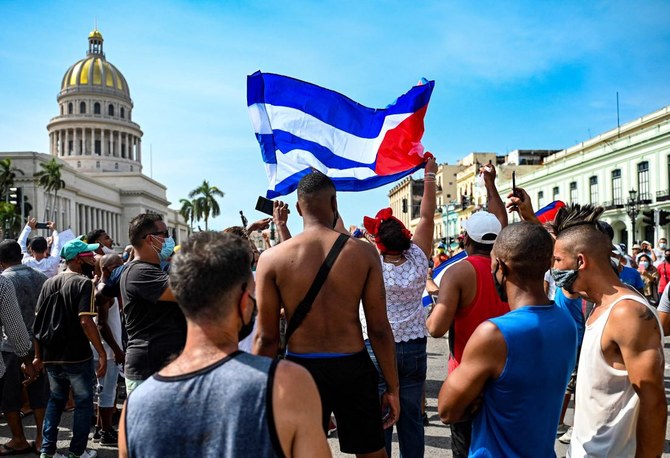
HAVANA: Thousands of Cubans took part in rare protests Sunday against the communist government, chanting, “Down with the dictatorship,” as President Miguel Diaz-Canel called on his supporters to confront the demonstrators.
The anti-government rallies started spontaneously in several cities as the country endures its worst economic crisis in 30 years, with chronic shortages of electricity and food.
Several hundred protesters marched through the capital Havana chanting, “We want liberty,” with a heavy military and police presence deployed after demonstrators massed outside the Capitol building.
Police used tear gas to disperse crowds, and at least ten people were arrested, while officers used plastic pipes to beat protesters, AFP journalists witnessed.
Diaz-Canel delivered a combative television address, saying: “The order to fight has been given — into the street, revolutionaries!“
“We call on all revolutionaries of the country, all communists, to go out in the streets where these provocations occur... and to face them in a decisive, firm and courageous way.”
The only authorized gatherings in Cuba are normally Communist Party events, but according to the data journalism site Inventario, a total of 40 demonstrations took place on Sunday.
Social media showed scenes from anti-government protests around the country, but mobile Internet — only introduced in Cuba since 2018 — was largely cut off on Sunday afternoon.
Several thousand protesters, mainly young people, took to the streets of San Antonio de los Banos, a town 30 kilometers (20 miles) southwest of Havana.
One local, on condition of anonymity, told AFP that she participated in the demonstration as she was exasperated by “the situation with electricity and food.”
Security forces arrived soon after the protests began, and the president later visited the town himself, surrounded by party activists as residents heckled him, according to videos posted online.
“The energy situation seems to have produced some reaction,” Diaz-Canel told reporters, blaming US sanctions imposed by Donald Trump and left unchanged by President Joe Biden.
He accused “a Cuban-American mafia” of whipping up the protests on social media.
Candido Abrines, a retired pro-government protester, told AFP he was demonstrating so that “capitalism will never come back here again and (so) that these mercenaries paid by the Empire (the US) will never again take our streets, first they have to kill us all.”
Government supporters also held some counter-demonstrations in Havana.
An Associated Press videojournalist was assaulted by some of them, and an AP photojournalist was injured by the police, the news agency said.
The United States reacted swiftly to the day’s events.
“The US supports freedom of expression and assembly across Cuba, and would strongly condemn any violence or targeting of peaceful protesters who are exercising their universal rights,” US National Security Adviser Jake Sullivan wrote on Twitter.
In Miami, thousands of Cubans and Cuban-Americans took to the streets of the city’s Little Havana district in support of the protests, on foot or waving Cuban flags out of car windows.
“These young people today have finally said ‘Enough is enough and we’re going to do what our old folks couldn’t do’,” Cuban-American Yanelis Sales told AFP.
“Cubans, we are here with you from the United States.”
Diaz-Canel has been president since 2018, succeeding Raul Castro, who served as leader after his brother Fidel Castro.
Public anger in Cuba has grown recently, driven by long food lines, worsening power shortages for several hours a day and a critical shortage of medicines since the start of the Covid-19 crisis, with Cuba under US sanctions.
The country is also experiencing its toughest phase yet of the coronavirus pandemic, and on Sunday reported a new daily record of infections and deaths.
The country of 11.2 million people was left relatively unscathed in the first months of the Covid-19 outbreak but has seen a recent hike in infections.
“These are alarming numbers which are increasing daily,” said Francisco Duran, head of epidemiology in the health ministry.
Under hashtags such as #SOSCuba, calls for assistance have multiplied on social media, with citizens and music stars alike urging the government to make it possible for much-needed foreign donations to enter the country.
An opposition group called Saturday for the creation of a “humanitarian corridor,” an initiative the government rejected by saying Cuba was not a conflict zone.
Ernesto Soberon, a foreign affairs official, denounced a “campaign” he said sought to “portray an image of total chaos in the country which does not correspond to the situation.”


![]()

Rare anti-government protests erupt in Cuba
Short Url
https://arab.news/ghz92
Rare anti-government protests erupt in Cuba
- Several thousand protesters, mainly young people, took to the streets of San Antonio de los Bano


Latest updates


© 2026 SAUDI RESEARCH & PUBLISHING COMPANY, All Rights Reserved And subject to Terms of Use Agreement.