

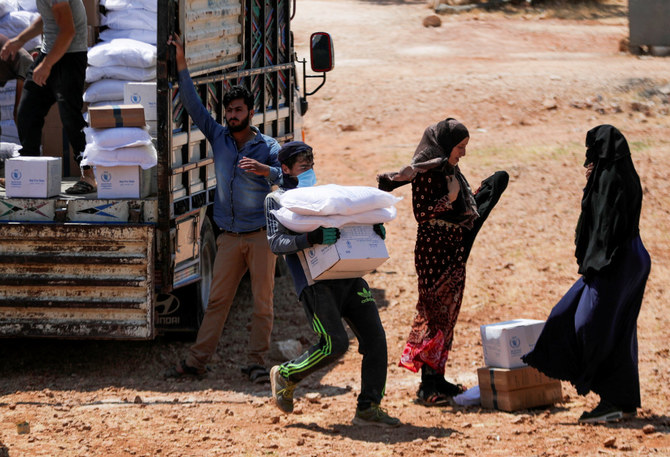

NEW YORK: The UN Security Council on Friday agreed to extend a cross-border humanitarian operation that provides life-saving aid to more than 4 million Syrians.
The unanimous vote to extend the mandate for the transport of aid to Syria through a crossing on the border with Turkey came after Russia finally agreed a compromise with the US. It followed weeks of intransigence on the part of Moscow, which argues that all aid should be channeled through the regime in Damascus, and blames the humanitarian crisis in the war-torn country on international sanctions imposed on the regime of President Bashar Assad.
The White House said that US President Joe Biden spoke with Russian counterpart Vladimir Putin after the Security Council vote. During their conversation, the leaders commended “the joint work of their respective teams following the US-Russia summit that led to the unanimous renewal of cross-border humanitarian assistance to Syria today in the Security Council.”
Biden has pledged to work to ease rising tensions between Washington and Moscow, and the issue of cross-border aid to Syria was seen by some as a “stress test” administered by Putin. In June, during their first summit since Biden took office, the renewal of cross-border assistance was a key US demand.
“The Biden’s administration signaling of the (Security Council) Syria aid deal as a diplomatic achievement is important, as the administration has long asserted that progress on the aid file would open the door for a more meaningful US-Russia engagement on Syria’s bigger diplomatic questions,” Charles Lister, a senior fellow and director of the Syria department at the Middle East Institute in Washington, DC, said in a message posted on Twitter.
Russia initially wanted all cross-border operations to end, which would have restricted the flow of aid to cross-line convoys of aid distributed by the regime in Damascus. After last-minute talks between the US and Russian delegations, Moscow proposed a compromise that renews the mandate for Bab Al-Hawa border crossing for six months.
The US and other Western nations had also called for the reopening of two previously closed border crossings: Bab Al-Salam on the border with Turkey, and Al-Yaroubiya on the border with Iraq. France expressed regret that those were not included in the agreement.
The result of the successful vote is the adoption of Resolution 2585 but concerns were raised about its wording, which some consider ambiguous. It states that the mandate for Bab Al-Hawa has been extended for six months until Jan. 10, “with an extension of an additional six months, until July 10, 2022, subject to the issuance of the secretary general’s substantive report.”
Some experts pointed out that it is unclear whether that second six-month extension will be conditional on contents of the report and therefore subject to another vote, which could give Russia the chance to use its power of veto if it objects to the report. Russia’s permanent representative to the UN, Vassily Nebenzya told the council that Moscow will be “watching closely” what happens in the months ahead.
French diplomat Charles Thepaut, a visiting fellow at The Washington Institute, described the wording of the resolution as “a constructive ambiguity,” adding: “That’s what just helped finding a compromise to keep Bab Al-Hawa cross-border access for another year in northwest Syria.”
Linda Thomas Greenfield, the US permanent representative ot the UN, was adamant that the US sees the resolution “being automatically renewed following the (secretary-general’s) report. No vote will be required and the council will work with the secretary-general’s office to ensure that once he puts his report on the table, that it will be accepted by all council members.”
She told the council: “Thanks to this resolution, millions of Syrians can breathe a sigh of relief tonight, knowing that vital humanitarian aid will continue to flow into Idlib through the Bab al-Hawa border crossing after tomorrow. And parents can sleep tonight knowing that for the next 12 months their children will be fed.”
The French delegation emphasized that the position of the European partners to the agreement remains unchanged. Envoy Nicolas de Riviere said: “We will not finance reconstruction and we will not lift sanctions as long as a credible political process is not firmly underway, in accordance with Resolution 2254 adopted unanimously by this council.
“Nor will we finance development efforts that would contribute to strengthening the Syrian regime in the absence of progress towards a political solution. Nothing in this resolution can be interpreted as a change in our well-known positions on this topic.”
UN Secretary-General Antonio Guterres welcomed the resolution but his spokesman, Stephane Dujarric, said that the humanitarian needs in Syria “continue to outstrip the response.”
He added: “With additional crossings and expanded funding, the United Nations could do more to help the rising number of people in need.”


