

Huriyyat calls for India-Pakistan dialogue to resolve Kashmir conflict

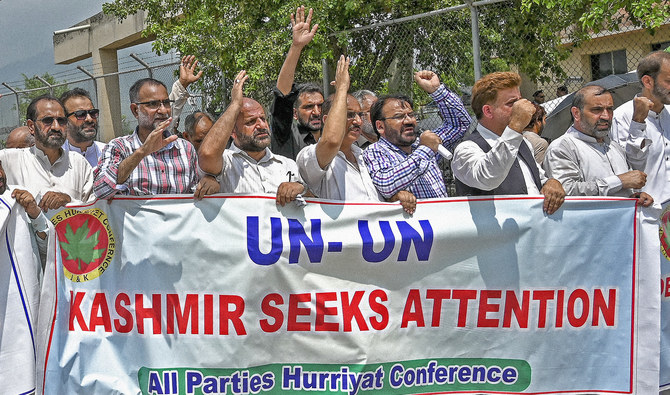
Protesters of the All Parties Hurriyat Conference (APHC) shout anti-Indian slogans near the United Nations office to launch their protest in Islamabad on August 16, 2019. (AFP/File)
Short Url
Updated 09 July 2021
Follow

Huriyyat calls for India-Pakistan dialogue to resolve Kashmir conflict

  • Huriyyat chairman says conflict resolution in the disputed region is 'urgent' in the current geopolitical situation 
  • Last month, Kashmiri leaders from pro-India parties also urged New Delhi to engage in dialogue with Pakistan

NEW DELHI: Kashmir's pro-independence alliance, the All Parties Hurriyat (Freedom) Conference (APHC), has called for dialogue between Pakistan and India to "urgently" resolve a decades-long conflict over the disputed territory.

Muslim-majority Kashmir is divided between India and Pakistan, which both claim it in full and rule it in part. Since gaining independence in 1947, the nuclear-armed neighbors have fought two of their three wars over control of Kashmiri territory.

The portion of the disputed region ruled by India has been plagued by separatist violence since the late 1980s that New Delhi says is supported by Pakistan. Islamabad denies state complicity.

On August 5, 2019, New Delhi scrapped Articles 370 and 35A of the Indian constitution that granted special autonomous status to the region, and divided the state into two federally administered units, sparking further hostility with Pakistan.

As the security situation is worsening in the region, the APHC said in a statement on Thursday evening that peace and the resolution of the Kashmir conflict can be achieved "through dialogue among India and Pakistan and the people of J&K (Jammu and Kashmir)."

“The fast-changing geopolitical reality of the region also points to the need for urgent conflict resolution," APHC chairman Mirwaiz Umar Farooq, who has been in house arrest since 2019, told Arab News on Friday.

Despite the recent resumption of a 2003 Kashmir border ceasefire between India and Pakistan in February, he added, "the oppressive situation on the ground continues unabated."

"Political leadership and hundreds of political prisoners and youth are languishing in jails or under house detention and the health condition of many among them is a constant source of worry," Farooq said, as most of Huriyyat leaders, including ailing Yasin Malik and Shabir Shah, remain in detention. 

Srinagar-based political analyst Gowhar Geelani called Farooq's comments on Pakistan-India dialogue a "significant development" that showed there were "backchannel diplomatic parleys" between the two nations.

"This is indicative of the fact that there could be some forward movement on Kashmir as far as symbolic restoration of a political process is concerned," he said.

Last month, Kashmiri leaders from pro-India parties, many of whom were also arrested in the 2019 crackdown, also urged New Delhi to engage in dialogue with Pakistan and use backchannel diplomacy to address tensions between the two nations for the sake of Kashmir's economic conditions.


Three Afghan migrants die of cold while trying to cross into Iran

Updated 2 sec ago
Follow

Three Afghan migrants die of cold while trying to cross into Iran

AFGHANISTAN: Three Afghans died from exposure in freezing temperatures in the western province of Herat while trying to illegally enter Iran, a local army official said on Saturday.
“Three people who wanted to illegally cross the Iran-Afghanistan border have died because of the cold weather,” the Afghan army official told AFP on condition of anonymity.
He added that a shepherd was also found dead in the mountainous area of Kohsan from the cold.
The migrants were part of a group that attempted to cross into Iran on Wednesday and was stopped by Afghan border forces.
“Searches took place on Wednesday night, but the bodies were only found on Thursday,” the army official said.
More than 1.8 million Afghans were forced to return to Afghanistan by the Iranian authorities between January and the end of November 2025, according to the latest figures from the United Nations refugee agency (UNHCR), which said that the majority were “forced and coerced returns.”
“These mass returns in adverse circumstances have strained Afghanistan’s already overstretched resources and services” which leads to “risks of onward and new displacement, including return movements back into Pakistan and Iran and onward,” UNHCR posted on its site dedicated to Afghanistan’s situation.
This week, Amnesty International called on countries to stop forcibly returning people to Afghanistan, citing a “real risk of serious harm for returnees.”
Hit by two major earthquakes in recent months and highly vulnerable to climate change, Afghanistan faces multiple challenges.
It is subject to international sanctions particularly due to the exclusion of women from many jobs and public places, described by the UN as “gender apartheid.”
More than 17 million people in the country are facing acute food insecurity, the UN World Food Programme said Tuesday.