

Explosion on ship at Jebel Ali Port shakes Dubai

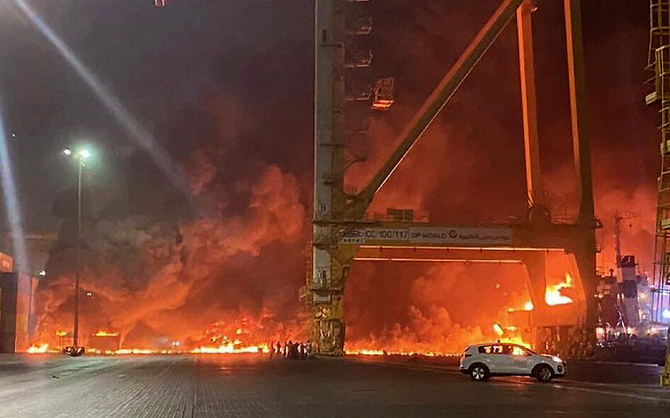
Fire erupts at Dubai's Jebel Ali Port after an explosion on July 07, 2021. (Photo courtesy: Social media)
Short Url
Updated 08 July 2021
Follow

Explosion on ship at Jebel Ali Port shakes Dubai

  • Dubai authorities say there have been no injuries reported and fire was brought under control
  • Blast happened in a container holding flammable materials

DUBAI: A huge explosion shook buildings in Dubai late on Wednesday with authorities saying there had been a fire on board a commercial ship anchored off Jebal Ali Port.

Dubai Media Office (DMO) said: "A fire has been reported to have broken out in a container within a ship anchored in Jebel Ali Port. A Dubai Civil Defense team is working to put out the blaze."
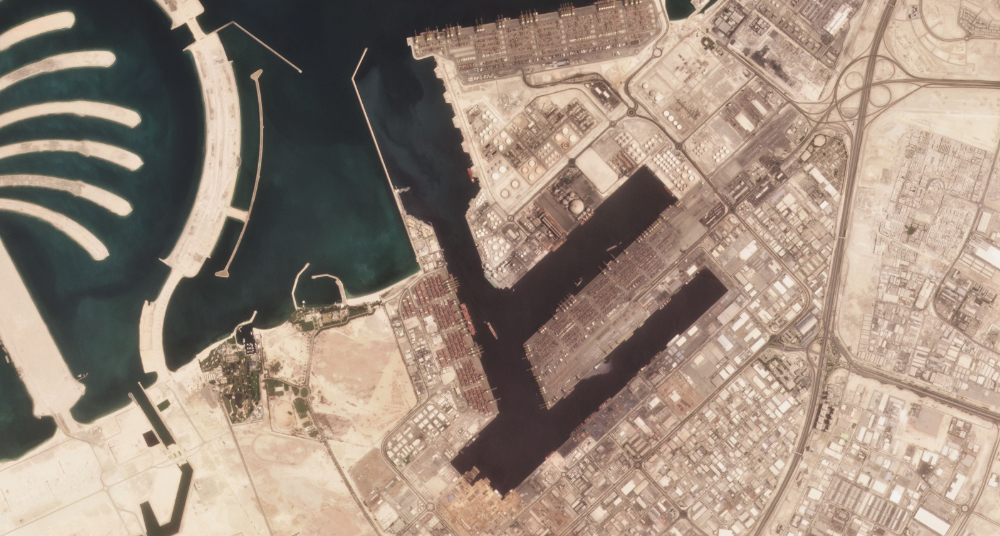


Jebel Ali Free Zone attracts nearly a quarter of foreign direct investment to Dubai. (AP)

No injuries were reported, the DMO said, adding that the fire had been brought under control.

Dubai authorities told the Saudi-owned Al-Arabiya TV that the crew had evacuated in time and that the fire appeared to have started in one of the containers holding flammable material, without elaborating.

Mona Al-Marri, director general of the Dubai Media Office, told Al-Arabiya the incident “could happen anywhere in the world” and that authorities were investigating the cause.

Dubai authorities did not identify the stricken ship beyond saying it was a small vessel with a capacity of 130 containers.
Ship tracker MarineTraffic showed a fleet of small support vessels surrounding a docked container ship called the Ocean Trader flagged in Comoros. 

The Ocean Trader docked at Jebel Ali Port at midday Wednesday. Ship tracking data showed the vessel had been sailing up and down the coast of the UAE since April. The United Nations ship database identified the vessel’s owners as Sash Shipping corporation. Sash and Inzu Ship Charter did not immediately respond to request for comment.

A video posted by the website Lovin Dubai filmed from an apartment tower showed a fireball leaping into the nightsky.


A Dubai official told Al Arabiya that the fire was the result of an accident inside a container that contained flammable materials.

The combustion unleashed a shock wave through the city of Dubai, causing walls and windows to shake in neighborhoods as far as 25 kilometers away from the port.

An Arab News reporter near the entrance to Jebel Ali Port saw emergency service vehicles going inseveral hours after the blast.

A worker at the port said he heard an enormous explosion that made his ears ring and then the area became thick with smoke.
He said the fire had been put out quickly.

Social media images showed fire crews dealing with the aftermath of the explosion.

Some 2.5 hours after the blast, Dubai’s civil defense teams said they had brought the fire under control and started the “cooling process.”

Authorities posted footage on social media of firefighters dousing giant shipping containers.
Jebel Ali Free Zone attracts nearly a quarter of foreign direct investment to Dubai, with more than 8,000 companies having established operations in the commercial zone since its inception in the mid-1980s, according to its website.

Jebel Ali sits on the eastern side of the Arabian Peninsula and is also the busiest port of call for American warships outside the US.

(With AFP)


Iraq’s political future in limbo as factions vie for power

Updated 21 December 2025
Follow

Iraq’s political future in limbo as factions vie for power

  • The government that eventually emerges will be inheriting a security situation that has stabilized in recent years

BAGHDAD: Political factions in Iraq have been maneuvering since the parliamentary election more than a month ago to form alliances that will shape the next government.
The November election didn’t produce a bloc with a decisive majority, opening the door to a prolonged period of negotiations.
The government that eventually emerges will be inheriting a security situation that has stabilized in recent years, but it will also face a fragmented parliament, growing political influence by armed factions, a fragile economy, and often conflicting international and regional pressures, including the future of Iran-backed armed groups.
Uncertain prospects
Prime Minister Mohammed Shia Al-Sudani’s party took the largest number of seats in the election. Al-Sudani positioned himself in his first term as a pragmatist focused on improving public services and managed to keep Iraq on the sidelines of regional conflicts.
While his party is nominally part of the Coordination Framework, a coalition of Iran-backed Shiite parties that became the largest parliamentary bloc, observers say it’s unlikely that the Coordination Framework will support Al-Sudani’s reelection bid.
“The choice for prime minister has to be someone the Framework believes they can control and doesn’t have his own political ambitions,” said Sajad Jiyad, an Iraqi political analyst and fellow at The Century Foundation think tank.
Al-Sudani came to power in 2022 with the backing of the Framework, but Jiyad said that he believes now the coalition “will not give Al-Sudani a second term as he has become a powerful competitor.”
The only Iraqi prime minister to serve a second term since 2003 was Nouri Al-Maliki, first elected in 2006. His bid for a third term failed after being criticized for monopolizing power and alienating Sunnis and Kurds.
Jiyad said that the Coordination Framework drew a lesson from Al-Maliki “that an ambitious prime minister will seek to consolidate power at the expense of others.”
He said that the figure selected as Iraq’s prime minister must generally be seen as acceptable to Iran and the United States — two countries with huge influence over Iraq — and to Iraq’s top Shiite cleric, Grand Ayatollah Ali Al-Sistani.
Al-Sudani in a bind
In the election, Shiite alliances and lists — dominated by the Coordination Framework parties — secured 187 seats, Sunni groups 77 seats, Kurdish groups 56 seats, in addition to nine seats reserved for members of minority groups.
The Reconstruction and Development Coalition, led by Al-Sudani, dominated in Baghdad, and in several other provinces, winning 46 seats.
Al-Sudani’s results, while strong, don’t allow him to form a government without the support of a coalition, forcing him to align the Coordination Framework to preserve his political prospects.
Some saw this dynamic at play earlier this month when Al-Sudani’s government retracted a terror designation that Iraq had imposed on the Lebanese Hezbollah militant group and Yemen’s Houthi rebels — Iran-aligned groups that are allied with Iraqi armed factions — just weeks after imposing the measure, saying it was a mistake.
The Coalition Framework saw its hand strengthened by the absence from the election of the powerful Sadrist movement led by Shiite cleric Muqtada Sadr, which has been boycotting the political system since being unable to form a government after winning the most seats in the 2021 election.
Hamed Al-Sayed, a political activist and official with the National Line Movement, an independent party that boycotted the election, said that Sadr’s absence had a “central impact.”
“It reduced participation in areas that were traditionally within his sphere of influence, such as Baghdad and the southern governorates, leaving an electoral vacuum that was exploited by rival militia groups,” he said, referring to several parties within the Coordination Framework that also have armed wings.
Groups with affiliated armed wings won more than 100 parliamentary seats, the largest showing since 2003.
Other political actors
Sunni forces, meanwhile, sought to reorganize under a new coalition called the National Political Council, aiming to regain influence lost since the 2018 and 2021 elections.
The Kurdish political scene remained dominated by the traditional split between the Kurdistan Democratic Party and Patriotic Union of Kurdistan parties, with ongoing negotiations between the two over the presidency.
By convention, Iraq’s president is always a Kurd, while the more powerful prime minister is Shiite and the parliamentary speaker Sunni.
Parliament is required to elect a speaker within 15 days of the Federal Supreme Court’s ratification of the election result, which occurred on Dec. 14.
The parliament should elect a president within 30 days of its first session, and the prime minister should be appointed within 15 days of the president’s election, with 30 days allotted to form the new government.
Washington steps in
The incoming government will face major economic and political challenges.
They include a high level of public debt — more than 90 trillion Iraqi dinars ($69 billion) — and a state budget that remains reliant on oil for about 90 percent of revenues, despite attempts to diversify, as well as entrenched corruption.
But perhaps the most delicate question will be the future of the Popular Mobilization Forces, a coalition of militias that formed to fight the Daesh group as it rampaged across Iraq more than a decade ago.
It was formally placed under the control of the Iraqi military in 2016 but in practice still operates with significant autonomy. After the Hamas-led attack in southern Israel on Oct. 7, 2023 sparked the devastating war in Gaza, some armed groups within the PMF launched attacks on US bases in the region in retaliation for Washington’s backing of Israel.
The US has been pushing for Iraq to disarm Iran-backed groups — a difficult proposition, given the political power that many of them hold and Iran’s likely opposition to such a step.
Two senior Iraqi political officials, who spoke on condition of anonymity because they weren’t authorized to comment publicly, said that the United States had warned against selecting any candidate for prime minister who controls an armed faction and also cautioned against letting figures associated with militias control key ministries or hold significant security posts.
“The biggest issue will be how to deal with the pro-Iran parties with armed wings, particularly those... which have been designated by the United States as terrorist entities,” Jiyad said.