Israel ban on Arab family unifications lapses after PM loses vote

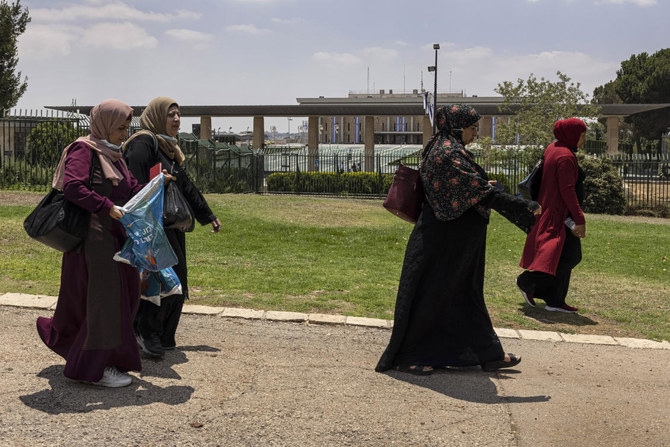
Israeli Arab women gather for a protest ahead of a vote by Israel's parliament on renewing a law that bars Arab citizens of Israel from extending citizenship or even residency to spouses from the occupied West Bank and Gaza, Monday, July 5, 2021.(AP)
Short Url
Updated 06 July 2021
Follow

Israel ban on Arab family unifications lapses after PM loses vote

JERUSALEM: A ban in force since 2003 on Arab citizens and residents of Israel extending their rights to their Palestinian spouses came to an end on Tuesday after lawmakers failed to extend the controversial measure.
Prime Minister Naftali Bennett’s request to prolong the ban had divided his disparate coalition with both Jewish left-wingers and Arab conservatives strongly opposed.
In a vote early Tuesday, parliament tied 59 votes to 59, meaning the measure lapsed.
The outcome underlined the wafer-thin majority Bennett’s coalition commands in the 120-seat parliament.
The eight parties in the coalition were united by little but their shared enmity to opposition leader Benjamin Netanyahu, whom they unseated from the premiership last month after a record 12 straight years in power.
The ban first enacted during the second Palestinian intifada, or uprising, had been justified by supporters on security grounds but critics derided it as a discriminatory measure targeting Israel’s Arab minority.
The ban has caused endless complications for Palestinians living across Israel and the territories it has occupied since 1967.
A substantial number of those affected live in annexed east Jerusalem and therefore have Israeli residency, without necessarily being citizens of the Jewish state.
In a protest against the measure outside parliament on Monday, some recounted the hardships of seeking permits to join their spouses, or the risks of entering Israeli territory without permission.
Ali Meteb told AFP that his wife not having Israeli residency rights had confined his family to a “continuous prison.”
“I am asking for rights that the state owes us... for my wife to have Israeli ID, residency rights and freedom of movement,” he said.
Jessica Montell, the head of Hamoked, an Israeli human rights group that provides legal services to Palestinians, said “tens of thousands of families are harmed by this law.”


Bahrain arrests four for spying for Iran’s IRGC as Gulf attacks intensify

Updated 12 March 2026
Follow

Bahrain arrests four for spying for Iran’s IRGC as Gulf attacks intensify

  • Investigators said the suspects were found to have sent pictures and coordinates of vital locations in Bahrain to the IRGC via encrypted software

MANAMA: Bahrain has detained four citizens suspected of spying for Iran’s Islamic Revolutionary Guard Corps (IRGC), as Tehran’s retaliatory strikes on Gulf states show no signs of letting up.

Bahrain’s General Directorate of Criminal Investigation and Forensic Science identified the four detainees as Murtadha Hussain Awal, 25; Ahmed Isa Al Haiki, 34; Sarah Abdulnabi Marhoon, 36; and Elias Salman Mirza, 22. A fifth suspect, Ali Mohammed Hassan Al Shaikh, 25, remains at large abroad.

Investigators said Murtadha Hussain and his cohorts, acting on IRGC instructions, used high-resolution equipment to photograph and record coordinates of vital locations in Bahrain, transmitting the data to the IRGC via encrypted software.

The arrests come as Iran escalates attacks across the Gulf. Bahrain’s Interior Ministry issued an advisory urging residents in Hidd, Arad, Qalali and Samaheej to stay indoors and seal windows against smoke from fires sparked by Iranian strikes. Fuel tanks at a facility in Muharraq Governorate, northeast of Manama, were among the targets. Oman’s Port of Salalah also battled blazes at fuel storage tanks following separate Iranian drone strikes.

Elsewhere in the region, two Iranian drones struck near Dubai International Airport, wounding four people, though flights continued uninterrupted. A fire broke out at a luxury apartment tower in Dubai Creek Harbour after another drone hit — extinguished by Thursday morning.

Iran also targeted commercial ships and struck what officials described as the world’s busiest international airport on Wednesday, as US and Israeli strikes continued to pound Tehran.

A war now 12 days old — and costly

The conflict began on February 28, when US and Israeli forces launched coordinated strikes on Iran. Tehran has since retaliated by targeting Gulf states, US and Israeli assets, and critical energy infrastructure.

Iran has declared a blockade on energy shipments through the Strait of Hormuz, a vital chokepoint for global oil and gas flows, sending commodity prices surging and rattling international markets.

The Pentagon told Congress this week that the first week of war cost the United States $11.3 billion — including $5 billion in munitions in the conflict’s opening weekend alone.

The UN Security Council on Wednesday voted to approve a resolution demanding a halt to Iran’s attacks on its Gulf neighbors. Bahrain’s UN Ambassador Jamal Alrowaiei welcomed the move.

“The international community is resolute in rejecting these Iranian attacks against sovereign countries that are threatening the stability of the peoples, especially in a region of strategic importance to global economy, energy security and global trade,” he said.

Despite the resolution, there were no immediate signs the conflict was easing.

(With AP)