
CAIRO: Egypt’s irrigation minister said on Monday that he had received official notice from Ethiopia that it had begun filling the reservoir behind its giant hydropower dam, the Grand Ethiopian Renaissance Dam (GERD), for a second year.
Egypt has informed Ethiopia of its categorical rejection of the measure, which it regards as a threat to regional stability, Irrigation Minister Mohamed Abdel Aty said.
The UN Security Council is set to meet Thursday on Ethiopia’s mega-dam project, which has sparked fears in downstream Sudan and Egypt over their water supplies, diplomats said.
Both nations have been pushing Ethiopia to ink a binding deal over the filling and operation of GERD on the Blue Nile that broke ground in 2011.
Addis Ababa, which said it last year reached its first target in the years-long filling of the dam, has announced it will proceed in July with or without a deal.
The public session was requested by Tunisia on Egypt and Sudan’s behalf, according to a diplomatic source.
France’s ambassador to the UN, Nicolas de Riviere, said last week that the council itself can do little apart from bringing the sides together.
“We can open the door, invite the three countries at the table, bring them to express their concerns, encourage them to get back to the negotiations and find a solution,” he told reporters.
Sudan and Egypt have written to the council to urge it to take up the matter in recent weeks.
Egypt’s Foreign Minister Sameh Shoukry said in his note that negotiations are at an impasse and he accused Ethiopia of adopting “a policy of intransigence that undermined our collective endeavors to reach an agreement.”
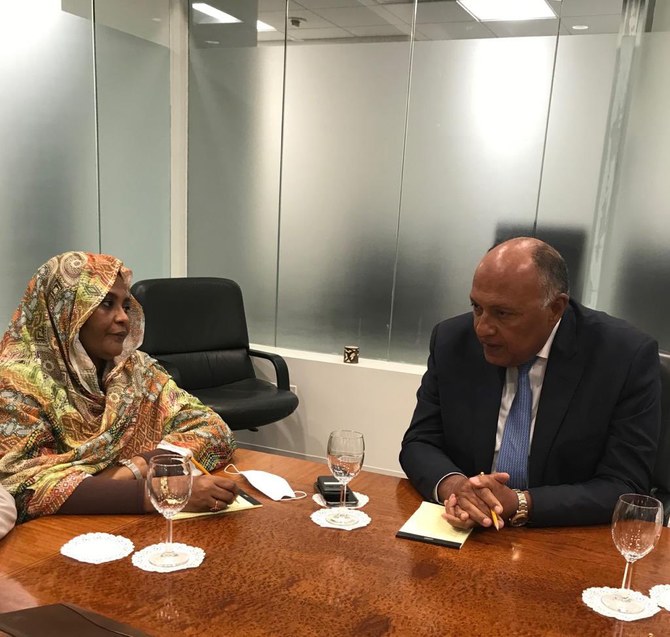
Shoukry also held talks with his Sudanese counterpart Mariam Sadiq Al-Mahdi in New York on Monday as part of the framework of Egyptian-Sudanese coordination in the preparation for the Security Council session.
Egyptian Sudanese coordination in the framework of the preparations for the SC session on #GERD, FM #Sameh_Shoukry meets with his Sudanese counterpart FM Dr. #Mariam_Alsadig@MofaSudan@Mariam_Sadig
pic.twitter.com/eZIXZFymP3— Egypt MFA Spokesperson (@MfaEgypt) July 5, 2021
Moreover, Ethiopia said Tuesday it rejected “unwelcome meddling” by the Arab League in the dispute over the mega-dam.
“Ethiopia rejects the unwelcome meddling by the League of Arab States on the matter of the Grand Ethiopian Renaissance Dam (GERD) following the League’s submission of a letter to the UN Security Council and UN General Assembly to intervene in the matter,” Tuesday’s Ethiopia foreign ministry statement said.
“The League of Arab States has a reputation for its unfettered and unconditional support to any claim Egypt has presented on the issue of the Nile.”
The Arab League announced last month it was backing Security Council intervention, despite Ethiopia’s insistence that talks proceed under an ongoing process led by the African Union.
Ethiopia says the dam on its Blue Nile is crucial to its economic development and providing power to its population.
Egypt views the dam as a grave threat to its Nile water supplies, on which it is almost entirely dependent. Sudan, another downstream country, has expressed concern about the safety of the dam and the impact on its own dams and water stations.
Egypt and Sudan have been engaged in a diplomatic campaign for a legally binding deal over the dam’s operation, but talks have repeatedly stalled.
The diplomatic push intensified ahead of the first filling of the dam with last summer’s rains in Ethiopia, and again in recent weeks ahead of the second filling.
(With Reuters and AFP)

keywords