Cyprus forest fire that killed 4 now under control

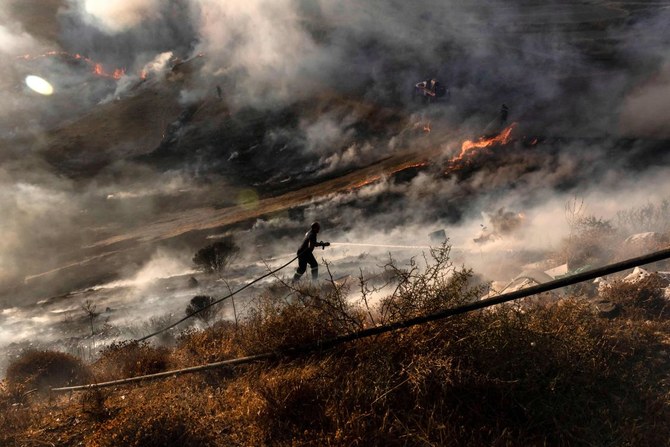
A firefighter douses the flames to contain a fire near the Kotsiatis area, on the outskirts of Cyprus’ capital Nicosia on Sunday. (AFP)
Short Url
Updated 05 July 2021
Follow

Cyprus forest fire that killed 4 now under control

  • Cyprus’ Forestry Department said more than 600 people managed to contain the blaze early Monday
  • President Nicos Anastasiades called the fire “an unprecedented tragedy” for Cyprus

NICOSIA: A deadly brush fire that claimed four lives and has been described as the most destructive blaze in Cyprus’ 61-year history as an independent republic is now fully under control, Cypriot authorities said Monday.
Cyprus’ Forestry Department said more than 600 people managed to contain the blaze early Monday after it scorched more than 55 square kilometers (21 square miles), forcing the evacuation of nine villages and burning down homes, businesses, orchards and forest.
Fire crews remain on the scene in case the blaze reignites amid temperatures reaching 35 C (95 F). Cyprus Electricity Authority officials said they hope to have power restored to at least seven villages by Monday evening.
Search crews on Sunday discovered the bodies of four people who are believed to be Egyptian laborers outside the village of Orou on the southern edge of Cyprus’ main Troodos mountain range.
The men, ages 22 to 29, had gone missing Saturday afternoon when the fire began outside the nearby village of Arakapas and spread quickly amid strong winds.
Officials said the four tried to flee the fire along a dirt mountain track, but their small truck veered off the road and fell down an embankment. They tried to flee on foot, but didn’t make it.
Trade Union PEO has asked for a full investigation into the laborers’ deaths as well as their work safety conditions.
President Nicos Anastasiades called the fire “an unprecedented tragedy” for Cyprus except for the destruction wreaked by a 1974 war that split the island along ethnic lines after Turkey invaded in response to a coup aimed at union with Greece.
Some residents who lost their homes and property to the fire wept as they described seeing a lifetime’s worth of labor going up in flames. People were allowed back to their homes after their villages were declared safe.
Anastasiades, who toured the fire-hit villages on Sunday, pledged immediate government help to farmers and homeowners who lost crops and property and the families of those who perished in the fire.
Crews are assessing the damage so that fire-afflicted residents can receive the first compensation packages later this week.
Anastasiades on Monday opened up a bank account for private contributions to help those who lost their homes and livelihoods.
The Cypriot president said to underscore that commitment, he instructed electricity generators to be sent to all villagers who lost power.
He also ordered a renewed tender process for the purchase of a mobile crisis management center, and asked his Cabinet to come up with ideas by Wednesday on how best to support residents financially.
Police spokesman Christos Andreou told The Associated Press that a 67-year-old man is being investigated on arson charges. He said “more than one witness” had seen the man leave his orchard shortly before a fire broke out there. A court ordered that he remain in custody for eight days.
Fire crews had been joined by police officers, soldiers, Civil Defense and Wildlife Service staff as well as many members of the public who volunteered to help. Authorities said more than 70 fire engines, 14 bulldozers and numerous water tankers were mobilized, while a National Guard drone provided eyes overhead to locate new fire fronts.
A total of nine Cypriot firefighting aircraft, and police and National Guard helicopters were deployed. Two helicopters from British military bases in Cyprus also helped firefighting efforts, along with two Greek Canadair CL-415 aircraft and two Israeli fixed-wing planes.
Anastasiades spoke separately with the prime ministers of Greece and Israel to thank them for their help.


T20 World Cup: ICC deputy chief in Lahore for talks after Pakistan boycotts India match

Updated 8 sec ago
Follow

T20 World Cup: ICC deputy chief in Lahore for talks after Pakistan boycotts India match

  • Islamabad’s boycott over Bangladesh’s exclusion has threatened the tournament’s most lucrative game
  • Bangladesh Cricket Board chief has also arrived in Pakistan and is expected to participate in meetings

ISLAMABAD: International Cricket Council (ICC) Deputy Chairman Imran Khwaja arrived in Lahore on Sunday for talks with Pakistan Cricket Board (PCB) officials, the PCB said, as the sport’s governing body strives to save a high-stakes T20 World Cup clash between arch-rivals Pakistan and India.

The development follows Islamabad’s decision to boycott the Feb. 15 Pakistan-India match in Colombo, a move to protest the ICC’s exclusion of Bangladesh from the ongoing T20 World Cup.

The controversy over Pakistan’s participation erupted after the ICC replaced Bangladesh with Scotland, following Bangladesh’s decision to not play matches in India owing to security fears.

The ICC has since requested the Pakistan Cricket Board to reconsider the decision to boycott their match against India in Colombo or they will have to forfeit the marquee game of the tournament.

“ICC Deputy Chairman Imran Khwaja arrived in Lahore,” the PCB said on Sunday, adding that he was received at the airport by the PCB chairman’s adviser, Aamir Mir.

Prior to Khwaja’s arrival in Lahore, where the PCB is headquartered, Pakistan welcomed Bangladesh Cricket Board (BCB) President Aminul Islam, who was received by PCB CEO Salman Naseer.

The two visiting officials are scheduled to meet PCB Chairman Mohsin Naqvi.

“Bangladesh Cricket Board President Aminul Islam will also take part in other meetings,” the PCB said in a statement, hinting that he will be part of the meeting with ICC’s Khwaja.

The dispute stems from the ICC’s decision to replace Bangladesh with Scotland last month after Bangladesh refused to play tournament matches in India. Dhaka’s decision followed the removal of Mustafizur Rahman from the Indian Premier League (IPL). He was bought for $1 million by the IPL’s Kolkata Knight Riders, but on Jan. 3 the Board of Control for Cricket in India (BCCI) ordered Kolkata to release Mustafizur without a public explanation but amid regional tensions.

Pakistan have boycotted the 27th match of the tournament against India, due to take place at R. Premadasa Stadium in Colombo. An India-Pakistan fixture is the sport’s most lucrative asset, generating a massive share of global broadcasting and sponsorship revenue.

The PCB has remained defiant amid reports of potential sanctions. On Saturday, the board rejected claims by Indian media that it had initiated a dialogue with the ICC to find a way out of the standoff.

“I categorically reject the claim by Indian sports journalist Vikrant Gupta that PCB approached the ICC,” PCB’s Mir said in a statement. “As usual, sections of Indian media are busy circulating fiction. A little patience and time will clearly show who actually went knocking and who didn’t.”

The standoff highlights the growing friction within the sport’s governance.

Pakistan has accused India’s cricket board of influencing the ICC’s decisions.

Defense Minister Khawaja Asif this week called for the formation of a new cricket governing body, saying the ICC, currently chaired by Jay Shah, son of India’s Home Minister Amit Shah, was being held “hostage” to “Indian political interests.”

India generates the largest share of cricket’s commercial revenue and hence enjoys considerable influence over the sport. Critics argue that this financial contribution translates into decisive leverage within the ICC.

A large part of that revenue comes from the Indian Premier League (IPL), the sport’s most lucrative T20 cricket competition, which is run by the Board of Control for Cricket in India (BCCI). Between 2024 and 2027, the IPL is projected to earn $1.15 billion, nearly 39 percent of the ICC’s total annual revenue, according to international media reports.

While the Pakistani government cleared the team to participate in the rest of the tournament, Prime Minister Shehbaz Sharif maintained that the boycott of the India game was necessary to protest the “unjust” treatment of Bangladesh.