Defiant ex-leader Jacob Zuma compares South African judges to apartheid state

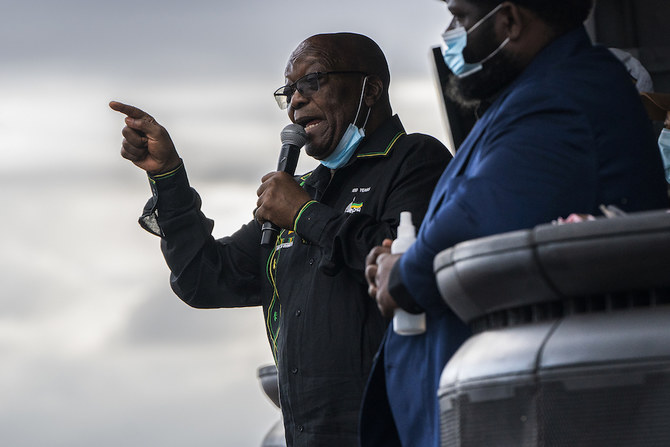
The Constitutional Court will hear Zuma's urgent application on July 12 to rescind its order sentencing him to jail for 15 months for contempt of court. Zuma was initially supposed to hand himself over to authorities for his incarceration by Sunday. (AP)
Short Url
Updated 04 July 2021
Follow

Defiant ex-leader Jacob Zuma compares South African judges to apartheid state

  • The constitutional court sentenced Zuma on Tuesday for contempt of court for failing to appear at a hearing in February

JOHANNESBURG: South Africa's ex-president Jacob Zuma lashed out on Sunday at the judges who this week gave him a 15-month jail term for absconding from a corruption inquiry, comparing them to the white minority apartheid rulers he once fought.
Zuma spoke at his home in Nklandla, in a rural part of Kwazulu Natal province, where hundreds of his supporters, some of them armed, were gathered to prevent his arrest.
"The fact that I was lambasted with a punitive jail sentence without trial should engender shock in all those who believe in freedom and the rule of law," Zuma told journalists.
"South Africa is fast sliding back to apartheid rule."
The constitutional court sentenced Zuma on Tuesday for contempt of court for failing to appear at a hearing in February of the inquiry led by Deputy Chief Justice Raymond Zondo.
On Saturday it agreed to hear his challenge to the jail term, suspending it until after a hearing on July 12.
The sentence was seen as a sign of just how far Zuma, once revered as a veteran of the struggle against white minority rule, has fallen since embarking on a presidency beset by multiple sleaze and graft scandals between 2009 and 2018.
Earlier on Sunday, gunshots rang out across Nklandla, as some of his supporters fired their weapons into the air, while others danced with spears and ox-hide shields -- the traditional weapons of Zuma's Zulu nation.
"I fought and went to prison so there must be justice and the rule of law. No honest person can accuse me of being against the rule of law," Zuma told journalists.


Only 4% women on ballot as Bangladesh prepares for post-Hasina vote

Updated 19 min 5 sec ago
Follow

Only 4% women on ballot as Bangladesh prepares for post-Hasina vote

  • Women PMs have ruled Bangladesh for over half of its independent history
  • For 2026 vote, only 20 out of 51 political parties nominated female candidates

DHAKA: As Bangladesh prepares for the first election since the ouster of its long-serving ex-prime minister Sheikh Hasina, only 4 percent of the registered candidates are women, as more than half of the political parties did not field female candidates.

The vote on Feb. 12 will bring in new leadership after an 18-month rule of the caretaker administration that took control following the student-led uprising that ended 15 years in power of Hasina’s Awami League party.

Nearly 128 million Bangladeshis will head to the polls, but while more than 62 million of them are women, the percentage of female candidates in the race is incomparably lower, despite last year’s consensus reached by political parties to have at least 5 percent women on their lists.

According to the Election Commission, among 1,981 candidates only 81 are women, in a country that in its 54 years of independence had for 32 years been led by women prime ministers — Hasina and her late rival Khaleda Zia.

According to Dr. Rasheda Rawnak Khan from the Department of Anthropology at Dhaka University, women’s political participation was neither reflected by the rule of Hasina nor Zia.

“Bangladesh has had women rulers, not women’s rule,” Khan told Arab News. “The structure of party politics in Bangladesh is deeply patriarchal.”

Only 20 out of 51 political parties nominated female candidates for the 2026 vote. Percentage-wise, the Bangladesh Socialist Party was leading with nine women, or 34 percent of its candidates.

The election’s main contender, the Bangladesh Nationalist Party, whose former leader Zia in 1991 became the second woman prime minister of a predominantly Muslim nation — after Pakistan’s Benazir Bhutto — was the party that last year put forward the 5 percent quota for women.

For the upcoming vote, however, it ended up nominating only 10 women, or 3.5 percent of its 288 candidates.

The second-largest party, Jamaat-e-Islami, has not nominated a single woman.

The 4 percent participation is lower than in the previous election in 2024, when it was slightly above 5 percent, but there was no decreasing trend. In 2019, the rate was 5.9 percent, and 4 percent in 2014.

“We have not seen any independent women’s political movement or institutional activities earlier, from where women could now participate in the election independently,” Khan said.

“Real political participation is different and difficult as well in this patriarchal society, where we need to establish internal party democracy, protection from political violence, ensure direct election, and cultural shifts around female leadership.”

While the 2024 student-led uprising featured a prominent presence of women activists, Election Commission data shows that this has not translated into their political participation, with very few women contesting the upcoming polls.

“In the student movement, women were recruited because they were useful, presentable for rallies and protests both on campus and in the field of political legitimacy. Women were kept at the forefront for exhibiting some sort of ‘inclusive’ images to the media and the people,” Khan said.

“To become a candidate in the general election, one needs to have a powerful mentor, money, muscle power, control over party people, activists, and locals. Within the male-dominated networks, it’s very difficult for women to get all these things.”