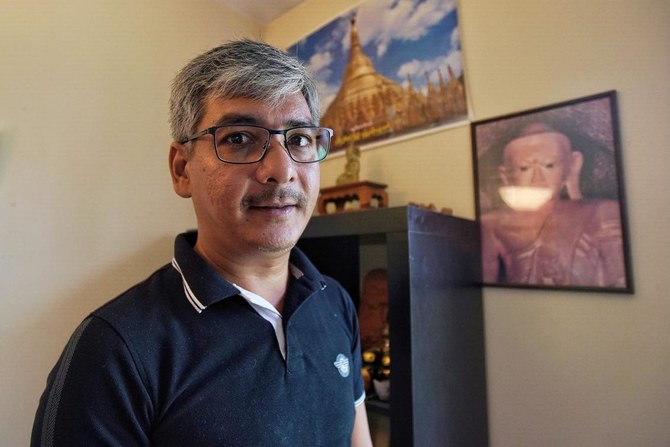
FAIRFAX, United States: Journalist Nathan Maung turned to meditation when he was jailed for reporting on Myanmar's bloody coup, but even back home in sleepy Virginia, he can't forget those left behind, including a colleague still at the mercy of their jailers.
In March, as the junta moved to crush mass pro-democracy protests on Myanmar's streets, about 45 soldiers arrived at Maung's office in the commercial capital Yangon, he told AFP in an interview.
As the squad battered their way through the gate and a locked door, Maung was frantically sending messages to friends telling them he was about to be arrested, he said.
When the soldiers finally broke through and stormed in with their guns up, "I said, 'Please, don't shoot us'."
Myanmar has been rocked by a huge uprising since the February putsch that ousted Aung San Suu Kyi and her government.
The junta has responded with force -- shooting protesters, arresting suspected dissidents, rounding up journalists and shutting down news outlets.
Maung and his colleague Hanthar Nyein watched the squad take "everything from our office" -- cash, jewelry, and even shoes -- before they were brought to an interrogation center in northern Yangon.
There, he said, he was held "for four days" -- during three of which he was denied food, and for two, water.
"I kept practicing Vipassana meditation to be mindful," said Maung, who is a Myanmar-born US citizen.
And with the first sip of water came hope.
"After I drank my first water, I thought I could live," he said. "I wouldn't be killed."
More than 880 people have been killed and almost 6,500 arrested in the crackdown according to a local monitoring group, although the State Administration Council -- as the junta calls itself -- disputes these figures.
Another group, Reporting ASEAN, says 89 journalists have been detained since the coup.
In March, one journalist livestreamed his own arrest on his employer's official Facebook page, with the chaotic footage showing loud bangs outside his apartment building.
Kamayut Media, which Maung founded, faced similar charges under a colonial-era law that criminalizes encouraging dissent against the military.
As well as brute force, the military has re-tooled a colonial-era law to make spreading "fake news" a crime as it tightens its grip on dissent.
Maung soon found out how brutal the consequences of being brought in could be.
"They hit my eardrums with their bare hands several times, they beat my face and shoulders," he said.
"(They) kicked... my sides."
His phone had been broken by the time he got to the center, and was of no use to his interrogators looking for contacts of dissidents and other journalists.
But Hanthar Nyein's was still working, and they needed his password.
"They put his legs on the ice block for hours, burnt his skin with a cigarette," Maung said.
He refused to tell them until they threatened to rape him, Maung said, and when they found pictures of him with Suu Kyi and other political figures, he was beaten again.
The junta's information team says all investigations and interrogations are being carried out according to the law.
Maung believes US diplomacy was one of the factors in all charges against him being dropped, and his release in June.
It is a freedom not yet afforded to fellow US citizen and journalist Danny Fenster, who has been held since May 24, the only foreign reporter remaining in junta custody.
In Fredericksburg, Virginia, Maung said he is committed to continuing his work and a "free Burma" -- using a previous name for Myanmar -- and to work to free other imprisoned journalists, such as his colleague Hanthar.
Until then, he has demons to live with.
"I contacted our lawyers when I arrived in the States, and I was told that he was crying in the court when I left him behind," he said.
"It broke my heart... I do not enjoy my freedom at all."


Freed American journalist remembers horrors of Myanmar junta jail
https://arab.news/v7dcu
Freed American journalist remembers horrors of Myanmar junta jail

- Myanmar has been rocked by a huge uprising since the February putsch that ousted Aung San Suu Kyi and her government
- More than 880 people have been killed and almost 6,500 arrested in the crackdown according to a local monitoring group


Saudi gaming industry has promising future, says Qiddiya executive
- Mike Milanov said that the industry had surpassed the combined industries of film, television, music and sports worldwide
- Milanov added that Saudi Arabia had talented teams with strong skills in esports and game development
RIYADH: Saudi Arabia is uniquely positioned for a highly promising future in the gaming sector, which is valued at $323 billion globally, according to the head of gaming at Saudi entertainment megaproject Qiddiya.
Mike Milanov, the company’s head of gaming and esports, spoke during the session “The Global Era of Gaming: How It Became the New Frontier for Media and Entertainment” at the Saudi Media Forum 2026 in Riyadh.
The industry, he said, had surpassed the combined industries of film, television, music and sports worldwide and was growing globally at an annual rate of 3 percent to 9 percent, expected to reach about $623 billion by 2035
He added that future generations held different perspectives and levels of engagement, as gaming represented a form of digital advancement and a powerful tool for connection.
Milanov also highlighted how Saudi Arabia had talented teams with strong skills in esports and game development, along with significant creative and innovative energy that supported building relationships both locally and globally.
He further noted that Qiddiya City spanned nearly 330 sq. km, and that more than 86 percent of Saudis identified themselves as gamers, reinforcing the Kingdom’s position as one of the world’s largest gaming and esports markets.
Karen Starr, vice president of marketing, branding and creative at Activision Publishing, also spoke during the panel and emphasized the major role gaming played across social media platforms.
She described this influence as positive for brand building, especially given the young audiences that followed gaming brands.
Starr added that the sustainability of major gaming brands depended on continuous engagement, community-building, and adapting content locally to maintain cultural relevance.
She explained that gaming had evolved into an ongoing media experience based on constant interaction and long-term audience connection.
She also said that gaming today had become a global media force that had surpassed traditional channels, shaping culture, content and audience engagement over time.
Meanwhile, Shelley Williams, executive vice president of sales at F1 Arcade Simulation, spoke about how gaming experiences were built on a sense of belonging and participation, which helped to create stronger infrastructure and extended media experiences.
She said that shared audience experiences opened the door to new ecosystems and further game development, supporting long-term content sustainability.


