

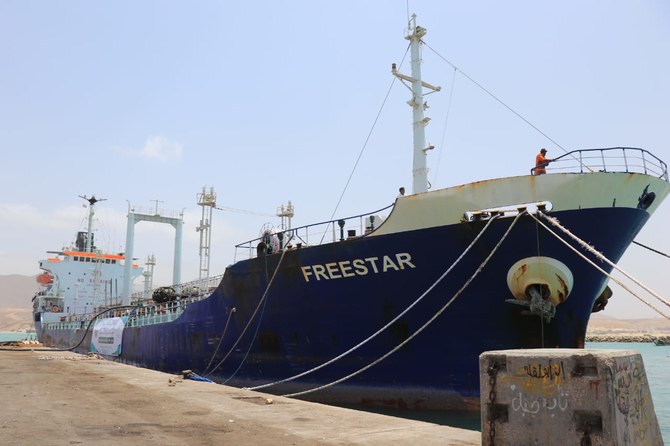
Saudi Arabia delivers diesel supplies for Yemen’s Mahra power stations

The fuel delivery involved the transport of 4,000 metric tons by the sea and 1,500 tons by land. (Saba)
Short Url
Updated 04 July 2021
Follow

Saudi Arabia delivers diesel supplies for Yemen’s Mahra power stations

  • Shipment will reduce daily blackouts and will help the government save funds for developmental projects

DUBAI: Saudi Arabia has delivered diesel supplies in Mahra governorate of Yemen, which will be used to fuel power stations there.

The fuel delivery, made through the Saudi Development and Reconstruction Program for Yemen (SDRPY), involved the transport of 4,000 metric tons by the sea and 1,500 tons by land, a report from state news Saba said.

The shipment will reduce daily blackouts and will help the government save funds for developmental projects, it added.

Such donation would meet the monthly needs of the governorate, a separate report from Saudi news agency SPA meanwhile noted.

The SDRPY in April signed a $422 million agreement with the Yemeni government to supply oil derivatives of up to 1.260 million tons to operate more than 80 power stations in the conflict-ridden country,

The grant was intended to serve the Yemeni people and alleviate their suffering, support the economy and develop infrastructure, SPA earlier reported.

Nearly 3,300 tons of diesel have been delivered to Hadramaut to help the governorate meet its energy demands.

Saudi Arabia fulfilled its shipment of oil derivatives earlier in May, involving 909,591 tons of diesel and 351,304 tons of fuel oil.


Israeli forces bulldozed part of war cemetery in Gaza containing Allied graves, satellite images show

Updated 10 sec ago
Follow

Israeli forces bulldozed part of war cemetery in Gaza containing Allied graves, satellite images show

  • Rows of gravestones removed and topsoil churned up by extensive earthworks at Gaza War Cemetery in Al-Tuffah, eastern Gaza City
  • More than 100 Second World War graves, mostly of Australians alongside British and Polish troops, appear to have been flattened, along with 4 sections of British First World War graves

GAZA CITY: Israeli forces bulldozed part of a Gaza cemetery containing the graves of British, Australian and other Allied soldiers killed during the First and Second World Wars, according to satellite imagery and witness testimony.

Satellite images of the Gaza War Cemetery at Al-Tuffah, in eastern Gaza City, reveal extensive earthworks in the southern corner of the graveyard. Rows of gravestones have been removed, topsoil is churned up and a large berm of piled earth cuts through the affected area. The damage appears consistent with the use of heavy machinery.

The destruction was not visible on satellite images from March last year but appears clearly in photographs taken on Aug. 8 and Dec. 13.

While vegetation has regrown across much of the cemetery, certain sections remain bare, with mounds of sand and disturbed soil marking the area where graves once lay.

Essam Jaradah, former caretaker of the cemetery, said bulldozing took place outside and inside the cemetery walls.

“Two bulldozing operations took place at the cemetery,” he said. “The first bulldozing occurred outside the cemetery walls, extending approximately 12 meters around all sides of the cemetery. These areas were entirely planted with olive trees.

“Later on, an area of slightly less than 1 dunum (1,000 sq. meters) was bulldozed inside the cemetery walls, specifically in the corner of the cemetery, which contains graves of Australian soldiers.

“The bulldozing covered the area from the bench where foreign visitors used to sit, up to the memorial monument. Bulldozers also created sand mounds that were used as earth barriers.”

Jaradah said he discovered the damage after Israeli forces withdrew from the area in late April or early May last year.

After being shown the satellite imagery, the Israeli army said it had taken “defensive measures” during active combat operations.

“At the relevant time, the area in question was an active combat zone,” a spokesperson for the Israel Defense Forces said.

“During IDF operations in the area, terrorists attempted to attack IDF troops and took cover in structures close to the cemetery. In response, to ensure the safety of IDF troops operating on the ground, operational measures were taken in the area to neutralize identified threats.

“We emphasize that underground terrorist infrastructure was identified within the cemetery and in its surrounding area, which the IDF located and dismantled. IDF activity in sensitive areas is approved by senior ranks in the army and handled with the required sensitivity needed.”

The Commonwealth War Graves Commission, which maintains the cemetery, said in December that there had been serious damage at the site.

“As a result of the conflict, the cemetery has suffered extensive damage to headstones, memorials, boundary walls, staff facilities and storage areas,” it said.

It confirmed that a memorial to the British army’s 54th (East Anglian) Infantry Division had been damaged, as well as an Indian UN memorial, and Hindu, Muslim and Turkish sections of the cemetery.

The satellite images suggest the destruction is even more widespread; two sections containing more than 100 Second World War graves, mostly of Australian soldiers alongside British and Polish service personnel, appear to have been flattened, along with four sections of First World War graves that Commonwealth War Graves Commission records show are almost entirely those of British troops.

Many of those buried there served in Palestine during the British mandate period, some of them stationed in field hospitals.

A spokesperson for the Royal British Legion said: “We are saddened to hear that graves of British and Allied personnel who bravely served in the First and Second World Wars have been damaged. War graves honor the memory of every member of the armed forces who has made the ultimate sacrifice and deserve to be treated with the utmost respect.”