

Yemenis express hope that new UN envoy will help to end war

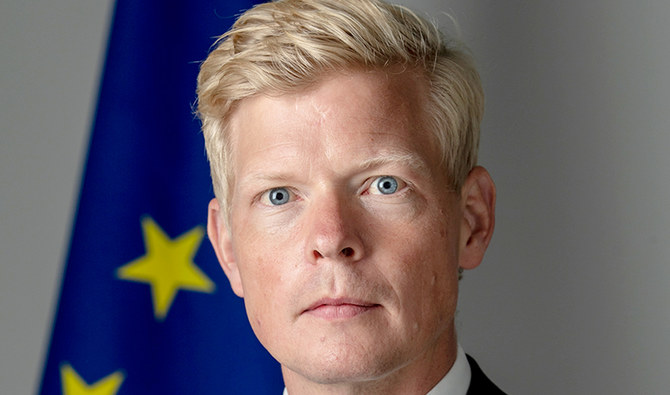
Hans Grundberg. (Photo/Twitter)
Short Url
Updated 04 July 2021
Follow

Yemenis express hope that new UN envoy will help to end war

  • Activists say Houthi rights abuses must end

ALEXANDRIA: Yemenis have expressed hope for a deal to end the war, amid reports that UN Secretary-General Antonio Guterres will name a new envoy to the country.

Politicians, rights activists and experts want the new envoy, tipped to be EU Ambassador to Yemen Hans Grundberg, to apply an inclusive approach for mediation between the warring parties.

Abu Bakr Al-Qirbi, Yemen’s former foreign minister, hailed the Swedish national as an experienced envoy with knowledge about the complications of the crisis as he had been working as a diplomat in the country for years.

A good knowledge of the region and its conflicts, a deep understanding of the Yemeni issue as ambassador to the country, and being aware of the obstacles and mistakes of previous envoys may help Grundberg get out of obstacles and failures, Al-Qirbi tweeted. He said the new envoy had to cooperate with regional forces to succeed in reaching an agreement that would end the war.

Activists said the envoy should focus on ending Houthi rights abuses and secure the release of hundreds of war prisoners.

“We strongly demand he personally pay attention to the issue of abducted and detained women in Houthi prisons and to provide them with psychological and legal support,” Amat Al-Salam Al-Hajj, chair of the Mothers of Abductees Association, an umbrella organization for thousands of female relatives of war prisoners, told Arab News.

FASTFACT

The Yemeni government had not been officially informed about the name of the new UN envoy.

The outgoing envoy to Yemen Martin Griffiths was appointed in Feb. 2018 but he, like previous envoys before him, failed to convince the Yemeni parties to strike a deal to end the war.

However his biggest achievement might be brokering the Stockholm Agreement, which defused a major offensive by government forces on the western city of Hodeidah through which most of the country’s humanitarian and food supplies enter.

He also sponsored an inmate swap between the government and Houthis that led to the freedom of more than 1,000 war prisoners.

Yassin Saeed Noaman, Yemen’s ambassador to the UK, said Grundberg would succeed in brokering a peace deal in Yemen if the EU used its relationship with Iran to pressure the Houthis to accept peace initiatives.

“Some hope can be expected that this huge European bloc will play a positive role in its relationship with Iran, which alone has the power to put pressure on the Houthis,” Noaman added.

In Riyadh, the Yemeni government had not been officially informed about the name of the new UN envoy, a senior government official told Arab News on Saturday.

Yemen experts argued that the new envoy would inherit a difficult situation as his predecessor had exhausted all options to convince factions to accept peace ideas.

“The world awaits the announcement of a new envoy whose mandate will be to find a swift path to peace where no obvious one exists,” Elana DeLozier, a fellow at the Washington Institute for Near East Policy, said on Friday. “The path is more likely to be a long, hard slog that requires a renewed focus on laying the groundwork for sustainable peace.”

Others advised the UN to expand talks to end the war beyond the government and Houthis and to include other parties such as women and leaders of military units and politicians.

“The Crisis Group has long advocated for the UN to expand the talks beyond the two-party framework,” Peter Salisbury, a senior Yemen analyst at the International Crisis Group, said last month. “It should include militia leaders and politicians who can make a ceasefire stick, as well as organizations, particularly women-led groups.”

Salisbury advised the new envoy to spend more time shuttling between Yemeni cities, mediating between different factions and groups instead of traveling between regional and international capitals.

“UN member states should press the new envoy to spend as much time in Yemen as possible, consulting widely among, and even mediating between, a range of groups,” he added.


Israel sees spike in PTSD and suicide among troops as war persists

Updated 3 sec ago
Follow

Israel sees spike in PTSD and suicide among troops as war persists

JERUSALEM: Israel is grappling with a dramatic increase in post-traumatic stress disorder and suicide among its troops after its two-year assault on Gaza, precipitated by the October 7, 2023, Hamas attack on southern Israel.
Recent reports by the Defense Ministry and by health providers have detailed the military’s mental health ​crisis, which comes as fighting persists in Gaza and Lebanon and as tensions flare with Iran.
The Gaza war quickly expanded with cross-border fire between Israel and Lebanon’s Hezbollah, and saw hundreds of thousands of soldiers and reservists deployed across both fronts in some of the heaviest fighting in the country’s history.
Israeli forces have killed more than 71,000 Palestinians in Gaza and 4,400 in southern Lebanon, according to Gazan and Lebanese officials, and Israel says more than 1,100 service members have been killed since October 7.
The war has left much of Gaza destroyed and its 2 million people overwhelmingly lack proper shelter, food or access to medical and health services.
Palestinian mental health specialists have said Gazans are suffering “a volcano” of psychological trauma, with large numbers now seeking treatment, and children suffering symptoms such as night terrors and an inability to focus.

PTSD CASES AMONG ISRAELI SOLDIERS UP 40 percent SINCE 2023
Israeli studies show the war has taken its toll on the mental health of soldiers carrying out Israel’s stated ‌war aims of eliminating ‌Hamas in Gaza, retrieving hostages there and disarming Hezbollah.
Some soldiers who came under attack when their military bases ‌were ⁠invaded by ​Hamas on ‌October 7 are also struggling.
Israel’s Defense Ministry says it has recorded a nearly 40 percent increase in PTSD cases among its soldiers since September 2023, and predicts the figure will increase by 180 percent by 2028. Of the 22,300 troops or personnel being treated for war wounds, 60 percent suffer from post-trauma, the ministry says.
It has expanded the health care provided to those dealing with mental health issues, expanded the budget, and said there was an increase of about 50 percent in the use of alternative treatments.
The country’s second-largest health care provider, Maccabi, said in its 2025 annual report that 39 percent of Israeli military personnel under its treatment had sought mental health support while 26 percent had voiced concerns about depression.
Several Israeli organizations like NGO HaGal Sheli, which uses surfing as a therapy technique, have taken on hundreds of soldiers and reservists suffering from PTSD. Some former soldiers have therapy dogs.

MORAL INJURY OVER DEATHS ⁠OF INNOCENTS
Ronen Sidi, a clinical psychologist who directs combat veteran research at Emek Medical Center in northern Israel, said soldiers were generally grappling with two different sources of trauma.
One source was related to “deep experiences of fear” and “being ‌afraid to die” while deployed in Gaza and Lebanon and even while at home in Israel. ‍Many witnessed the Hamas assault on southern Israel — in which the militants also ‍took around 250 hostages back into Gaza — and its aftermath firsthand.
Sidi said the second source is from moral injury, or the damage done to a person’s ‍conscience or moral compass from something they did.
“A lot of (soldiers’) split-second decisions are good decisions,” which they take under fire, “but some of them are not, and then women and children are injured and killed by accident, and living with the feeling that you have killed innocent people... is a very difficult feeling and you can’t correct what you have done,” he said.
One reservist, Paul, a 28-year-old father of three, said he had to leave his job as a project manager with a global firm because “the whistles of the bullets” above his head ​lingered with him even after returning home.
Paul, who declined to give his last name over privacy concerns, said he deployed in combat roles in Gaza, Lebanon and Syria. Although fighting has abated in recent months, he says he lives in a constant state of alert.
“I ⁠live that way every day,” Paul said.

UNTREATED TRAUMA
A soldier seeking state support for their mental health must appear before a defense ministry assessment committee which determines the severity of their case and grants them official recognition. That process can take months and can deter soldiers from seeking help, some trauma professionals say.
Israel’s Defense Ministry says it provides some immediate help to soldiers once they start the evaluation process and has increased this effort since the war began.
An Israeli parliamentary committee found in October that 279 soldiers had attempted suicide in the period from January 2024 to July 2025, a sharp increase from previous years. The report found that combat soldiers comprised 78 percent of all suicide cases in Israel in 2024.
The risk of suicide or self-harm increases if trauma is untreated, said Sidi, the clinical psychologist.
“After October 7 and the war, the mental health institutions in Israel are overwhelmed completely, and a lot of people either can’t get therapy or don’t even understand the distress that they are feeling has to do with what they have experienced.”
For soldiers, the chance of seeing combat remains high. Israel’s military remains deployed in over half of Gaza and fighting has persisted there despite a US-backed truce in October, with more than 440 Palestinians and three Israeli soldiers killed.
Its troops still occupy parts of southern Lebanon, as the Lebanese army presses on with disarming Hezbollah under a separate US-brokered ‌deal. In Syria, Israeli troops have occupied an expanded section of the country’s south since the ouster of former leader Bashar Assad.
As tensions flare with Iran and the US threatens to intervene, Israel could also find itself in another violent confrontation with Tehran, after last June’s 12-day war.