

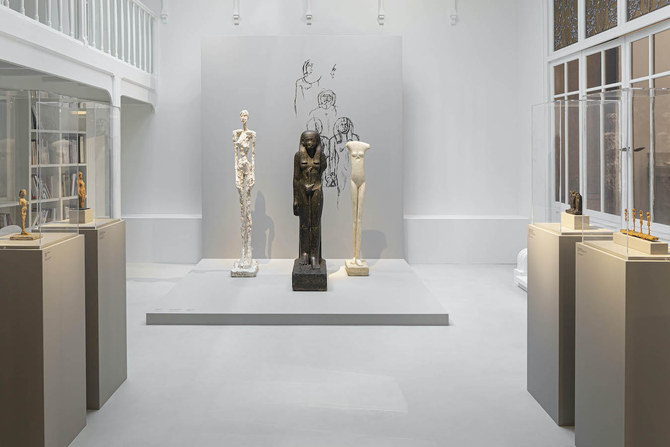

DUBAI: Paris is famed for its fabulous big-name museums, which attract crowds from across the world. But the city is also home to smaller, understated cultural gems that deserve attention too. Among them is Institut Giacometti, devoted to researching, archiving and displaying the work of the prominent 20th-century Swiss sculptor Alberto Giacometti.
For 40 years, Giacometti lived and worked in the heritage building that currently houses the museum, in the Montparnasse neighborhood. Although he died in 1966, Giacometti lives on through the museum’s unique showcase of his cluttered atelier, personal pieces of furniture, and rarely seen artworks.
The institute’s new summer exhibition, running until October 10, examines how ancient Egyptian art profoundly informed the sculptor’s artistic practice. “Giacometti and Ancient Egypt” is a marriage of antiquity and modernity, where East meets West. Giacometti’s distinctive thin elongated figurative statues confront or stand side-by-side with objects from the Old, Middle, and New Kingdoms of ancient Egypt. The Louvre has exceptionally loaned 16 artifacts to this exhibition.

For 40 years, Giacometti lived and worked in the heritage building that currently houses the museum, in the Montparnasse neighborhood. (Supplied)
Giacometti never set foot on Egyptian soil, but that did not prevent him from admiring its artistic heritage from afar. “Giacometti was a very cultivated man,” the exhibition’s co-curator Romain Perrin told Arab News. “I think the passion he had for Egypt began in the library of his father. When Giacometti was a young boy at the College of Schiers in Switzerland, he did a conference on the question, ‘What was the most important art of humankind?’ His answer was Egypt.”
Aside from devouring European-published books on Egyptian art, museum visits in Italy and France from the 1920s onwards led Giacometti to draw insightful sketches of representations of formidable Egyptian pharaohs, including Rahotep and Amenophis, which dated back thousands of years. Giacometti was struck by how they still exuded life through their quiet, confident presence.
“The Egyptian sculptures are tremendous, their lines and forms are so well-proportioned, their technique is perfect, no one has ever equalled them,” he once wrote in a letter to his parents.
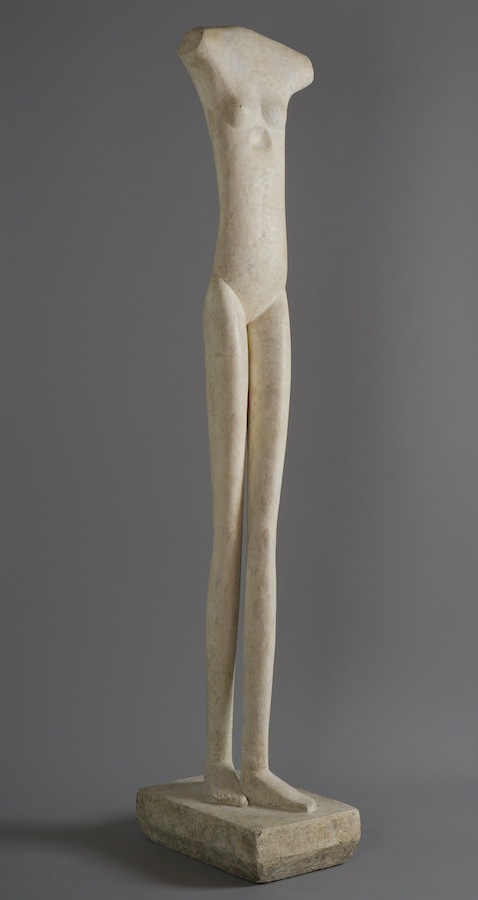
WALKING WOMAN - Alberto Giacometti Femme qui marche I 1932, Succession Alberto Giacometti (Fondation Giacometti + ADAGP 2021). (Supplied)
Giacometti’s passion for Egyptian art may have been further fuelled by the tail end of Europe’s ‘Egyptomania,’ which had been sparked by Napoleon’s Egyptian campaign at the end of the 18th century. Its influence meant Paris staged operas that were set in ancient Egypt, some local venues took on Egyptian-related names such as Le Louxor Cinema, Passage du Caire, and a famed brothel called Le Sphinx. Obelisks and pyramids were also installed — and still stand — on the streets of the French capital.
As the exhibition shows, Giacometti was particularly influenced by the Egyptian figurines’ still and straight forms, upright postures, and hieratic poses (arms alongside the body and joined feet). Whether depicting a seated scribe or a standing cat, they embodied balance and character. Through expressive plaster figures including “Walking Woman I” (1932-3) and “Bust of a Seated Man” (1965), Giacometti applied these aesthetic principles of ancient Egyptian art to his own work.
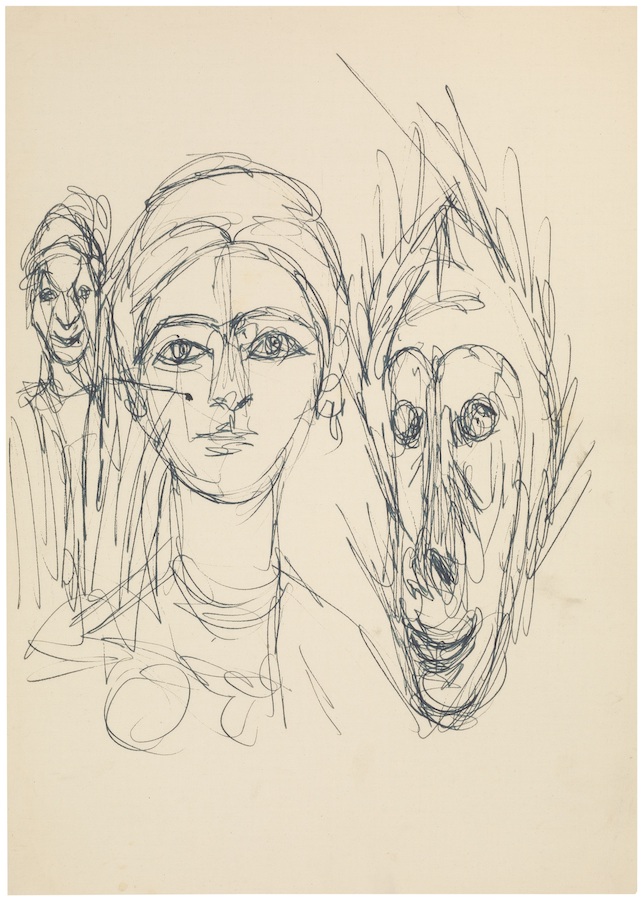
Alberto Giacometti, copies of a Fayum mummy portrait, a New Guinea mask and a Malekoula mannequin circa 1950, Ink on paper, 29.5x21cm, Fondation Giacometti. (Supplied)
“What we are trying to show in this exhibition is that Giacometti didn’t copy from a book — he had another perception and selected some specific images,” explained Perrin. One of the most compelling works on display is a funerary Fayum portrait from the Roman epoch of a woman with a direct-yet-gentle gaze. Giacometti made a sketch of such portraits, praising and adopting the manner in which Egyptian artists effectively depicted the fixated gaze, bringing the sitter to life. The piercing gaze became an iconic aspect of Giacometti’s sculptural portraits, reflecting emotional fragility and complexity.
“There is an aspect of life in the portrait,” remarked Perrin. “This is paradoxical because ancient Egyptian art was considered by western theoreticians at that time as something archaic. But Giacometti used this archaism to say that it was more realistic than any other art.” According to Perrin, Giacometti might have seen himself in this art form as an alter ego of the intellectual scribe. He also revealed that a rediscovered private photograph from the archive shows Giacometti playfully posing in a way that is reminiscent of the ancient Egyptians’ stature.
The exhibition has come as a surprise to many visitors, who were unaware of the undeniable link between Giacometti and the world of ancient Egypt.
“The most beautiful comments I heard in the first two days of the exhibition,” recalled Perrin, “were from a couple who saw ‘Walking Woman’ and thought it was Egyptian. But it’s Giacometti.”


