

Military top brass to brief Pakistani lawmakers today on Afghanistan, security challenges 

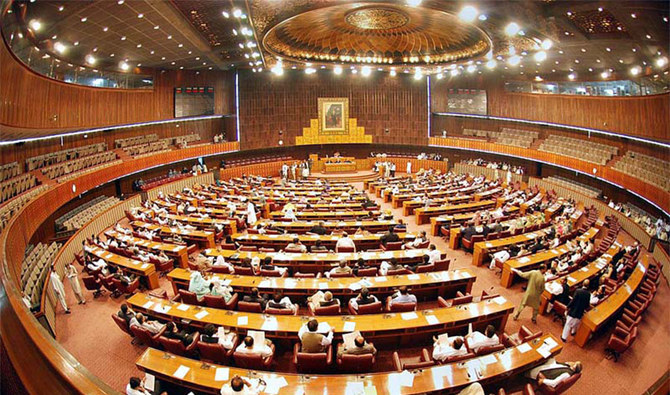
Pakistan's National Assembly session is underway in Islamabad on January 12, 2018. (Photo Courtesy: Governmnet of Pakistan)
Short Url
Updated 02 August 2021
Follow

Military top brass to brief Pakistani lawmakers today on Afghanistan, security challenges 

  • Army chief and DG ISI to give in-camera briefing to Parliamentary Committee on National Security
  • Pakistan worried about security vacuum in Afghanistan after US pullout, implications for neighbors

ISLAMABAD: The Pakistani military’s top brass, including army chief General Qamar Javed Bajwa and Inter-Services Intelligence (ISI) Director General Lt. Gen. Faiz Hameed, will today, Thursday, brief the Parliamentary Committee on National Security on the situation in Afghanistan as US troops leave the war-battered country, Pakistani media reported.
The briefing, summoned by national assembly speaker Asad Qaiser, will be off the record and attended by leader of the Opposition Shehbaz Sharif, Pakistan Peoples Party chairperson Bilawal Bhutto-Zardari and central leaders of other political parties represented in parliament.
Media reported that the main strategic briefing would be given by the spy chief while the army chief would answer lawmakers’ questions. Media has also reported that the briefing is being held after repeated requests from opposition lawmakers.
On Monday, Bhutto-Zardari wrote in a tweet:
“I had demanded on the floor of the house that the Parliament be briefed on the Afghanistan situation by the relevant departments & institutions.”

US President Joe Biden has announced a deadline of September 11 for US troops to fully withdraw from Afghanistan, but recent reports suggest most American troops will leave by mid-July. Pakistan’s political leaders, including Prime Minister Imran Khan, have since expressed concerns over a security vacuum in Afghanistan after the US pullout and its implications for neighboring Pakistan.


Pakistan warns of heightened glacial lake flood risk as temperatures rise

Updated 6 sec ago
Follow

Pakistan warns of heightened glacial lake flood risk as temperatures rise

  • NDMA says early heatwave conditions could accelerate glacier melt in northern Pakistan
  • Authorities urge contingency planning, early warnings and evacuations in at-risk areas

PESHAWAR: Pakistan’s disaster management authority warned on Thursday of an elevated risk of glacial lake outburst floods (GLOFs) starting next month as rising temperatures threaten to accelerate snow and glacier melt in the country’s northern regions.

The National Disaster Management Authority (NDMA) said seasonal forecasts point to higher-than-normal temperatures and possible early heatwave conditions that could destabilize glacial lakes in Gilgit-Baltistan and upper Khyber Pakhtunkhwa.

GLOFs occur when water from melting glaciers breaches natural barriers and is suddenly released, triggering fast-moving floods downstream.

“Increasing temperatures during March to June 2026 may accelerate snow and glacier melt in Gilgit Baltistan and Upper Khyber Pakhtunkhwa, heightening the risk of GLOF incidents,” the NDMA said in a statement. “Such events can trigger flash floods, causing damage to homes, infrastructure, agriculture, communication networks and may result in human casualties in vulnerable downstream communities.”

The advisory identified several potentially exposed areas, including valleys in Gilgit-Baltistan such as Ishkoman, Gulkin and Gulmit, as well as parts of Chitral and Upper Dir in Khyber Pakhtunkhwa.

The NDMA urged provincial and local authorities to review contingency plans, strengthen early warning systems and prepare evacuation arrangements where necessary.

Communities living near glacial streams were advised to remain vigilant, avoid unnecessary movement in high-risk zones and follow official instructions.

Climate change has become a major concern for Pakistan, which is frequently ranked among the world’s most vulnerable countries to global warming despite contributing less than 1 percent of global greenhouse gas emissions.

In recent years, the country has endured devastating floods, prolonged droughts and record-breaking heatwaves that have killed thousands of people, damaged critical infrastructure and deepened food security challenges.