BERLIN: Most European troops have already pulled out of Afghanistan, quietly withdrawing months before the US-led mission was officially expected to end — part of an anticlimactic close to the “forever war” that risks leaving the country on the brink of civil war.
Germany and Italy declared their missions in Afghanistan over on Wednesday and Poland’s last troops returned home, bringing their deployments to a low-key end nearly 20 years after the first Western soldiers were deployed there.
Announcements from several countries analyzed by The Associated Press show that a majority of European troops has now left with little ceremony — a stark contrast to the dramatic and public show of force and unity when NATO allies lined up to back the US invasion to rid the country of Al-Qaeda after the Sept. 11, 2001, attacks.
In the ensuing decades, the war went from one mission to another. Former US President George W. Bush’s administration shied away from nation-building and the United Nations advocated a light footprint. But with the passing years, NATO and US troops took on greater roles developing Afghanistan’s National Security and Defense Forces and training police. At the war’s peak, the US and NATO military numbers surpassed 150,000.
NATO agreed in April to withdraw its roughly 7,000 non-American forces from Afghanistan to match US President Joe Biden’s decision to pull all American troops from the country, starting May 1.
Biden set a Sept. 11 deadline for the withdrawal of US troops. But more recently, American officials have said that pullout would most likely be completed by July 4 — and many allies have moved to wrap up their own presence by then as well.
NATO declined to give an update Wednesday on how many nations still have troops in its Resolute Support mission. But an analysis of governments’ own announcements shows that more than 4,100 of the non-American forces have left.
The US has refused to give troop figures, but when Biden announced the final pullout between 2,500 and 3,500 troops were deployed. The US has also refused to give a clear date for their final withdrawal.
Germany publicly announced the end of its nearly 20-year deployment in a statement and a series of tweets from the defense minister late Tuesday evening, shortly after the last plane carrying its troops had left Afghan airspace.
Three transport aircraft landed at the Wunstorf air base in northern Germany on Wednesday afternoon. The troops, wearing masks, lined up on the tarmac for a brief ceremony, but the military dispensed with a bigger reception because of the coronavirus pandemic.
“We have worked long and hard to stand here today,” said Brig. Gen. Ansgar Meyer, the last commander of the German contingent. “As your commander, I can say for you: ‘Mission accomplished.’ You have fulfilled your task.”
But the top American general in Afghanistan gave a sobering assessment Tuesday, warning about the recent rapid loss of districts to the Taliban and cautioning that the country could descend into civil war.
The German pullout came amid a spate of withdrawals by European nations. Poland’s last departing troops were greeted Wednesday by Defense Minister Mariusz Blaszczak. Some 33,000 Polish troops have served in Afghanistan over the past 20 years.
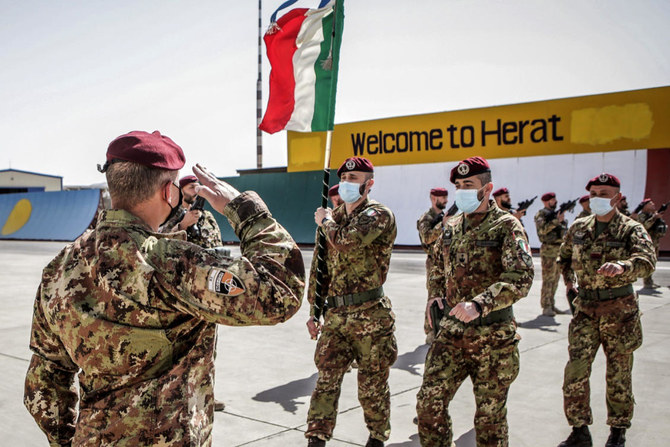
The last Italian troops from Italy’s base in Herat arrived at the military airport in Pisa late Tuesday. Italy officially declared its mission in Afghanistan over in a statement Wednesday, with Defense Minister Lorenzo Guerini paying tribute to the 53 Italians who died, and 723 who were injured over the past two decades.
Going forward, Guerini said Italy’s commitment to Afghanistan would remain strong but in other forms, “beginning with the strengthening of development cooperation and support for Afghan institutions.”
Georgia’s last troops returned home on Monday, while Romania brought home its remaining 140 troops on Saturday, when Norway also pulled out. Troops from Denmark, Estonia and the Netherlands also returned home last week. Spain withdrew its last troops on May 13, Sweden on May 25, and Belgium on June 14. The small contingents deployed by Portugal, the Czech Republic, Slovenia, Finland and Albania have all left as well.
The pullout is nearing its end as security in Afghanistan worsens. Since May 1, when the withdrawal began, the Taliban have overrun district after district, including key ones along major transportation routes. Many have fallen after Afghan soldiers surrendered, often being convinced to leave their post by elders. But elsewhere there have been bitter military battles, with Afghan troops sometimes losing when their positions could not be resupplied.
The US military commander in Afghanistan, Gen. Austen S. Miller, meanwhile, expressed concern about the resurrection of militias, which were deployed to help the beleaguered national security forces but have a brutal reputation for widespread killing.
“A civil war is certainly a path that can be visualized if this continues on the trajectory it’s on right now, that should be of concern to the world,” he said.
At a ceremony last week to mark the official end of the Dutch deployment, Dutch Defense Minister Ank Bijleveld-Schouten underscored the uncertain outlook.
“We see reports of the rise of the Taliban, growing violence, also in areas where we were stationed,” she said. “A lot has been achieved but we must be realistic: The results are not irreversible.”


![]()

Most European troops exit Afghanistan quietly after 20 years
Short Url
https://arab.news/ge723
Most European troops exit Afghanistan quietly after 20 years
- Germany and Italy declared their missions in Afghanistan over on Wednesday and Poland's last troops returned home
- Majority of European troops has now left with little ceremony


Latest updates


© 2026 SAUDI RESEARCH & PUBLISHING COMPANY, All Rights Reserved And subject to Terms of Use Agreement.