Pakistan approves federal budget as several opposition lawmakers absent from parliament 

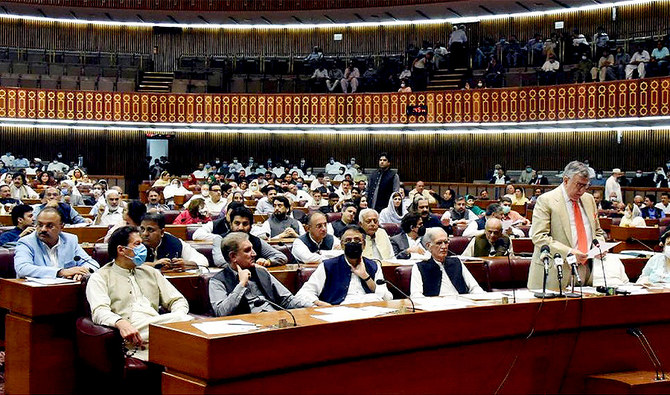
Pakistan's Federal Finance Minister Shaukat Tarin (second from right), speaking on the floor of National Assembly in Islamabad on June 29, 2021. (PID)
Short Url
Updated 30 June 2021
Follow

Pakistan approves federal budget as several opposition lawmakers absent from parliament 

  • National Assembly on Tuesday approved Finance Bill 2021-22 in a session also attended by PM Imran Khan
  • Leader of the opposition Shehbaz Sharif and several other leaders of opposition Pakistan Muslim League-Nawaz party were not in parliament 

ISLAMABAD: Pakistan’s National Assembly on Tuesday approved the Finance Bill 2021-22 during a session which was also attended by Prime Minister Imran Khan, though not the opposition leader Shehbaz Sharif and several other leaders of his Pakistan Muslim League-Nawaz (PML-N) party.
Finance Minister Shaukat Tarin dismissed the opposition’s criticism of the government’s economic policies, saying the ruling Pakistan Tehreek-e-Insaf (PTI) had to seek financial assistance from the International Monetary Fund (IMF) to deal with the fiscal deficit accumulated by previous governments.
The federal budget was passed after several tumultuous sessions in which members of the treasury benches sometimes impeded opposition politicians from delivering critical speeches and protesting the government’s economic policies.
According to the local media, Information Minister Fawad Chaudhry applauded the “huge development budget,” saying that the government managed to get it approved “with great ease.” 
He said Shehbaz Sharif’s absence from the National Assembly probably owed to a leadership tussle within the largest opposition party.
The non-attendance of the leader of the opposition from the final budget sitting was also highlighted by Pakistan Peoples Party (PPP) Chairman Bilawal Bhutto Zardari who slammed the government for “depriving” the provinces of their financial share by neglecting the National Finance Commission (NFC) award.
The absence of several opposition lawmakers from the National Assembly session stood in stark contrast to the opposition’s earlier decision to forcefully oppose the approval of the finance bill.
However, PML-N leader Ahsan Iqbal told local media that Sharif was absent from the session since his cousin had passed away.
He also added that a “vast majority” of his party members were present during Tuesday’s session.
Earlier this month, the government presented a deficit budget with a total outlay of $53.93 billion, a revenue generation target of $37 billion and a growth target at 4.8 percent of the country’s total Gross Domestic Product.


Pakistan urges developed nations, global institutions to expand role in climate financing

Updated 4 sec ago
Follow

Pakistan urges developed nations, global institutions to expand role in climate financing

  • Pakistan is recognized among countries worldwide most affected by climate-induced disasters
  • Planning minister stresses redesigning global financial system on principles of responsibility, equity

ISLAMABAD: Pakistan’s Planning Minister Ahsan Iqbal this week called on developed nations and international financial institutions to play a greater role in helping developing countries adopt green technologies at lower costs, state-run media reported. 

Pakistan has suffered frequent climate change-induced disasters over the past couple of years, ranging from floods, droughts, heatwaves, cyclones and other irregular weather patterns. 

This year the South Asian country reported over 1,000 deaths from floods and landslides triggered by heavy rains and the melting of glaciers. 

“He [Iqbal] said Pakistan has urged developed countries and international financial institutions to expand their role in climate financing to enable developing nations to adopt green technologies at lower costs,” state-run Associated Press of Pakistan (APP) reported on Saturday. 

The minister was speaking at the Second Asia Energy Transition Summit held at Pakistani university LUMS on Saturday. 

Iqbal warned that climate change is intensifying emergencies and increasing economic burdens on vulnerable countries, adding that financial incentives and concessional financing have become indispensable for sustainable climate action.

“He further emphasized the need to redesign the global financial system based on the principles of collective responsibility and equity,” APP said. 

The minister noted that Pakistan has been introducing comprehensive reforms in its development agenda to promote renewable energy, solar power and green technological solutions. 

The country, he said, possesses “strong solar potential,” a robust renewable energy market, a wide talent pool in engineering and science and an enabling environment for green innovation.

Pakistan has regularly urged developed countries to fulfill past pledges and provide easy access to climate funding without attaching conditions, especially at Conference of Parties (COP30) climate summits. 

Islamabad was instrumental in getting the Fund for Responding to Loss and Damage (FRLD) established at the COP27 climate summit in Egypt in 2022. The Loss and Damage Fund aims to help developing and least developed countries cope with both economic and non-economic impacts of climate change, such as extreme weather events and slow-onset crises like sea-level rise and droughts.