KARACHI: The family of a Karachi-based lawyer who was recently mauled by two dogs in the city’s affluent Defense Housing Authority (DHA) neighborhood on Tuesday welcomed a decision by the Clifton Cantonment Board to enforce rules to register dogs, saying he was resolved to take the owner of the dogs to court and campaign for more effective legislation to deal with such incidents.
Mirza Akhter Ali, a senior lawyer, was taking a morning walk on June 16 when he was attacked by two dogs owned by another resident. The CCTV footage of the incident was widely circulated on social media platforms where many users described it as “horrific.”
“Registration is encouraging, and we are happy that the authorities have taken the issue seriously,” Barrister Taimoor Ali Mirza, a son of the senior lawyer, told Arab News, adding that it was not enough that the accused had rendered an apology on television and in a court.
“This is not the first time something like this has happened,” Ali said. “Such incidents have also been reported in the past and we don’t want anyone else to face the same ordeal that we did. This is the reason why we aim to take the culprit to justice.”
Mirza’s family lodged a police report, and the Sindh High Court rejected the bail application of the accused, Humayun Khan, who has since absconded.
A CBC spokesperson told Arab News residents of DHA and Clifton neighborhoods had been notified to register their pet dogs with authorities.
“It is mandatory as per Section 119 of the Cantonments Act, 1924 (as amended up to date), to get pet dogs duly registered with Cantonments Boards,” a public notification, available with Arab News, said. “Owing to non-registration, it becomes impossible for the Board to confirm as to whether the dogs have been muzzled and are disease free or not.”
Keeping unregistered dogs was illegal, according to the notice. The registration process includes “the completion of all formalities which includes, but are not limited to, issuance/wearing of metal token, vaccination of dogs against rabies and keeping the dogs muzzled in public.”
Dr. Naseem Salahuddin, head of the Rabies Free Pakistan (RFP), said the registration process for pet dogs was a good initiative, though she added that the way public anger was directed toward dogs after such instances was wrong.
“All anger is directed toward the animal when a dog bite case takes place,” she said, adding that culling them was not a remedy.
“This is a good initiative by the Cantonment Board Clifton. All pet animals should be registered and properly collared with details of identity and status of vaccination,” she told Arab News.
Salahuddin also insisted that there should be a ban on the import of aggressive dogs, noting that there was no legislation in this regard.
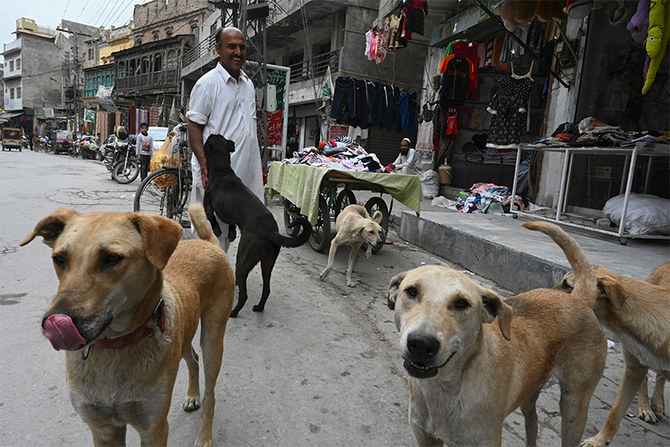
“Pet dogs only constitute one part of the problem,” she said. “The issue of stray dogs is much larger, and thousands of people are bitten by them across the country.”
She said there were about 60,000 stray dogs in Karachi about two years ago, a number that could have surpassed 100,000 by now.
A district council in Karachi killed 800 stray dogs in August 2016, prompting a local lawyer to file a petition in the Sindh High Court to stop the act. The lawyer also demanded that the animals be neutered and vaccinated instead.
Salahuddin said dozens of dogs were still killed by city authorities last year, including those neutered by her organization which started working as a pilot project to deal with stray dogs in specific locations of Karachi.
The RFP has now been asked by the local authorities to cover the entire city.
“On the directive of the court, the provincial administration of Sindh is going to finalize a three-year plan in which all canine population will be vaccinated and neutered,” she said while informing that about 100 teams would be established to perform the job.
“Dogs never become aggressive if humans treat them with kindness and gentleness,” she added.


![]()

Canine registration to be enforced in Karachi neighborhoods after viral dog-biting incident
Short Url
https://arab.news/m5uay
Canine registration to be enforced in Karachi neighborhoods after viral dog-biting incident
- Clifton Cantonment Board decides to enforce 1924 law to register dogs after lawyer bitten by two dogs while out on a walk
- Animal rights activists say all pet animals should be registered and properly collared with details of identity and status of vaccination
Latest updates


Recommended


© 2026 SAUDI RESEARCH & PUBLISHING COMPANY, All Rights Reserved And subject to Terms of Use Agreement.