DUBAI: Calm prevailed in Lebanon after a night of violence that left scores injured as hundreds of protestors took to the streets across the small Mediterranean country to decry deteriorating living conditions.
Over the weekend, Lebanon’s currency hit record lows, with market dealers saying that the pound was trading at just shy of 18,000 to the dollar. This represents a depreciation of almost 92 percent since the economic and financial crisis erupted in October 2019.
Despite still being pegged to the dollar and the official rate being set at 1,507.5 pounds per greenback, the highly coveted hard currency is in short supply, giving way to the rise of a black market.
The northern port city of Tripoli, where meager government aid and rising unemployment has turned Lebanon’s second capital into a hotbed for demonstrations over the past 20 months, saw dozens of angry residents attempt to storm the city hall before lighting a fire outside the building.
Nearby, armed clashes broke out between a group of protestors and guards of local MP Mohamad Kabbara. According to the National News Agency, panic ensued after shots rang out before the Lebanese Army restored order.
Images circulating on social media showed at least two people injured while local media reported that at least four were transported to a nearby hospital.
Protestors also charged at the central bank offices in Tripoli, broke through the metal gate and entered the courtyard before being pushed back by army soldiers. In a statement, the army said Sunday that 10 of its members were injured in the clashes.
In the southern city of Saida, protesters targeted another branch of the central bank, which has found itself at the receiving end of Lebanese anger. Scuffles also broke out between security forces and protestors gathered outside the branches of the state electricity company and the local water establishment.
Images circulating on social media also showed injured residents being carried into ambulances.
Protests rocked the capital Beirut as well, with local media reporting that demonstrators blocked roads with burning tires in a number of districts.
Lebanon has been without a fully functioning government for almost a year as political players fail to agree on the makeup of the Cabinet.
Prime Minister-designate Saad Hariri, who was appointed in October, has been at loggerheads with President Michel Aoun over naming ministers and the size of the government.
With the central bank’s foreign currency reserves dwindling, officials have decided to hike fuel prices starting Monday.
On Friday, caretaker Prime Minister Hassan Diab approved the import of fuel at a rate of 3,900 pounds to the dollar, rather than the official rate of 1,507.5 pounds, weeks after gas stations started rationing supply.


Army soldiers, protestors injured after night of violence in Lebanon
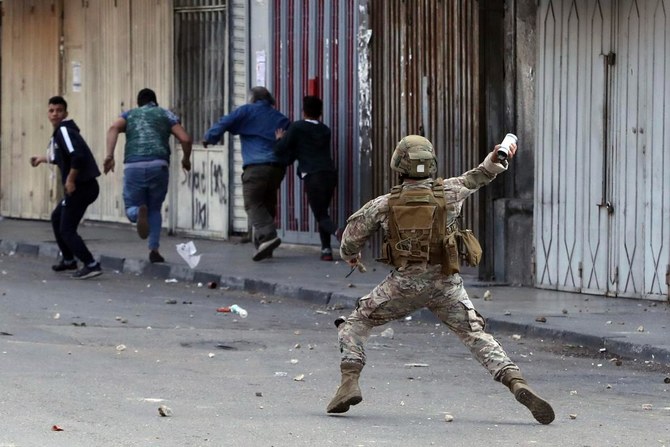
https://arab.news/cumxw
Army soldiers, protestors injured after night of violence in Lebanon
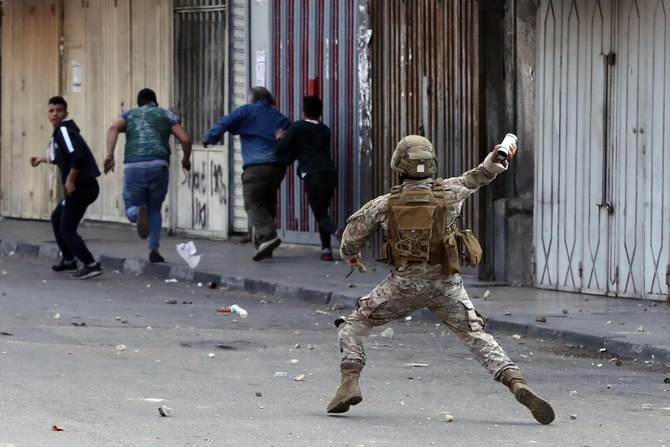
- Lebanon has been without a fully functioning government for almost a year as political players fail to agree on the makeup of the Cabinet

Bahrain arrests 4 suspected Iranian Revolutionary Guard spies
RIYADH: Bahrain's Ministry of Interior said Thursday that four citizens are facing detention for allegedly spying for Iran's IRGC, or the Islamic Revolutionary Guard Corps (IRGC).
A fifth suspect is still at large abroad, the General Directorate of Criminal Investigation and Forensic Science told the state-run Bahrain News Agency.
In a report on its news site, BNA identified the four detainees as Murtadha Hussain Awal, 25; Ahmed Isa Al Haiki, 34; Sarah Abdulnabi Marhoon, 36; and Elias Salman Mirza, 22. The fifth suspect was identified as Ali Mohammed Hassan Al Shaikh, 25.
The arrest comes amid relentless strikes by Iran on its Gulf neighbors — Bahrain, Kuwait, Oman, Qatar, Saudi Arabia and the UAE — in retaliation for ongoing US-Israeli attacks on Iranian territory.


