OPEC+ expected to move to cool overheating oil market

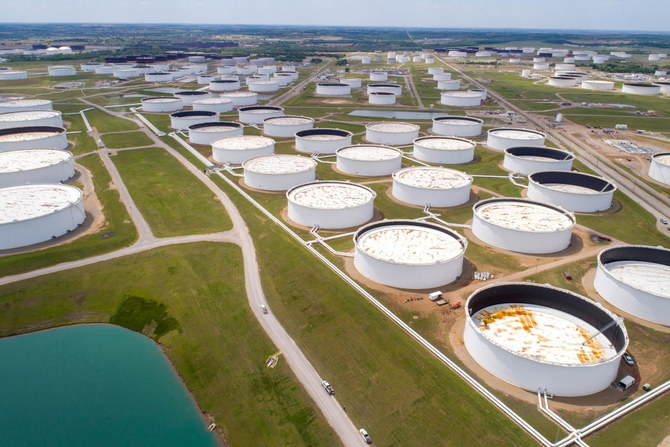
Crude oil storage tanks are seen in an aerial photograph at the Cushing oil hub in Cushing, Oklahoma. (Reuters)
Short Url
Updated 29 June 2021
Follow

OPEC+ expected to move to cool overheating oil market

  • The outlook for crude demand has been steadily improving in recent months

LONDON: The OPEC+ group of oil-producing countries will meet on Thursday and are expected to agree to boost production in August in order to meet demand and dampen recent price rises.
While improvement in demand drove the group’s most recent rises in production, now price levels will also be a guiding force behind the club’s decisions.
After demand dropped when the coronavirus pandemic broke out last year and crude prices briefly turned negative, the club led by Saudi Arabia and Russia imposed sharp production cuts in order to raise prices.
The 13 members of OPEC and their 10 allies in the OPEC+ grouping were rewarded by seeing prices for the two contracts of reference, Brent and WTI, recover to around $75 per barrel, levels not seen since October 2018.
However that strategy has worked almost too well and the group is currently following a policy of cautiously turning the taps back on.
While on the face of it buoyant prices are a boon for producers — and some of them will be pushing to increase output to cash in — there are also risks.
Russia is expected to favor increasing output, as it has done at several recent OPEC+ meetings.
Moscow “may be more inclined to support a production increase in order to ensure a higher market share while limiting the risk of rising non-OPEC production,” according to Ole Hansen from Saxobank.
“Pressure will likely not only come from within the group, but there will also be growing calls from key consumers to cool the market down, as countries come out of the other side of Covid-19 lockdowns,” says Warren Patterson of ING bank.
India is a notable example. The world’s third-largest consumer of crude has been hit by a vicious coronavirus wave in recent months and has urged OPEC+ “to phase out crude output cuts to temper rising inflationary pressures,” noted Stephen Brennock from PVM.
“If prices remain this high, this will eat into consumers’ disposable incomes and potentially choke economic growth, which, over time, will weigh on crude prices,” explained Fawad Razaqzada of Thinkmarkets.
The OPEC+ states have left themselves soom room for maneuver as they are currently still planning to leave 5.8 million barrels per day (bpd) of crude in the ground over the month of July that they could easily extract and sell.
Most investors are currently expecting a modest rise of some 500,000 bpd over the month of August.
But OPEC+ always has the capacity to surprise.
The outlook for crude demand has been steadily improving in recent months.
In its last report in mid-June, the International Energy Agency (IEA) forecast that global demand would outstrip pre-pandemic levels by the end of 2022.
Jeffrey Halley of Oanda noted that demand will be boosted as “Americans embrace a travel intensive summer” on cars, planes, and cruises, as well as due to the fact that “the global vaccination rollout is improving.”
As ever in recent months, the group will have to pay attention to diplomatic developments relating to one of its members in particular — Iran.
If current negotiations on a US return to the 2015 Iran nuclear deal are successful, the country may be able to resume exporting oil at levels prior to 2018, when former US President Donald Trump dramatically withdrew from the deal and imposed sanctions.
However, this would be unlikely to affect the market until later in the year and there are plenty of other factors at play.
The spread of the highly contagious Delta variant of the coronavirus has led to fresh restrictions being imposed in Australia, South Africa and Thailand.
Since December the OPEC+ countries have been meeting every month in order to calibrate their strategy as closely as possible to the latest developments.


Supplier hub to anchor Saudi car industry, says TASARU CEO

Updated 7 sec ago
Follow

Supplier hub to anchor Saudi car industry, says TASARU CEO

RIYADH: Saudi Arabia’s Public Investment Fund is stepping up efforts to localize automotive manufacturing, with its portfolio company TASARU announcing partnerships with five Tier-1 global suppliers to localize advanced component manufacturing in the Kingdom. 

The agreements were announced at the fourth PIF Private Sector Forum in Riyadh. TASARU also revealed plans to establish a new Supplier Hub in the King Salman Automotive Cluster in King Abdullah Economic City, designed to support next-generation vehicle development and strengthen the national automotive ecosystem in alignment with Vision 2030. 

TASARU also revealed plans to establish a new Supplier Hub in the King Salman Automotive Cluster in King Abdullah Economic City. Supplied

Speaking to Arab News on the sidelines of the forum, Michael Mueller, CEO of TASARU, said: “You cannot build cars without having the right partners from the supplier side, and with that, together with the OEMs, we selected the partners that we just announced today to localize them.” 

He added that the presence of large international suppliers is expected to attract smaller Tier-2 and Tier-3 manufacturers, helping the ecosystem scale. 

The five partners include Shin Young for metal stamping and body structures, JVIS for exterior plastics, and BENTELER for chassis and hot-formed steel components. Guangxi Fangxin will supply interior systems, while Lear Corp. completes the group, with all expected to establish manufacturing operations in the Kingdom. 

Founded more than three years ago, TASARU was established to introduce new technologies into Saudi Arabia’s mobility sector. The company has prioritized localizing smaller OEM and supplier businesses while bringing next-generation solutions into the Kingdom. 

Mueller said visible progress on factory construction by Ceer, Lucid and Hyundai is shifting perceptions about the sector’s viability. 

“A lot of people on the sideline watched whether automotive is really happening,” he said. “Now they recognize that the factories … are under construction, so that’s the first signal that it’s not just the bubble. It’s not just PowerPoint. It’s getting real now on the ground.” 

The CEO shares that KAEC is positioned as a hub for Saudi Arabia’s automotive industry, making it a strategic location for the TASARU Supplier Hub. The facility is designed to support OEMs and next-generation vehicles, including Ceer and Lucid Motors, through a shared, just-in-time manufacturing model with integrated logistics and regulatory support. 

TASARU will provide infrastructure and operational support, while partners bring technical expertise and gradually develop training centers to build a local workforce, Mueller said. 

He positioned Saudi Arabia as an attractive base for global suppliers because of its access to minerals and rare earth resources, energy availability and coordination across PIF portfolio companies and government entities.  

“They have access to minerals. They have access to rare earth. They can benefit from what is already existing. They have stable energy solutions. I think this footprint might benefit from the whole ecosystem as it is, not just automotive,” he said. 

Companies without a Saudi footprint risk missing a “huge opportunity,” Mueller added. 

He said advancing the industry will require clearer regulatory frameworks, including defined trigger points and licensing pathways that allow companies to execute their mandates. 

“Of course, you need to have more or less the regulatory framework to allow autonomous cars, sooner or later, on the streets. But it's happening, and this is a huge chance also for Saudi Arabia,” Muller said. 
 
He added: “If you are advanced in bringing such regulations onto a fast track, then you have a huge opportunity to be one of the first countries that establish this.”  

With rising traffic levels in Riyadh, Mueller said emerging mobility technologies could help solve first- and last-mile transportation challenges. 

“If the Metro is already full, that is good because people are using it. Now, you have to connect the dots. You have to finally make sure that people get from home to the metros and or to the bus station. So this first last-mile transportation is something where new technologies might help to bridge that,” he said. 

The CEO said the project is expected to take roughly one and a half to two years for suppliers to go live. More broadly, the initiative reflects Saudi Arabia’s transition from investment attraction to full-scale industrial localization, strengthening local content, private-sector participation, and long-term industrial resilience in line with Vision 2030.