Afghanistan defends move to arm people against Taliban territorial gains

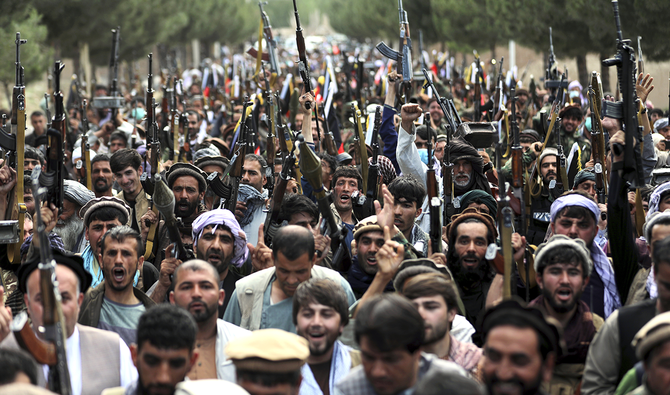
Afghan militiamen join Afghan defense and security forces during a gathering in Kabul, Afghanistan, Wednesday, June 23, 2021. (AP)
Short Url
Updated 27 June 2021
Follow

Afghanistan defends move to arm people against Taliban territorial gains

  • ‘Spontaneous local uprising forces’ will operate under scrutiny of security sectors, says Interior Ministry spokesman

KABUL: Afghanistan on Sunday defended its controversial decision to arm nearly 30,000 people to help troops limit the Taliban from making more territorial gains, which began with the phased withdrawal of US-led forces from the country on May 1.

“These are spontaneous local uprising forces to help national security and defense forces against the Taliban because these terrorists have committed brutalities in captured areas,” Tariq Arian, a spokesman for the Interior Ministry, told Arab News on Sunday.

He said these armed groups were not militia forces and would operate “under the scrutiny” of security sectors.

“We are not concerned that they will change into a threat but, if they act against the spirit of security forces, we will prevent that.”

Government resources for those wishing to join the “national mobilization” initiative are being channeled through factional and ethnic leaders, some of whom are accused of heinous crimes.

Factional militia bosses have repeatedly challenged past governments, including the administration led by President Ashraf Ghani, who pushed for the establishment of a “united front” and supporting local forces to strengthen peace and “safeguard the republic system" during a meeting with former anti-Soviet and anti-Taliban figures last week.

Arian added that 30,000 locals had either “unearthed their arms” or been given weapons and resources by Kabul. They belong to various regions where the predominantly ethnic Pashtun Taliban have captured several dozen districts from troops in recent weeks.

Defense Ministry spokesman Fawad Aman said that most “volunteers” were from the north, where ethnic Hazara and Uzbek loyalists of warlords blocked the Taliban from capturing the area over two decades ago.

Thousands of militants were massacred, and an equal number of Taliban were reportedly left to suffocate in shipping containers after surrendering to the militias during a US-led invasion in 2001.

“The number of these people keeps rising,” Aman told Arab News.  “These are educated people who have picked up arms against the Taliban, and we can call them volunteers.”

Both officials said that the process of providing arms and resources to the locals “was not unchecked” and would not lead to another era of civil war similar to the 1990s after Soviet forces withdrew from Afghanistan.

The Taliban were unavailable for comment when contacted by Arab News on Sunday.

They have intensified their attacks in recent months, taking advantage of the reduced number of foreign forces amid an ongoing drawdown process which ends on Sept. 11.

The Taliban have overrun some strategic districts in the north, including in Kunduz where nearly 5,000 Afghan families fled their homes after days of fighting between the Taliban and government forces, according to media reports. There were also reports of an escalation in attacks in the provinces of Kandahar and Baghlan.

Ghani replaced his security chiefs last week amid increased Taliban gains, with newly appointed Defense Minister Bismillah Khan Mohammadi calling on “patriots and people everywhere to stand alongside their security and defense forces,” while assuring of the government's support to “provide all equipment and resources.”

Some parliamentarians backed the move to arm locals, while others expressed concern about providing them with resources through militia bosses.

Mohammad Ibrahim Gheshtelai, an MP from southeastern Paktia province, explained why the initiative was a win-win for all.

“The nation had the desire to defend the country,” he told Arab News. “That is why they picked up arms by welcoming the government’s proposal. The government found a good source for defending the system. This is good for the survival of the system. Majority in the parliament support this, and there is no serious concern about it.”

However Ghulam Wali Afghan, a legislator from southern Helmand province, told Arab News that Kabul needed to make sure that the resources were not “misused by thieves, human rights abusers and criminals” as, otherwise, it would be civilians who suffered the most.

Some critics warned that relying on former ethnic militia leaders and informal local fighting groups could further weaken Kabul’s control over the military's effort and risk a revival of “abusive and predatory behavior by warlords” against whose narrative Ghani came to power in 2014.

“It is solidly clear that the immediate and long-term threat that militias will pose is for sure,” Zabihullah Pakteen, a political affairs analyst based in northern Afghanistan, told Arab News. “However, the government has no option but to opt for militias to stand against the Taliban. Genuine public uprising and militias are two different things, yet we do not see a mass public movement to counter the Taliban.”

Others pointed to the “dangerous” precedent being set by the government including ethnic leaders.

“The uprising movement, or making of militias, is very dangerous for now and the future of Afghanistan,” said Nasratullah Haqpal, a Kabul-based expert in political affairs, as several ethnic leaders had committed brutalities during the civil war in the past. “The public is concerned about this. Leaders benefit from this process, and it may stoke ethnic tension, and this has to stop,” he added.

In recent weeks, the Taliban have fiercely criticized the deployment of local groups by the government, referring to them as “arbakis” or former local militias who were notoriously abusive, and accusing them of “fanning the flames of war” to maintain a grip on power.

They also warned that such groups would receive “stern” treatment from Islamic authorities.


Federal agents must limit tear gas for now at protests outside Portland ICE building, judge says

Updated 7 sec ago
Follow

Federal agents must limit tear gas for now at protests outside Portland ICE building, judge says

  • The ruling came in response to a lawsuit filed by the ACLU of Oregon on behalf of protesters and freelance journalists covering demonstrations at the flashpoint US Immigration and Customs Enforcement building

PORTLAND, Oregon: A judge in Oregon on Tuesday temporarily restricted federal officers from using tear gas at protests at the US Immigration and Customs Enforcement building in Portland, just days after agents launched gas at a crowd of demonstrators including young children that local officials described as peaceful.
US District Judge Michael Simon ordered federal officers not to use chemical or projectile munitions on people who pose no imminent threat of physical harm, or who are merely trespassing or refusing to disperse. Simon also limited federal officers from firing munitions at the head, neck or torso “unless the officer is legally justified in using deadly force against that person.”
Simon, whose temporary restraining order is in effect for 14 days, wrote that the nation “is now at a crossroads.”
“In a well-functioning constitutional democratic republic, free speech, courageous newsgathering, and nonviolent protest are all permitted, respected, and even celebrated,” he wrote. “In helping our nation find its constitutional compass, an impartial and independent judiciary operating under the rule of law has a responsibility that it may not shirk.”
Ruling follows a lawsuit filed by the ACLU of Oregon
The ruling came in response to a lawsuit filed by the ACLU of Oregon on behalf of protesters and freelance journalists covering demonstrations at the flashpoint US Immigration and Customs Enforcement building.
The suit names as defendants the Department of Homeland Security and its head Kristi Noem, as well as President Donald Trump. It argues that federal officers’ use of chemical munitions and excessive force is a retaliation against protesters that chills their First Amendment rights.
The Department of Homeland Security said federal officers have “followed their training and used the minimum amount of force necessary to protect themselves, the public, and federal property.”
“DHS is taking appropriate and constitutional measures to uphold the rule of law and protect our officers and the public from dangerous rioters,” spokesperson Tricia McLaughlin said.
Courts consider question of tear gas use
Cities across the country have seen demonstrations against the administration’s immigration enforcement surge.
Last month, a federal appeals court suspended a decision that prohibited federal officers from using tear gas or pepper spray against peaceful protesters in Minnesota who aren’t obstructing law enforcement. An appeals court also halted a ruling from a federal judge in Chicago that restricted federal agents from using certain riot control weapons, such as tear gas and pepper balls, unless necessary to prevent an immediate threat. A similar lawsuit brought by the state is now before the same judge.
The Oregon complaint describes instances in which the plaintiffs — including a protester known for wearing a chicken costume, a married couple in their 80s and two freelance journalists — had chemical or “less-lethal” munitions used against them.
In October, 83-year-old Vietnam War veteran Richard Eckman and his 84-year-old wife Laurie Eckman joined a peaceful march to the ICE building. Federal officers then launched chemical munitions at the crowd, hitting Laurie Eckman in the head with a pepper ball and causing her to bleed, according to the complaint. With bloody clothes and hair, she sought treatment at a hospital, which gave her instructions for caring for a concussion. A munition also hit her husband’s walker, the complaint says.
Jack Dickinson, who frequently attends protests at the ICE building in a chicken suit, has had munitions aimed at him while posing no threat, according to the complaint. Federal officers have shot munitions at his face respirator and at his back, and launched a tear-gas canister that sparked next to his leg and burned a hole in his costume, the complaint says.
Freelance journalists Hugo Rios and Mason Lake have similarly been hit with pepper balls and tear gassed while marked as press, the complaint says.
“Defendants must be enjoined from gassing, shooting, hitting and arresting peaceful Portlanders and journalists willing to document federal abuses as if they are enemy combatants,” the complaint states.
The owner and residents of the affordable housing complex across the street from the ICE building has filed a separate lawsuit, similarly seeking to restrict federal officers’ use of tear gas because its residents have been repeatedly exposed over the past year.
Local officials have also spoken out against use of chemical munitions. Portland Mayor Keith Wilson demanded ICE leave the city after federal officers used such munitions Saturday at what he described as a “peaceful daytime protest where the vast majority of those present violated no laws, made no threat, and posed no danger to federal forces.”
“To those who continue to work for ICE: Resign. To those who control this facility: Leave,” Wilson wrote in a statement Saturday night.
The protest was one of many similar demonstrations nationwide against the immigration crackdown in cities like Minneapolis, where in recent weeks federal agents killed two people, Alex Pretti and Renee Good.