

Pakistan calls for international attention to illegal uranium sales in India

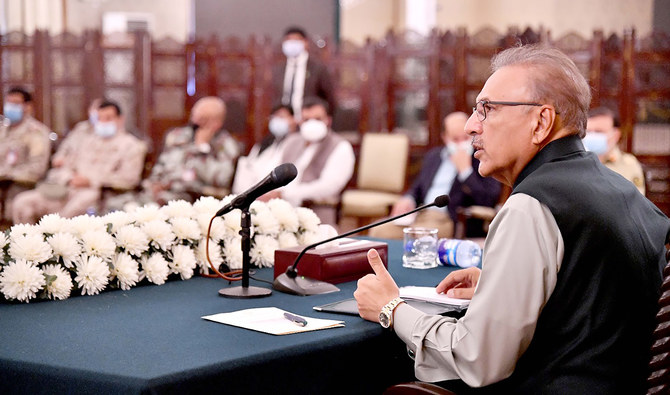
Pakistan's president Arif Alvi speaks during a session with military officers from 12 countries who were attending a security workshop by the National Defense University in Islamabad on June 25, 2021. (Photo courtesy: @PresOfPakistan/Twitter)
Short Url
Updated 26 June 2021
Follow

Pakistan calls for international attention to illegal uranium sales in India

  • Since May, at least 13 kilograms of uranium worth millions of dollars were seized by Indian law enforcers
  • In early June, Pakistan called for a probe into illegal possession and sales of nuclear materials in India

ISLAMABAD: Pakistan President Arif Alvi on Friday called for international attention to illegal uranium sales in India after a number of recent incidents in which kilograms of the nuclear material were seized by Indian authorities.

Since early May, at least 13 kilograms of uranium worth millions of dollars were seized by law enforcers in the western Indian state of Maharashtra and in the eastern state of Jharkhand.

Pakistan has since expressed its "deep concern" over the incidents and called for a thorough investigation.

"International community should take serious note of illegal sale of uranium on black market in India," President Alvi said during a session with military officers from 12 countries who were attending a security workshop by the National Defense University in Islamabad.

"Radioactive substances in the wrong hands can endanger human lives and the security of nations," Alvi said, as quoted by his office.


On June 4, after the uranium incident in Jharkhand, Pakistan's foreign office said such incidents "point to lax controls, poor regulatory and enforcement mechanisms, as well as possible existence of a black market for nuclear materials inside India."

It also called for a probe over the security of nuclear materials in India to "prevent their diversion."

"It is equally important to ascertain the intent and ultimate user of the attempted uranium sale given its relevance to international peace and security as well as the sanctity of global non-proliferation regime."

"The United Nations Security Council Resolution 1540 and the IAEA Convention on the Physical Protection of Nuclear Material (CPPNM) make it binding on states to ensure stringent measures to prevent nuclear material from falling into wrong hands."
 
The UN resolution regarding the non-proliferation of weapons of mass destruction was adopted unanimously in 2004.

The IAEA convention, ratified by both Pakistan and India, establishes legal obligations for parties regarding the physical protection of nuclear material. It criminalizes offences related to illicit trafficking and sabotage of nuclear material.


Pakistan urges Afghan rulers to ‘rid their soil of terrorists’ at regional meeting in Tehran

Updated 4 sec ago
Follow

Pakistan urges Afghan rulers to ‘rid their soil of terrorists’ at regional meeting in Tehran

  • Iran hosts meeting of special representatives on Afghanistan from Pakistan, China, Russia, Central Asian countries
  • Pakistan alleges militants use Afghan soil to launch attacks against it, charges the Afghan Taliban deny repeatedly

ISLAMABAD: Pakistan’s special envoy on Afghanistan Mohammad Sadiq urged rulers in Kabul on Sunday to rid their soil of “terrorists,” saying the move would inspire confidence in its neighbors to engage with the country.

Sadiq, who is Pakistan’s special representative to Afghanistan, was part of a high-level meeting hosted by Iran in Tehran to discuss issues related to Afghanistan. The meeting featured Afghan affairs representatives from Pakistan, Tajikistan, Uzbekistan, Turkmenistan, China and Russia, Iranian state news agency IRNA said. 

Pakistan blames a surge in attacks on its soil on militants it says are based in Afghanistan, a charge Kabul denies. The allegations have caused tensions between the neighbors to rise, resulting in deadly border clashes in October that saw dozens of soldiers killed on both sides. 

“It is imperative that the current de facto rulers [in Afghanistan] take steps to ameliorate their suffering,” Sadiq wrote on social media platform X. 

“And the foremost step in this regard would be to rid their soil indiscriminately of all types of terrorists.”

Sadiq said he agreed with other participating countries during the meeting that the “threat of terrorism” originating from Afghanistan’s soil is a “big challenge” for the region. 

“Also made this point that only an Afghanistan that does not harbor terrorists will inspire confidence in the neighboring and regional countries to meaningfully engage with Afghanistan, helping to realize the country’s immense economic and connectivity potential,” he concluded. 

Officials from Pakistan and Afghanistan engaged in three rounds of peace talks in Türkiye, Qatar and Saudi Arabia since the October clashes but were unable to reach an agreement. 

While Pakistan has vowed it would go after militants in Afghanistan that threaten it, Kabul has said it would retaliate to any act of aggression from Islamabad.