In dark longing, Arooj Aftab expands soundscape of Pakistan and has the world listening

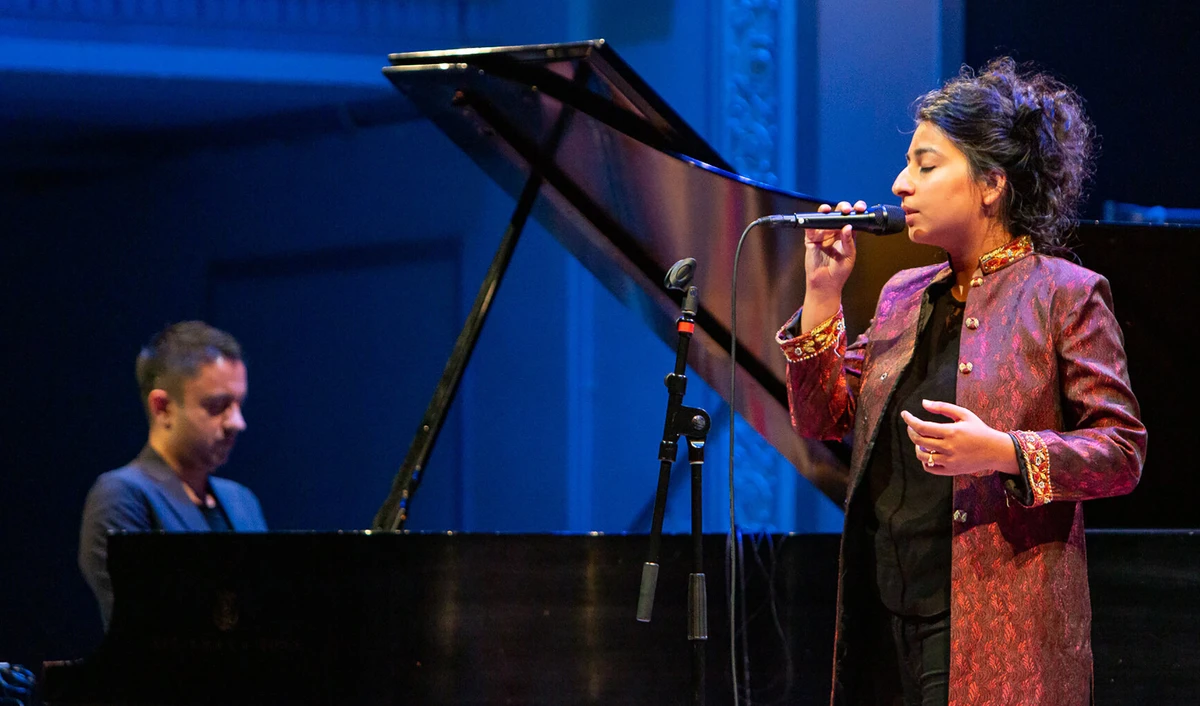
Musician Arooj Aftab, right, performs at Resonant Bodies Festival in New York on June 5, 2019. (Photo courtesy: Resonant Bodies Festival)
Short Url
Updated 27 June 2021
Follow

In dark longing, Arooj Aftab expands soundscape of Pakistan and has the world listening

  • Aftab’s third album “Vulture Prince” featuring ghazals was released in late April and has already gained critical acclaim
  • Pitchfork magazine, a barometer of the independent music scene, has praised her “technical skill and compositional fearlessness” 

RAWALPINDI: Though Arooj Aftab has lived in the United States for nearly two decades since she left Pakistan for Boston to study at the Berklee College of Music, she says her music owes a large debt to her hometown, Lahore, and the music and the poetry of her country of origin.
The musician’s third album, “Vulture Prince,” was released by New Amsterdam Records in late April and features ghazals, poems of beauty in longing. The collection has already gained critical acclaim, with Pitchfork magazine, a barometer of the independent music scene, praising Aftab’s “technical skill and compositional fearlessness” in blending Pakistani classical music with jazz and trance to create her singular sound.

The 36-year-old began to make headlines in 2018, when the National Public Radio (NPR) listed her “Lullaby” as one of the 200 Greatest Songs by 21st Century Women+ and the New York Times celebrated her “Island No 2” among the Best Classical Music Tracks of 2018.
“I’ve inherited a lot of different types of music, and they’ve created a route inside of me,” she told Arab News in an interview this week. “I will always have my relationship with Lahore and with Pakistan, our culture and our heritage, our poetry, our music, our style of being.”
“I don’t think you can ever erase that and it’s still real life for me even though I am not physically spending time there. It’s not a memory — it’s definitely a part of where I am. I don’t think it can go away.”
That part seems to have entered a new cycle of life with Aftab’s recent album. The “vulture” in the title spreads its wings over all seven tracks.



In this undated photo, musician Arooj Aftab is performing at Highline Ballroom in New York. (Photo courtesy: Social Media) 

“Vulture is kind of like mystical, exalted kind of almost feared type of bird,” she said.
In the Zoroastrian tradition of South Asia’s Parsis, vultures connect the world of the living and the afterlife. The bodies of the deceased are placed for burial in “towers of silence” where the birds come to consume them.
“I had been thinking about how, how beautiful and how dark is the Zoroastrian tower of silence, and the role that vultures play in returning us back into the cycle of life,” Aftab said. “They eat the deceased and then, in that way, your loved ones, their energy goes back into the earth and the world, and the cycle continues.”
“I find that insane, and also really beautiful.”
Many in South Asia will recognize that same nostalgia in the lead single “Mohabbat.”

The ghazal, written by Hafeez Hoshiarpuri in the 1920s, is one the most famous classical Urdu poems, an ode to the devouring sadness of loss, separation and longing that is “equal to the sadness of all the world.”
Performed by greats such as Mehdi Hassan and Iqbal Bano, the longing in the song at some point reaches its peak, but not in Aftab’s version. She had completely transformed it, making the sadness burn slowly, at multiple levels.
“It has dual modes, it has multiple modes, it has multiple feelings going on, you can feel a lot of things through it,” she said. “It can be interpreted in so many different ways.”
It can also heal.
“Music has always been a personal healing tool for me. It always came to me that way,” Aftab said. “That’s always been my base: to use music as a therapy for myself.”


Pakistan says will press ahead with trilateral cooperation with China and Bangladesh

Updated 4 sec ago
Follow

Pakistan says will press ahead with trilateral cooperation with China and Bangladesh

  • Islamabad signals closer engagement with Dhaka amid shifting regional dynamics
  • Trilateral platform gains traction after recent China-Pakistan strategic talks last week

ISLAMABAD: Pakistan said on Thursday it would continue to pursue a trilateral cooperation framework with China and Bangladesh aimed at boosting regional connectivity, trade and development, as consultations among the three countries move forward.

The framework, launched last year at the senior officials’ level, has gained renewed attention as ties between Pakistan and Bangladesh improve following years of limited engagement, while Dhaka’s relations with India, a longtime archrival of Pakistan, have come under strain amid domestic political upheaval.

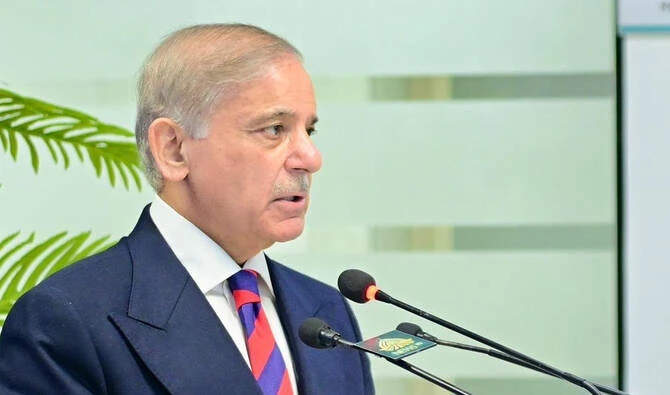
Addressing reporters on Thursday, Pakistan’s Foreign Office spokesman Tahir Andrabi said Islamabad remained committed to the Pakistan-China-Bangladesh cooperation mechanism and intended to follow up on earlier consultations to deliver “practical outcomes.”

“On the Pakistan, Bangladesh and China mechanism, if you recall, a meeting took place last year [2025] at the level of vice ministers and foreign secretaries,” Andrabi told a weekly media briefing, adding that Pakistan looked forward to “positive outcomes” in line with an agreed joint communiqué.

“So of course, the consultations between the three of us would continue in the future to strive for outcomes which are beneficial for the peace, progress and prosperity of our people,” he said when asked specifically about Bangladesh’s role in the framework.

The trilateral cooperation was also referenced in a joint press communiqué issued after the Seventh Round of the China-Pakistan Foreign Ministers’ Strategic Dialogue held last week.

“The two sides expressed readiness to continue leveraging the China-Afghanistan-Pakistan Trilateral Foreign Ministers’

Dialogue and the China-Bangladesh-Pakistan cooperation mechanism to deliver new outcomes,” the statement said.
Andrabi said Pakistan’s engagement with China would continue across bilateral and trilateral formats, underscoring Islamabad’s preference for cooperative regional approaches focused on economic development rather than bloc politics.

Bangladesh was part of Pakistan until 1971, when it gained independence following a bloody war of independence. Relations between the two countries have shown signs of improvement in recent months, as Dhaka recalibrates its foreign policy after the ouster of former prime minister Sheikh Hasina in 2024. India has so far declined Bangladesh’s request to extradite Hasina, who fled to New Delhi after violent student-led protests.

In a related development, Pakistan’s Air Chief Marshal Zaheer Ahmed Baber Sidhu earlier this week held talks with a high-level Bangladeshi defense delegation on strengthening air force cooperation, including the potential sale of JF-17 Thunder fighter jets jointly developed by Pakistan and China.