ISLAMABAD: A senior member of Pakistan’s federal cabinet said on Friday his country was not likely to be blacklisted by the Financial Action Task Force (FATF) after the global money laundering and terror financing watchdog announced to keep Islamabad on the “increased monitoring list” of countries for continued weaknesses in its financial system.
Addressing a media briefing, the country’s energy minister, Hammad Azhar, who is also responsible for dealing with the FATF, said that the global financial watchdog had given Pakistan a new seven-point action plan that focused on money laundering after its recent plenary session, adding that the government was hoping to implement all agenda items within a span of a year.
He also reiterated his government’s commitment to implement the only remaining item on a previous 27-point action plan which was the FATF developed in 2018.
“It is necessary to complete both plans to exit the grey list,” he said.
“The previous [FATF] action plan was extremely challenging and difficult since Pakistan was declared a high-risk country in terror financing which led to increased compliance thresholds,” Azhar explained. “The new [seven-point] action plan on money laundering is relatively less challenging because we are declared a low-risk country in the area.”
The minister expressed his resolve to implement the first action plan “in the next three to four months” before taking care of the other set of recommendations related to money laundering “within 12 months.”
“There is no danger of blacklisting now,” he said. “In fact, the whole [FATF] debate is now revolving around when Pakistan should be whitelisted.”
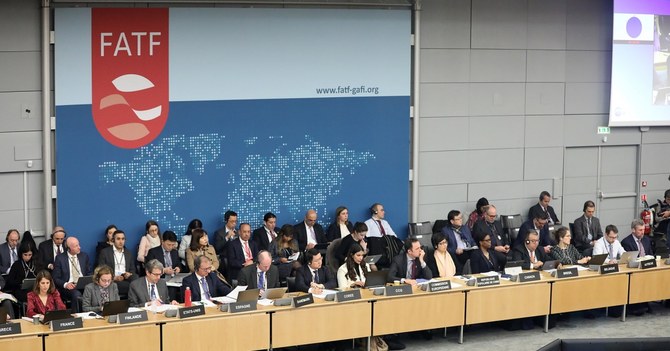
Earlier in the day, the global financial watchdog announced to keep Pakistan on the “grey list” of countries.
“Pakistani government has made substantial progress in making its counter-terrorist financing system stronger and more effective,” said FATF President Dr. Marcus Pleyer while addressing a news conference through a video link.
“It has largely addressed 26 out of 27 items on the action plan it first committed to in 2018,” he continued. “That action plan focused on terrorist financing issues. However, one key action item still needs to be completed which concerns the investigation and prosecution of senior leaders and commanders of UN-designated terror groups.”
The FATF placed Pakistan on its “grey list” in 2018 and devised a 27-step action plan for implementation.
Pakistan’s foreign minister Shah Mahmood Qureshi recently claimed that the global financial watchdog had “no justification” to keep his country on the grey list after its recent progress.
However, Pleyer also mentioned a parallel evaluation and improvement process related to Pakistan’s financial system where the country was “failing.”
“In addition to this [27-point action plan], a separate process has been taking place over the past few years,” he said in his statement. “Back in 2019, the FATF regional partner, the APG [or] the Asia Pacific Group, identified a number of serious issues during its assessment of Pakistan’s entire anti-money laundering and counter-terrorist financing system. Since then, Pakistan has made improvements. This includes clear effort to raise awareness in the private sector to Pakistan’s money laundering risks.”
“Pakistan is still failing to effectively implement the global FATF standards across a number of areas,” Pleyer continued. “This means risks of money laundering remain high which in turn can fuel corruption and organized crime.”
He added this was also the reason behind his organization’s decision to continue to work with Pakistan “in areas that still need to be improved” and mostly related to money laundering risks.
“This includes increasing the number of investigations and prosecutions and making sure that law enforcement agencies cooperate internationally to trace, freeze and confiscate assets,” he said.
Pleyer thanked the Pakistani authorities for their “continuous strong commitment to this process.”


![]()

Pakistan says ‘no danger’ of being blacklisted by global dirty money watchdog
Short Url
https://arab.news/cacwu
Pakistan says ‘no danger’ of being blacklisted by global dirty money watchdog
- Hammad Azhar, who is responsible for dealing with the global financial watchdog, says the FATF debate is now revolving around when Pakistan should be whitelisted
- The Financial Action Task Force wants Islamabad to investigate and prosecute ‘senior leaders and commanders of UN-designated terror groups’
Latest updates


© 2026 SAUDI RESEARCH & PUBLISHING COMPANY, All Rights Reserved And subject to Terms of Use Agreement.