Saudi Arabia’s holiday season full of ‘Summer Vibes’

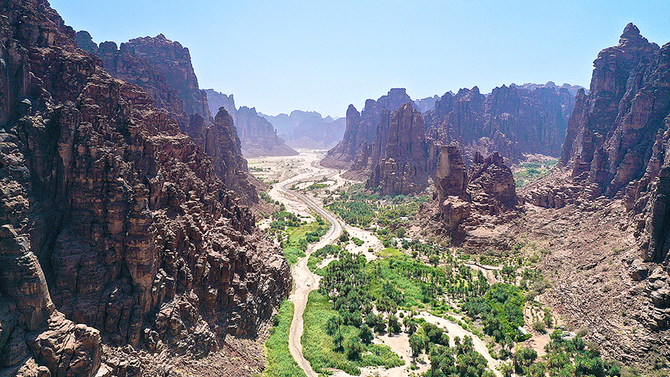
Tourists who are longing for outings but have to forgo foreign trips due to the pandemic are encouraged to explore the diversity of Saudi destinations — from the clear water beaches to rugged mountain tops to bustling cities. (Supplied)
Short Url
Updated 26 June 2021
Follow

Saudi Arabia’s holiday season full of ‘Summer Vibes’

  • Saudi Tourism Authority’s program, bringing 500 rich and fun experiences across 11 destinations, runs until September end

JEDDAH: Saudi Arabia’s “Summer Vibes” is bringing 500 tourist experiences across 11 destinations to Saudi residents this summer in what promises to be a rich and fun experience for all.

The Saudi Tourism Authority has launched its Saudi Summer Program 2021, running from June 24 until the end of September, offering tourist experiences through the Visit Saudi platform alongside 250 private-sector partners. 

The “Summer Vibes” program targets local and international tourists with some of the best destinations available — from the shores of Jeddah and Yanbu to Umluj and King Abdullah Economic City, to the cooler mountainous regions of Taif, Baha and Asir. Experiences can also be enjoyed across the historical and heritage areas of Tabuk, AlUla and Al-Ahsa, and the Kingdom’s beating heart, Riyadh.

Dania Al-Ali, a 33-year-old mother of two, decided to forgo any international trips with her family this summer due to the uncertainty caused by the COVID-19 pandemic. 

The news of the program excited her as the long summer will need to be filled with some sort of activities for her young children.

“We’ve made it a habit to travel every summer but things changed since last summer and we don’t really want to risk it this year,” she told Arab News. “It’s better to be closer to home and to experience something new, and there’s so much to see here. I think this is going to be a good one just like every other summer vacation.”

“The launch of the Saudi summer program this year highlights the determination of the tourism sector in the Kingdom, despite the ongoing challenges facing the global tourism sector, to edge closer to achieving our ambitious goals,” said Minister of Tourism Ahmed Al-Khateeb, chairman of the board of directors of the Saudi Tourism Authority. 

“In line with the Kingdom’s Vision 2030, which seeks to cement Saudi’s position as one of the most important tourist destinations in the region, the launch of the Saudi summer program is a key contributor to strengthening the efforts of the tourism sector, to develop our destinations, provide investment opportunities, create permanent and seasonal jobs for local communities, and contribute to advancing economic and social development in the Kingdom,” he said.

CEO of the Saudi Tourism Authority Fahd Hamidaddin said: “Once again, we encourage tourists to explore the diversity of Saudi’s summer destinations, from the clear water beaches to rugged mountain tops to bustling cities. The efforts of the Saudi Tourism Authority are supported by our partners in the public and private sectors and are key to the creation, implementation and success of all programs,” he said.

Information is available on the Visit Saudi website and phone app (search “Visit Saudi” in the app store), with details available in several languages. Tourists can also contact the Tourist Care Center (930) and speak to the dedicated team working around the clock to answer all inquiries.



Ramadan boosts dates demand as Saudi sector sees seasonal rush

Updated 15 sec ago
Follow

Ramadan boosts dates demand as Saudi sector sees seasonal rush

RIYADH: Dates hold an important place in Saudi Arabia’s spiritual and cultural fabric, and their association with hospitality and religious tradition makes them a staple of iftar tables during Ramadan.

The holy month also reshapes one of the Kingdom’s most established agricultural sectors, with the date industry shifting gear. Faith-driven consumption and a gifting culture amplifies demand throughout supermarkets and premium packaging segments.

Economic adviser Fadhel Al-Buainain told Arab News that while demand for dates remained steady across the year, domestic consumption rose noticeably during Ramadan.

“Recently, there has also been growing global demand for Saudi dates. However, local demand increases noticeably during Ramadan due to the association of dates with the iftar meal,” he said.

Many people prefer to break their fast with fresh rutab dates or, when these are unavailable, with dried dates, as per tradition. Along with the religious aspect, dates are also valued for their nutritional benefits — valuable during long fasting hours.

Al-Buainain said Ramadan was “a driver for increased sales and exports,” reinforcing the sector’s seasonal momentum, but he stressed Ramadan did not represent the industry’s true economic peak.

“I do not believe it creates a peak season, despite its marketing importance,” he said. “The true peak season is the period following the date harvest, when markets flourish and large quantities are sold as farm output supplies the market. However, in the retail sector, Ramadan can be considered one of the important seasons in which marketing activity increases.”

The distinction highlights a key dynamic in the industry. While Ramadan accelerates retail turnover and boosts demand in supermarkets and gift markets, production cycles and wholesale auctions remain closely tied to harvest season.

“The peak of date sales occurs at the time of harvest, both in terms of sales volume and prices,” Al-Buainain said.

Date auctions, he added, are linked to the beginning of the harvest, after which large quantities are sold wholesale — the most important channel for producers — before reaching retailers and consumers. By contrast, sales during Ramadan are mostly from previously harvested stock.

“For example, the upcoming Ramadan will arrive before this year’s harvest season,” he said. “Therefore, the dates being sold are from last year’s crop. This further illustrates the point.”

Despite the seasonal rise in consumption, Al-Buainain said production volumes remained sufficient to prevent significant price volatility.

“Production volumes are large, and supply exceeds demand,” he said, adding that traditional dates marketed through conventional channels were expected to maintain stable prices. Any price increases are largely confined to processed or attractively repackaged varieties.

“Price increases are linked to dates packaged in modern, gift-like formats or processed dates that include added ingredients such as nuts and others. Traditional dates, however, still have stable prices,” he said.

Most dates available locally are domestically produced, with limited processed products manufactured abroad. Price differences are primarily determined by type, quality and packaging rather than Ramadan-related demand pressures.

“There are also some practices carried out by wholesale traders through auctions, where buyers bid against one another, artificially driving prices up, filming these scenes and broadcasting them to influence prices. This cannot be taken as a reliable benchmark,” Al-Buainain told Arab News.

At a structural level, the sector has expanded significantly in recent years. Saudi date exports reached SAR 1.695 billion in 2024, according to the National Centre for Palms & Dates, citing data from the General Authority for Statistics. Production exceeded 1.9 million tonnes, with exports reaching 133 countries — a 15.9 percent increase in value compared to 2023.

Since the launch of Vision 2030, export value has grown by 192.5 percent between 2016 and 2024.

Saudi Arabia, the world’s second-largest date producer, is home to more than 33 million palm trees — representing 27 percent of the global total — across approximately 123,000 agricultural holdings.

Dates also recorded the highest self-sufficiency ratio among fruits at 121 percent, according to the General Authority of Statistics.

Al-Buainain described dates as a strategic commodity and a core component of the Kingdom’s food security framework.

The sector holds significant potential to further support agricultural diversification, provided it is backed by clearer long-term strategy, improved pest control and stronger coordination across the value chain.

“The date sector needs a clear strategy that ensures maximum benefit from dates produced in the Kingdom. It also requires full protection from expatriate labor that focuses solely on profit and harms the date sector, its future, and its sustainability,” he said.

“The sector also needs a final solution to pests that damage palm trees, including the red palm weevil, as well as the establishment of a national date company to purchase crops, process, package, distribute, and export them, in addition to entering date-based industries to generate added value for the economy.”