Saudi Arabia’s holiday season full of ‘Summer Vibes’

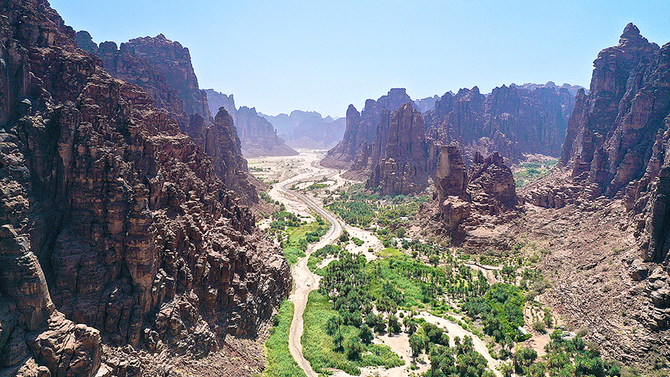
Tourists who are longing for outings but have to forgo foreign trips due to the pandemic are encouraged to explore the diversity of Saudi destinations — from the clear water beaches to rugged mountain tops to bustling cities. (Supplied)
Short Url
Updated 26 June 2021
Follow

Saudi Arabia’s holiday season full of ‘Summer Vibes’

  • Saudi Tourism Authority’s program, bringing 500 rich and fun experiences across 11 destinations, runs until September end

JEDDAH: Saudi Arabia’s “Summer Vibes” is bringing 500 tourist experiences across 11 destinations to Saudi residents this summer in what promises to be a rich and fun experience for all.

The Saudi Tourism Authority has launched its Saudi Summer Program 2021, running from June 24 until the end of September, offering tourist experiences through the Visit Saudi platform alongside 250 private-sector partners. 

The “Summer Vibes” program targets local and international tourists with some of the best destinations available — from the shores of Jeddah and Yanbu to Umluj and King Abdullah Economic City, to the cooler mountainous regions of Taif, Baha and Asir. Experiences can also be enjoyed across the historical and heritage areas of Tabuk, AlUla and Al-Ahsa, and the Kingdom’s beating heart, Riyadh.

Dania Al-Ali, a 33-year-old mother of two, decided to forgo any international trips with her family this summer due to the uncertainty caused by the COVID-19 pandemic. 

The news of the program excited her as the long summer will need to be filled with some sort of activities for her young children.

“We’ve made it a habit to travel every summer but things changed since last summer and we don’t really want to risk it this year,” she told Arab News. “It’s better to be closer to home and to experience something new, and there’s so much to see here. I think this is going to be a good one just like every other summer vacation.”

“The launch of the Saudi summer program this year highlights the determination of the tourism sector in the Kingdom, despite the ongoing challenges facing the global tourism sector, to edge closer to achieving our ambitious goals,” said Minister of Tourism Ahmed Al-Khateeb, chairman of the board of directors of the Saudi Tourism Authority. 

“In line with the Kingdom’s Vision 2030, which seeks to cement Saudi’s position as one of the most important tourist destinations in the region, the launch of the Saudi summer program is a key contributor to strengthening the efforts of the tourism sector, to develop our destinations, provide investment opportunities, create permanent and seasonal jobs for local communities, and contribute to advancing economic and social development in the Kingdom,” he said.

CEO of the Saudi Tourism Authority Fahd Hamidaddin said: “Once again, we encourage tourists to explore the diversity of Saudi’s summer destinations, from the clear water beaches to rugged mountain tops to bustling cities. The efforts of the Saudi Tourism Authority are supported by our partners in the public and private sectors and are key to the creation, implementation and success of all programs,” he said.

Information is available on the Visit Saudi website and phone app (search “Visit Saudi” in the app store), with details available in several languages. Tourists can also contact the Tourist Care Center (930) and speak to the dedicated team working around the clock to answer all inquiries.


Airbus seeks to strengthen Saudi defense ties

Updated 10 sec ago
Follow

Airbus seeks to strengthen Saudi defense ties

MALHAM: Airbus is aiming to deepen its strategic relationship with Saudi Arabia, a “core customer” in the region, according to Head of Air Power, Airbus Defense and Space Jean-Brice Dumont.

“Saudi Arabia is one of our customers in the region that we have a very strong link with,” Dumont told Arab News on the sidelines of the World Defense Show in Riyadh.

“We have a very strong link with decades of history of Airbus in the country, be it for helicopters, but in my case for military aircraft.

He said the Kingdom was “sort of a hometown for us for these flying platforms and for the maintenance, repair, and overhaul of these platforms.”

Airbus has a longstanding partnership with Saudi Arabia in both commercial and defense aircraft that dates back nearly 50 years.

“We have already invested quite significantly in the region,” Dumont said. “Notably, we have a JV (joint venture) with SAMI (Saudi Arabia Military Industries) in Saudi Arabia and that, I believe is the beginning of a longer journey. But so far, when we see what’s happening in the region, it’s already quite good.”

In 2021 SAMI, a wholly owned subsidiary of the Public Investment Fund and the National Champion of Military Industries Localization, and Airbus signed an agreement to form a joint venture on military aviation services and maintenance, repair and overhaul capabilities.

During the interview Dumont also looked ahead, detailing the strategic roadmap for 2026–2030 that moves beyond traditional hardware toward a digitally-dominant battlefield.

“I think we are reaching the end or the limits of the ‘fighter goes alone’ kind of model,” he said. “Now, the fighters need to communicate, to command drones, to be themselves receiving information by a mass, high-throughput data link so that they can play their role — their new role — in the battlefield.”

He also spoke about how the A330 aircraft was moving beyond its basic reputation as a “flying gas station” to become a high-tech “command center” in the sky.

“The A330 can be first much more automated. The air-to-air refueling can be automatic, and we have developed that capability,” he explained.

“On the other hand, it’s a big platform flying high, which can act as a command-and-control node in the system of systems that the air forces are all aspiring to.”

On the Eurofighter, he said it was “a bit symmetrical,” while speaking about the “buzz” around artificial intelligence he said that while neural networks have been embedded in Airbus platforms for nearly 20 years, the next decade would see AI move to the forefront of decision-making.

From mission preparation to real-time command, he said, the goal is to process vast amounts of data to act faster than the adversary.

“The one who gets that right has won,” he said.