Fourth coronavirus wave may hit Pakistan next month — planning minister

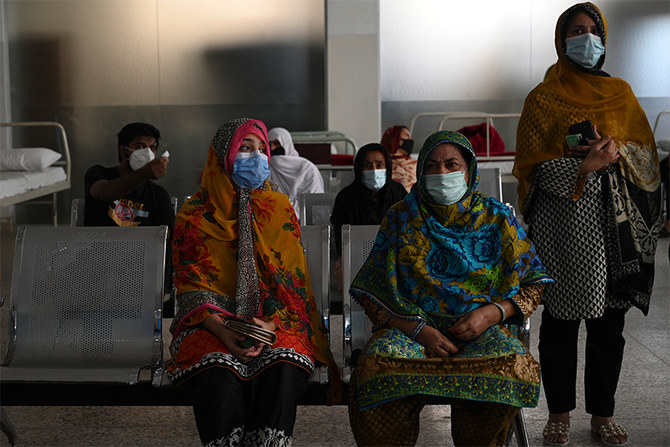
People wait for their turn to get a Covid-19 coronavirus Sinovac vaccine at the Red Crescent vaccination centre in Rawalpindi on May 24, 2021. (AFP)
Short Url
Updated 25 June 2021
Follow

Fourth coronavirus wave may hit Pakistan next month — planning minister

  • Pakistan has been reopening all sectors over a steady decline in coronavirus cases
  • Highly contagious virus variants first reported in the UK, South Africa, Brazil and India are already present in the country

ISLAMABAD: A new wave of the coronavirus pandemic may hit Pakistan in July if health guidelines are not strictly observed, Planning Minister Asad Umar said on Friday.
Pakistan has been reopening all sectors over a steady decline in coronavirus cases and its coronavirus positivity rate is now about 2.3 percent compared to more than 11 percent in April. However social distancing, mask wearing, and other virus protocols are often ignored, raising concerns that the calm may end soon.
The Pakistan Medical Association (PMA) warned last week that without strict implementation of health guidelines, the country would face a fourth wave of the pandemic, as the highly contagious virus variants first reported in the UK, South Africa, Brazil and India are already present in the country.
The planning minister, who heads the National Command and Operation Center (NCOC) that oversees coronavirus response, said he had reviewed the agency’s analyzes on Thursday and the fourth wave may emerge in the country next month.
“Reviewed the artificial intelligence-based disease modeling analysis today in NCOC,” Umar said in a tweet. “In the absence of strong SOP enforcement and continued strong vaccination program, the 4th wave could emerge in Pakistan in July.”

Pakistan started its vaccination drive in February, planning to inoculate 70 million people of its 220 million population by next year. So far, it has administered 14.5 million doses to its citizens, attracting criticism that reaching the vaccination target may take years.


Saudi Wafi Energy signs agreement to supply lubricants to Hyundai vehicles in Pakistan

Updated 28 January 2026
Follow

Saudi Wafi Energy signs agreement to supply lubricants to Hyundai vehicles in Pakistan

  • Wafi Energy Pakistan says Shell Helix HX8 0W-20 AH lubricant specifically caters to Hyundai vehicles’ requirements
  • Lubricant delivers comprehensive engine protection and enhanced fuel efficiency, says Wafi Energy Pakistan 

ISLAMABAD: Saudi company Wafi Energy Pakistan Limited announced on Wednesday that it has inked an agreement with Hyundai’s official manufacturing partner to supply premium lubricants for the company’s vehicles in Pakistan. 

Wafi Energy, an affiliate of the Asyad Group, became the majority shareholder of Shell Pakistan Limited (SPL) in November 2024 and now holds approximately 87.78 percent of the total issued share capital of SPL, one of the oldest multinationals in Pakistan. The SPL has a network of over 600 sites, countrywide storage facilities and a broad portfolio of global lubricant brands.

Hyundai Nishat Motors is a joint venture among three leading international businesses: The Nishat Group, the Japan-based Sojitz Corporation and Millat Tractors Ltd. Hyundai Nishat Motors manufactures, markets and distributes Hyundai’s product line in Pakistan. 

“Wafi Energy Pakistan Limited and Hyundai Nishat Motors have signed a strategic agreement for the supply of Shell lubricants for Hyundai vehicles in Pakistan,” the Saudi company said in a press release.

The contract signing ceremony in Lahore marked the launch of Shell Helix HX8 0W-20 AH, the company said.

Wafi Energy Pakistan said the lubricant is specifically designed in line with Hyundai’s technical specifications. It delivers comprehensive engine protection, enhanced fuel efficiency and optimized performance suited to local driving conditions across Pakistan, the statement said. 

“Shell Helix HX8 0W-20 AH is the second co-branded lubricant introduced under the Hyundai–Shell collaboration in Pakistan, further expanding the jointly developed product range,” Wafi Energy said. 

“Through this collaboration, customers can confidently rely on authentic, OEM-approved lubricants that meet the highest standards of performance and reliability.”

Wafi Energy has two retail stations in Pakistan’s Karachi and Rawalpindi cities. It has also built a 730-foot plastic road outside its Karachi head office using 2.5 tons of waste lubricant bottles.