

Foreign fighters must leave Libya: US official

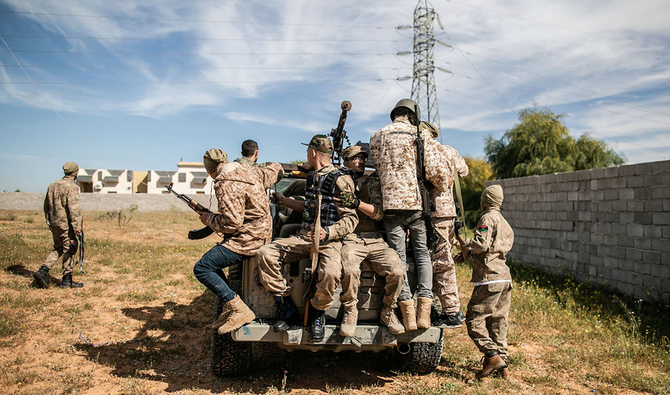
Fighters of Libya's UN-backed Government of National Accord (GNA) during clashes at the Ain Zara frontline, in the southern suburbs of capital Tripoli, with the forces of the Libyan National Army. (AP/File)
Short Url
Updated 24 June 2021
Follow

Foreign fighters must leave Libya: US official

  • US acting assistant secretary of state for Near Eastern affairs was attending Berlin conference on Libya
  • ‘Libyan ceasefire agreement calls for withdrawal of all foreign fighters and mercenaries, no exceptions’

LONDON: The remaining “thousands” of foreign fighters and mercenaries in Libya must leave the country urgently, US Acting Assistant Secretary of State for Near Eastern Affairs Joey Hood said on Thursday at a press briefing attended by Arab News.

Hood was speaking from Berlin, where he was attending a conference on Libya alongside international allies and partners.

The US will “continue to work with our allies to operationalize their (foreign fighters’) departure. Progress on this was made here in Berlin, but obviously there’s much more work to do,” he said.

“The Libyan ceasefire agreement calls for the withdrawal of all foreign fighters and mercenaries, no exceptions … The Libyans are clear: They want everybody out.”

The conference was organized amid plans to hold Libyan elections this December to select a new government. The Libyan state is currently controlled by a government of national unity.

Hood said Prime Minister Abdul Hamid Dbeibeh “represents an effort by the Libyan people and the major political actors to come together and form a government of national unity on an interim basis to bring them toward elections. If you’d asked them a year-and-a-half ago if that was possible, they’d say no.”

He added: “We’ve seen remarkable progress among political actors to stop fighting, to start various committees … and to make important decisions, which has ended the fighting and brought the political actors together to form a government.”

Hood said the conference was aimed at producing a unified, stable and peaceful Libya, and the US has “had contact on the sidelines … with all the major players, including Russia.”

He added that Washington wants to pursue opportunities for cooperation with Moscow and the other influential nations.

“I think there’s space for cooperation here, not just on the humanitarian side but on the security side as well,” he said. “I think we all have an interest in making sure Libya isn’t an exporter of instability.”


Fire from Iran, Lebanon triggers sirens across Israel

Updated 2 min 26 sec ago
Follow

Fire from Iran, Lebanon triggers sirens across Israel

  • Alerts were sounded in Jerusalem, Tel Aviv, Haifa and several other northern regions
  • The Israeli army had noticed a gradual decrease in the number of Iranian missiles launched at Israel since Saturday
JERUSALEM: The Israeli military said it had detected multiple missile barrages from Iran on Wednesday, as well as launches from Lebanon, but added that the number of missiles fired from the Islamic republic at Israel was declining.
AFP journalists heard several blasts and multiple rounds of sirens from Jerusalem, while alerts also sounded in Tel Aviv, central Israel, Haifa and several other northern regions.
“The IDF identified missiles launched from Iran toward the territory of the State of Israel. Defensive systems are operating to intercept the threat,” the military said four times throughout the afternoon and early evening.
In a statement shortly after the first salvo was announced, the military said that “several launches... from Lebanon toward Israeli territory were successfully intercepted” after sirens sounded in central Israel.
The new salvos came on the fifth day of the Middle East war, which began on Saturday with joint US-Israeli strikes on Iran.
Lebanon was dragged into the war on Monday when the Tehran-backed Hezbollah group launched an attack on Israel to “avenge” the killing of Iran’s supreme leader Ayatollah Ali Khamenei, prompting ongoing Israeli air strikes.
Israeli military spokesman Lt. Col. Nadav Shoshani told reporters Wednesday evening that the army had noticed a gradual decrease in the number of Iranian missiles launched at Israel since the start of the war.
“We are speaking about many dozens the first day going down gradually to a few dozen and very low amounts,” he said.
“The barrages are much smaller. Today, some of them weren’t even a barrage, they were just one missile,” he added.
Shoshani said that some projectiles were launched from Iraq too, where some militias act as Iran proxies.
“We’ve seen small amounts of fire coming from Iraq, mostly UAVs (drones), but the vast majority of fire is from Iran and now from Hezbollah,” he said.
Israel’s Magen David Adom (MDA) emergency services said they had evacuated to hospital two people in central Israel with mild injuries, including “a man of about 30 with shrapnel wounds and another casualty with blast injuries.”
Police said in a statement that officers were dispatched to five locations in the Jerusalem area “where various intercepted projectiles had fallen, causing only damage.”
The military said that the “majority of the launches” from Lebanon were intercepted.
Not including Wednesday’s figures, MDA said that since the start of the war its teams had provided medical treatment to 414 casualties including “10 fatalities, 2 seriously injured, 6 moderately injured and 396 lightly injured.”