

Libya sees progress on removal of foreign mercenaries at Berlin talks

1 / 3
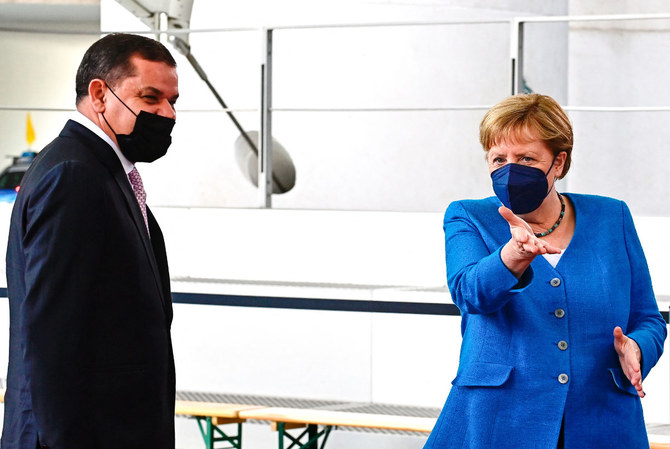
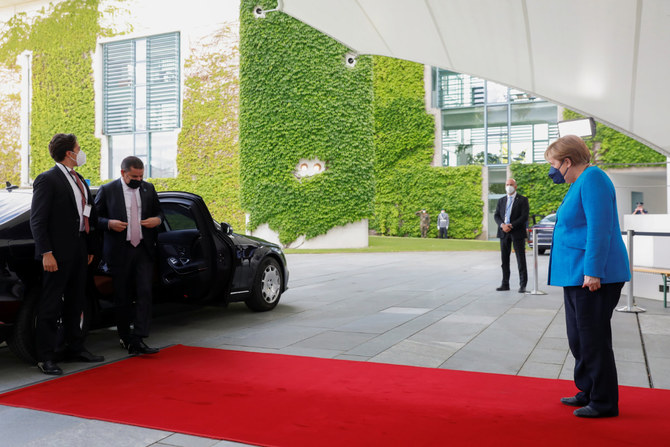
German Chancellor Angela Merkel welcomes Libyan Prime Minister Abdulhamid Dbeibeh at the sidelines of the second Libya summit in Berlin on June 23, 2021. (REUTERS/Michele Tantussi)
2 / 3
German Chancellor Angela Merkel welcomes Libyan Prime Minister Abdul Hamid Dbeibah in Berlin on June 23, 2021, on the sidelines of a new round of Libya peace talks. (AFP / Tobias Schwarz)
3 / 3
French Foreign Minister Jean-Yves Le Drian and Libyan Prime Minister Abdulhamid Mohammed Dbeiba at Wednesday’s Libya conference in Berlin. (GettyImages)/AFP)
Short Url
Updated 24 June 2021
Follow

Libya sees progress on removal of foreign mercenaries at Berlin talks

  • Premier urges parliament to approve election law to allow December election to go ahead

BERLIN: Libya’s foreign minister said on Wednesday international powers had made progress at talks in Berlin on the removal of foreign fighters from the country, although a final communique from the UN-backed conference specified no concrete new measures.

Libya has had little stability since a 2011 NATO-backed uprising against then-head of state Muammar Qaddafi, but a UN-led peace process brought a ceasefire last summer after fighting between rival factions paused.

Wednesday’s meeting in Berlin aimed to make progress on removing mercenaries and other foreign forces from Libya, months after the ceasefire called for their withdrawal, as well as on steps toward securing a December election.

“Hopefully within coming days mercenaries (on) both sides will be withdrawn,” Libya’s Foreign Minister Najla Mangoush told a news conference following the talks.

A senior official at the US State Department said Turkey and Russia, which back opposing sides in Libya, had reached an initial understanding to work toward a target of pulling out 300 Syrian mercenaries from each side of the conflict.

HIGHLIGHT

A US State Department official said it was unrealistic to think a full withdrawal of foreign fighters would come overnight and that it would be a phased approach.

German Foreign Minister Heiko Maas also said he believed there was an understanding between Russia and Turkey on a step-by-step withdrawal of their fighters.

“This will not mean that everybody will take their mercenaries back overnight,” he said. The talks were also attended by US Secretary of State Antony Blinken.

A second State Department official said it was unrealistic to think a full withdrawal of foreign fighters would come overnight and that it would be a phased approach.

“Getting at what we think is one of the key de-stabilizing elements, the presence of these foreign fighters, Syrians, Chadians, Sudanese, that is an important first step and it’s not something we had before,” the official said.

Libyan Prime Minister Abdulhamid Dbeiba called on Libya’s parliament to approve an election law to allow the December election to go ahead and to pass his government’s budget.

“Unfortunately, we have not yet seen the necessary seriousness from the legislative bodies,” he said.


RSF drone strike causes blackout in Sudan’s El-Obeid

Drone strikes are causing huge suffering in Sudan’s Kordofan region. (Reuters)
Updated 5 sec ago
Follow

RSF drone strike causes blackout in Sudan’s El-Obeid

  • North Kordofan state capital El-Obeid lies on a key crossroads that connects RSF-controlled Darfur in the west with the army-controlled east, including the capital Khartoum

KHARTOUM: A paramilitary drone strike on a power plant Tuesday caused a blackout in Sudan’s key Kordofan city of El-Obeid, a local official and an eyewitness told AFP.
“A drone belonging to the Rapid Support Forces bombed the city’s power station early this morning, causing a fire,” an official with the state electricity company said, requesting anonymity because they were not authorized to brief the media. El-Obeid is the largest city in Sudan’s Kordofan region, currently the fiercest battlefield in the war raging between the RSF and the regular army since April 2023.

HIGHLIGHT

For a year, since the army broke a long-running RSF siege, the paramilitary has been trying to encircle the city, including by launching drone strikes and attacking nearby towns.

“I heard an explosion at 2:00 a.m. (0000 GMT) then saw flames coming from the direction of the station,” city resident Awad Ali told AFP. “It’s now past 9:00 a.m. and power isn’t back.”
North Kordofan state capital El-Obeid lies on a key crossroads that connects RSF-controlled Darfur in the west with the army-controlled east, including the capital Khartoum.
For a year, since the army broke a long-running RSF siege, the paramilitary has been trying to encircle the city, including by launching drone strikes and attacking nearby towns.
Recent weeks have seen the army mount a counteroffensive, managing to break the siege on Kordofan’s two other major cities: Dilling and Kadugli, where hundreds of thousands faced mass starvation. Since it began, the war has killed tens of thousands and left around 11 million people displaced, creating the world’s largest hunger and displacement crises.
It has also effectively split the country in two, with the army holding the north, center and east while the RSF and its allies control the west and parts of the south.