

Pakistani Taliban warn women in northwest against working for government, NGOs

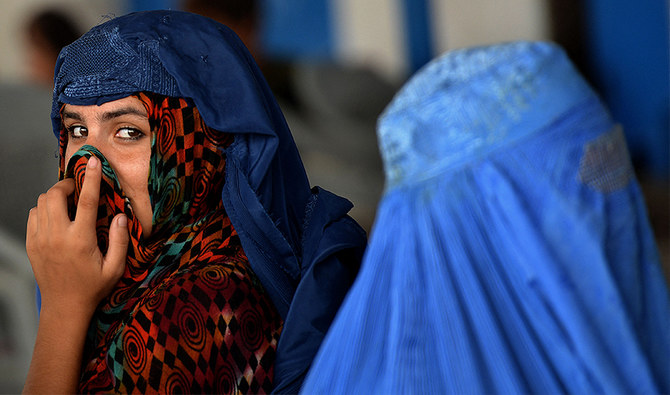
Women wait to board trucks at the United Nations High Commissioner for Refugees (UNHCR) centre on the outskirts of Peshawar on July 28, 2016. (AFP)
Short Url
Updated 25 June 2021
Follow

Pakistani Taliban warn women in northwest against working for government, NGOs

  • Threaten "consequences" if women in North Waziristan take up jobs with government departments
  • In February this year, militants shot dead four female aid workers near a main town in North Waziristan

PESHAWAR: The Pakistani Taliban on Thursday warned women in Pakistan's northwest of "consequences" and meeting their "ultimate fate" if they took up jobs with the government or non-governmental organizations.

The Pakistani Taliban are an umbrella of militant groups called the Tehrik-e-Taliban Pakistan (TTP), which is banned by the Pakistani government and designated a terrorist group by the US. They are a separate entity from the Afghan Taliban.

In February this year, militants shot dead four female aid workers near Mir Ali, a main town in North Waziristan.

“Women are strictly warned not to undertake jobs at any government body or its stooges (NGOs) on the soil of (North) Waziristan, otherwise everyone knows its consequences,” TTP's spokesperson for North Waziristan, Abdul Rehman, said in a statement.

"Females from the adjacent Bannu or other districts continue to work with government or NGOs presumably for public welfare, but they are causing obscenity despite repeated warnings," Rehman said, adding that the women were "under our observation" and "will meet their ultimate fate soon."

TTP has been in disarray in recent years, after Pakistan military operations and US drone strikes targeting their hideouts in North and South Waziristan, but in August announced a reunion with some of its splinters. The group has since stepped up attacks on government troops and installations in tribal regions bordering Afghanistan, rising concerns that the militants are regrouping there.

The war-torn tribal belt remains one of the most underdeveloped areas of Pakistan.

Senior analyst Rustam Shah Mohmand said the TTP was trying to regain grip over the region and building pressure with threats.

"The TTP is now disorganized, desperate and wants to restore its standing," he said. "But people aren’t ready to accept them." 


Pakistan president calls for facilitating trade, business interactions with Iraq

Updated 6 sec ago
Follow

Pakistan president calls for facilitating trade, business interactions with Iraq

  • President Asif Ali Zardari meets Caretaker Iraqi PM Mohammed Shia Al-Sudani in Baghdad
  • Zardari calls for closer cooperation between chambers of commerce of both nations, private sector

ISLAMABAD: President Asif Ali Zardari recently called for facilitating trade and business interactions between Pakistan and Iraq to facilitate cooperation in key sectors of the economy between the two countries, Pakistani state media reported. 

Zardari arrived in Iraq on Saturday for a four-day visit to the country aimed to deepen Pakistan’s bilateral ties with Baghdad. The Pakistani president met Iraqi Caretaker Prime Minister Mohammed Shia Al-Sudani to discuss practical measures to enhance bilateral cooperation, state broadcaster Radio Pakistan reported on Sunday. 

According to the Press Information Department, Pakistan’s exports to Iraq totaled $54.29 million in 2024 while imports from Iraq, primarily petroleum products, amounted to $145.46 million the same year. Analysts have noted that these figures are modest, considering the market sizes and mutual interests of both nations.

“He [Zardari] highlighted priority sectors including information technology, agriculture and food security, construction, pharmaceuticals and medicines,” Radio Pakistan said. 

“The president also stressed the importance of direct banking channels to facilitate trade, business interaction and the movement of pilgrims.”

Every year, thousands of Pakistani pilgrims travel to Iraq to visit some of the most revered shrines in Shia Islam, including the mausoleums of Ali in Najaf and Hussain in Karbala. 

The scale of travel, often involving long stays and cross-border movements, has long posed logistical, security and migration-management challenges for Pakistani authorities and host governments alike.

The president called for improved facilitation for Pakistani pilgrims at immigration points, greater flexibility in emergency travel cases and measures to ease difficulties faced by pilgrims. 

Zardari and Al-Sudani agreed on the importance of maintaining regular high-level exchanges to carry forward bilateral engagement. The Pakistani president spoke of Islamabad’s participation in major trade and health exhibitions in Baghdad, noting these engagements as a step toward sustained business-to-business connectivity.

“He encouraged closer coordination between chambers of commerce and the private sector of both countries through regular exchanges and virtual engagement,” Radio Pakistan said. 

Zardari expressed satisfaction over the steady progress in bilateral defense ties with Iraq, including ongoing training programs and completed defense deliveries.

“He reaffirmed Pakistan’s willingness to further strengthen defense collaboration in line with Iraq’s requirements and evolving security needs,” the state media outlet reported.