

Canada’s Trudeau survives vote of no confidence

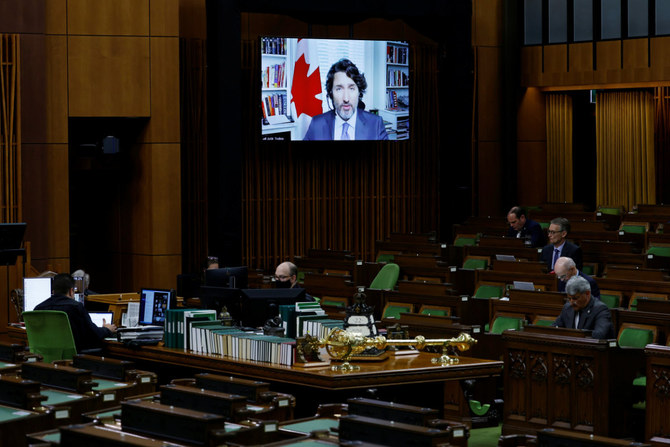
Canada's Prime Minister Justin Trudeau is seen on a screen as he speaks during Question Period in the House of Commons on Parliament Hill in Ottawa on June 22, 2021. (REUTERS/Blair Gable)
Short Url
Updated 24 June 2021
Follow

Canada’s Trudeau survives vote of no confidence

  • The conservative opposition voted together against Trudeau, but he was able to hang with the support of three other smaller blocs in the lower chamber

OTTAWA, Canada: The minority government of Canadian Prime Minister Justin Trudeau survived a parliamentary vote of no confidence Wednesday in a face-off over the proposed budget, eliminating the possibility of early elections this summer.
The House of Commons voted 211 to 121 in favor of approving the budget, which was proposed in April and contains a plan to spend CAN$101.4 billion (69 billion euros) over three years.
The conservative opposition voted together against Trudeau, who was able to hang on thanks to the support of three other smaller blocs in the lower chamber.
The 2021-2022 budget, which began April 1, must still be approved by the Senate — a formality expected Friday, ahead of the summer recess.
After clearing this hurdle — and with Canada’s Covid-19 vaccination campaign progressing rapidly — Trudeau, who enjoys a high approval rating, could be tempted to call for snap elections at the end of the summer in an effort to regain a parliamentary majority, which his Liberal party lost after October 2019’s general election.
The budget’s flagship provision is a CAN$30 billion investment over five years to establish a network of low-cost, high-quality public daycares to encourage the participation of women in the labor market.
Some CAN$17.6 billion are earmarked for green initiatives, including helping companies reduce their carbon footprints and supporting public transport projects in large cities.


China’s top diplomat to visit Somalia on Africa tour

Updated 6 sec ago
Follow

China’s top diplomat to visit Somalia on Africa tour

  • Stop in Mogadishu provides diplomatic boost after Israel became the first country to formally recognize breakaway Somaliland
  • Tour focusses on Beijing's strategic trade ​access across eastern and southern Africa
BEIJING: China’s top diplomat began his annual New Year tour of Africa on Wednesday, focusing on strategic trade ​access across eastern and southern Africa as Beijing seeks to secure key shipping routes and resource supply lines.
Foreign Minister Wang Yi will travel to Ethiopia, Africa’s fastest-growing large economy; Somalia, a Horn of Africa state offering access to key global shipping lanes; Tanzania, a logistics hub linking minerals-rich central Africa to the Indian Ocean; and Lesotho, a small southern African economy squeezed by US trade measures. His trip this year runs until January 12.
Beijing aims to highlight countries it views as model partners of President Xi Jinping’s flagship “Belt and Road” infrastructure program and to expand export markets, particularly in young, increasingly ‌affluent economies such ‌as Ethiopia, where the IMF forecasts growth of 7.2 percent this year.
China, ‌the ⁠world’s ​largest bilateral ‌lender, faces growing competition from the European Union to finance African infrastructure, as countries hit by pandemic-era debt strains now seek investment over loans.
“The real litmus test for 2026 isn’t just the arrival of Chinese investment, but the ‘Africanization’ of that investment. As Wang Yi visits hubs like Ethiopia and Tanzania, the conversation must move beyond just building roads to building factories,” said Judith Mwai, policy analyst at Development Reimagined, an Africa-focussed consultancy.
“For African leaders, this tour is an opportunity to demand that China’s ‘small yet beautiful’ projects specifically target our industrial gaps, ⁠turning African raw materials into finished products on African soil, rather than just facilitating their exit,” she added.
On his start-of-year trip in 2025, ‌Wang visited Namibia, the Republic of Congo, Chad and Nigeria.
His visit ‍to Somalia will be the first by a Chinese foreign minister since the 1980s and is ‍expected to provide Mogadishu with a diplomatic boost after Israel became the first country to formally recognize the breakaway Republic of Somaliland, a northern region that declared itself independent in 1991.
Beijing, which reiterated its support for Somalia after the Israeli announcement in December, is keen to reinforce its influence around the Gulf of Aden, the entrance ​to the Red Sea and a vital corridor for Chinese trade transiting the Suez Canal to Europe.
Further south, Tanzania is central to Beijing’s plan to secure access to Africa’s ⁠vast copper deposits. Chinese firms are refurbishing the Tazara Railway that runs through the country into Zambia. Li Qiang made a landmark trip to Zambia in November, the first visit by a Chinese premier in 28 years.
The railway is widely seen as a counterweight to the US and European Union-backed Lobito Corridor, which connects Zambia to Atlantic ports via Angola and the Democratic Republic of the Congo.
By visiting the southern African kingdom of Lesotho, Wang aims to highlight Beijing’s push to position itself as a champion of free trade. Last year, China offered tariff-free market access to its $19 trillion economy for the world’s poorest nations, fulfilling a pledge by Chinese President Xi Jinping at the 2024 China-Africa Cooperation summit in Beijing.
Lesotho, one of the world’s poorest nations with a gross domestic product of just over $2 billion, ‌was among the countries hardest hit by US President Donald Trump’s sweeping tariffs last year, facing duties of up to 50 percent on its exports to the United States.