

Donations pour in to rebuild Gaza bookshop

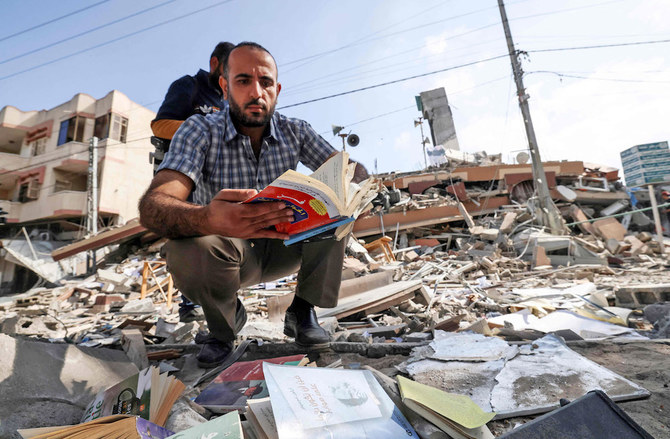
A Palestinian man browses through a book he found amid the rubble of the Kuhail building, which housed Samir Mansour’s bookstore in Gaza City. (AFP)
Short Url
Updated 21 June 2021
Follow

Donations pour in to rebuild Gaza bookshop

  • Over $210,000 raised, tens of thousands of books donated via global campaign
  • Samir Mansour’s shop was destroyed in multiple Israeli airstrikes in May

LONDON: Cash and book donations have flooded in to help rebuild one of Gaza’s largest and oldest bookshops, a two-storey building completely leveled by Israeli attacks.

The Samir Mansour bookshop was hit by multiple airstrikes on May 18, during 11 days of fighting between Israel and Palestinian militants that claimed the lives of around 150 Palestinians.

Founded over two decades ago, the Palestinian-owned shop was a much-loved part of the community.

It contained tens of thousands of books, covering genres from fiction to philosophy and everything in between.

Now a global movement has emerged to rebuild the Gaza treasure, with UK-based online children’s bookseller Books2Door donating 1,000 books.

“Without any hesitation I knew we could help,” said Books2Door founder Abdul Thadha. “We were kindly informed by the fundraisers that Samir had a diverse, eclectic collection, so we hope we have done him proud.”

A fundraiser set up by human rights lawyers Mahvish Rukhsana and Clive Stafford Smith has raised over $210,000, and tens of thousands of books from all over the world have been donated to Mansour’s rebuilding effort.

“Dropping bombs on Samir Mansour’s bookshop is not the worst tragedy to have hit the people of Gaza — but this particular airstrike targeted access to books,” said Rukhsana.

“It was an attack on the knowledge and literacy of this community. Samir lost almost 100,000 books and served schoolchildren and adults alike,” she added. 

“I knew hospitals and roads would receive funding, but secondary cultural institutions such as libraries are often overlooked but equally critical to the community.”

They are hoping to rebuild the bookshop, replace all of Mansour’s 100,000 lost books and create a new project, the Gaza Cultural Center, which would be a new library next door, allowing readers to borrow books without paying.

Rukhsana said in Mansour’s shop, “people were allowed to stay, have tea and read his books for as long as they wanted free of charge without an obligation to purchase … He has decided to use all gently used and some new books to create a true library.”

Mansour told The Guardian that his “heart was burning” when he realized missiles had hit his bookshop.

“The Israeli airstrikes bombed half of the building and my bookshop was in the other half. I wished they would stop … My feet took me a few steps forward, towards the bookshop. The last missile came and destroyed the building,” he said.

“It was six in the morning. I didn’t know what to do. I started searching among the rubble for anything related to my library. But everything was under the rubble,” he added.

“I sat thinking about why my shop was bombed. I did not publish, write, or attack any country or person in my life. I did not spread hatred but spread culture, science and love. I did not find answers to my questions.” But he vowed to “rebuild all over again, no matter what it took from me.”


Iraq says it will prosecute Daesh detainees sent from Syria

Updated 8 sec ago
Follow

Iraq says it will prosecute Daesh detainees sent from Syria

  • Iraq government says transfer was pre-emptive step to protect national security
  • Prosoners have been held for years in prisons and camps guarded by the Kurdish-led SDF
BAGHDAD: Iraq’s Supreme Judicial Council said on Thursday it would begin ​legal proceedings against Daesh detainees transferred from Syria, after the rapid collapse of Kurdish-led forces in northeast Syria triggered concerns over prison security.
More than 10,000 members of the ultra-hard-line militant group have been held for years in about a dozen prisons and detention camps guarded by the Kurdish-led Syrian Democratic Forces (SDF) in Syria’s northeast.
The US military said on Tuesday its forces had transferred 150 Daesh detainees from Syria to Iraq and that the operation could eventually see up to 7,000 detainees moved out of Syria.
It cited concerns over security at the prisons, which also hold thousands more women and children with ties to the militant group, after military setbacks ‌suffered by the ‌SDF.
A US official told Reuters on Tuesday that about 200 low-level ‌Daesh ⁠fighters ​escaped from ‌Syria’s Shaddadi prison, although Syrian government forces had recaptured many of them.
Iraqi officials said Prime Minister Mohammed Shia Al-Sudani mentioned the transfer of Daesh prisoners to Iraq in a phone call with Syrian President Ahmad Al-Sharaa on Tuesday, adding that the transfers went ahead following a formal request by the Iraqi government to Syrian authorities.
Iraqi government spokesperson Basim Al-Awadi said the transfer was “a pre-emptive step to protect Iraq’s national security,” adding that Baghdad could not delay action given the rapid pace of security and political developments in Syria.
Daesh emerged in Iraq and Syria, and at the ⁠height of its power from 2014-2017 held swathes of the two countries. The group was defeated after a military campaign by ‌a US-led coalition.
An Iraqi military spokesperson confirmed that Iraq had received ‍a first batch of 150 Daesh detainees, including ‍Iraqis and foreigners, and said the number of future transfers would depend on security and field assessments. The ‍spokesperson described the detainees as senior figures within the group.
In a statement, the Supreme Judicial Council said Iraqi courts would take “due legal measures” against the detainees once they are handed over and placed in specialized correctional facilities, citing the Iraqi constitution and criminal laws.
“All suspects, regardless of their nationalities or positions within the terrorist ​organization, are subject exclusively to the authority of the Iraqi judiciary,” the statement said.
Iraqi officials say under the legal measures, Daesh detainees will be separated, with senior figures including foreign nationals to ⁠be held at a high-security detention facility near Baghdad airport that was previously used by US forces.
Two Iraqi legal sources said the Daesh detainees sent from Syria include a mix of nationalities, with Iraqis making up the largest group, alongside Arab fighters from other countries as well as European and other ‌Western nationals.
The sources said the detainees include nationals of Britain, Germany, France, Belgium and Sweden, and other European Union countries, and will be prosecuted under Iraqi jurisdiction.