TOKYO: The Tokyo Olympics will allow some local fans to attend when the games open in just over a month, organizing committee officials and the IOC said on Monday.
Organizers set a limit of 50% of capacity up to a maximum of 10,000 fans for all Olympic venues.
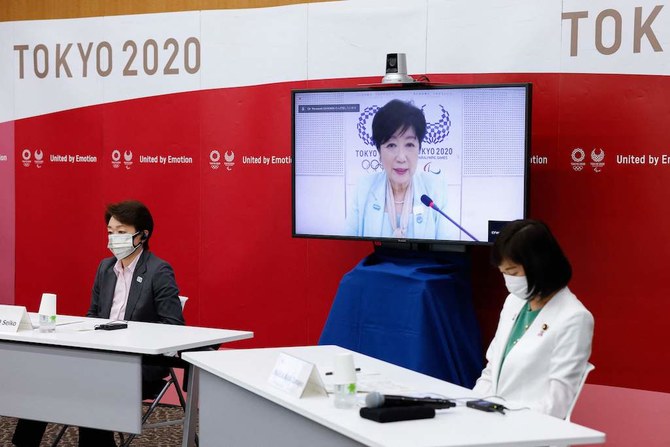
The decision was announced after so-called Five Party talks online with local organizers, the International Olympic Committee, the International Paralympic Committee, the Japanese government and the government of metropolitan Tokyo.
The decision contradicts the country’s top medical adviser, Dr. Shigeru Omi, who recommended last week that the safest way to hold the Olympics would be without fans. He had previously called it “abnormal” to hold the Olympics during the pandemic.
The Tokyo Games are set to open on July 23.
Fans from abroad were banned several months ago. Officials say local fans will be under strict rules. They will not be allowed to cheer, must wear masks, and are being told to go straight home afterward.
Organizers say between 3.6-3.7 million tickets are in the hands of Japanese residents.
Having fans in the venues presents a risk of spreading the COVID-19 infections, and not just at the venues, since it causes more circulation on commuter trains, in restaurants and other public spaces.
Tokyo and other areas are under “quasi-emergency” status until July 11. This replaced a tougher full state of emergency that was in effect until last weekend. The new rules will allow restaurants to serve alcohol during limited hours.
Prime Minister Yoshihide Suga, who has favored allowing fans, said before the official announcement that he would bar fans if conditions change.
“If a state of emergency is necessary, I will be flexible and open to no fans in order to achieve that the games give top priority to safety and security for the people,” Suga said. ”In case of a state of emergency, it is quite possible ... for safe and secure (games) I will not hesitate to have no fans.”
He said he took “seriously” Omi’s recommendations but did not follow them.
Tokyo Governor Yuriko Koike also said before the the talks that fans may need to be banned if conditions changes.
“Under this COVID-19 pandemic, people in Tokyo, people in Japan, are feeling very uneasy. We have concerns and the experts are also making recommendations about the risk of spreading the infection,” Koike said. “If there should be a major change in the sanitary situation, or infection situation, we need to revisit this matter among ourselves and we may need to consider the option of having no spectators in the venues.”
In recent polls, support seems to be increasing for holding the Olympics, though opposition is strong, depending how the question is worded. An Asahi newspaper poll of June 19-20 of almost 1,500 people showed 62% supported another postponement or cancellation of the games. But about one-third supported holding the Olympics, up from 14% in May in the same poll.
In the same survey, 83% said they “feel uneasy” that the Olympics might spread the virus. The poll said 53% wanted no fans and 42% said attendance should be limited.
The seven-day average for new infections in Tokyo is about 400 daily. The curve has flattened but health officials fear the Olympics and new variants will drive it up.
About 6.5% of Japanese are fully vaccinated, and 16.5% have had at least one shot, according to figures from the prime minister’s office. More than 14,000 deaths in Japan have been attributed to COVID-19.


10,000-fan cap for Tokyo Olympics: organisers
https://arab.news/wkmur
10,000-fan cap for Tokyo Olympics: organisers


Spain will host 2030 World Cup final, says RFEF president
- Louzan did not say whether the match would be played at Santiago Bernabeu or Camp Nou
- Once completed in late 2028, the new stadium in Morocco is expected to hold 115,000 spectators
MADRID: Spanish Football Federation (RFEF) President Rafael Louzan has said that Spain will stage the final of the 2030 World Cup, which will be co-hosted by Spain, Portugal and Morocco.
Morocco wants to stage the game in Casablanca at the Grand Stade Hassan II, a huge stadium currently under construction north of the city.
“Spain has proven its organizational capacity over many years. It will be the leader of the 2030 World Cup and the final of that World Cup will be held here,” Louzan said late on Monday at an event organized by the Madrid Sports Press Association.
Louzan did not say whether the match would be played at Madrid’s Santiago Bernabeu or Barcelona’s Camp Nou, the two leading candidates.
Once completed in late 2028, the new stadium in Morocco is expected to hold 115,000 spectators. Morocco’s Royal Football Federation (FRMF) President Faouzi Lekjaa last year expressed his wish to see a final against Spain in Casablanca.
Louzan also alluded to the challenges Morocco faced during its hosting of the last Africa Cup of Nations, including the chaotic scenes during the final between Senegal and Morocco this month.
That match, which Senegal won 1-0, was overshadowed by fan disruptions and player protests that temporarily halted play.
“Morocco is really undergoing a transformation in every sense, with magnificent stadiums,” Louzan said. “We must recognize what has been done well. But in the Africa Cup of Nations, we have seen scenes that damage the image of world football.”
FIFA and the Portuguese and Moroccan football federations have not responded to requests for comment on the final’s location.
FIFA told Reuters last year it was premature to decide the venue for the 2030 final, saying the host city for the 2026 World Cup final was revealed only two years before the tournament. World soccer’s ruling body has the final say on where the match will be played.


