

Nuclear deal talks will not be open-ended, Iran warned

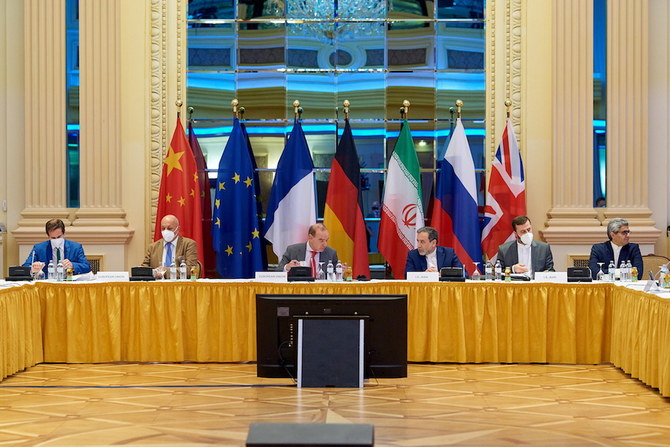
EEAS Deputy Secretary General Enrique Mora and Iranian Deputy at Ministry of Foreign Affairs Abbas Araghchi wait for the start of talks on reviving the 2015 Iran nuclear deal in Vienna. (Reuters)
Short Url
Updated 21 June 2021
Follow

Nuclear deal talks will not be open-ended, Iran warned

  • The longer Iran produces banned nuclear material, the harder it becomes to restore the pact, say Western officials
  • Israeli Prime Minister Naftali Bennett called on world powers to “wake up”

VIENNA: Western officials warned Tehran on Sunday that negotiations to revive its nuclear deal could not continue indefinitely, after the sides announced a break following the election of a new hard-line president in Iran.

Negotiations have been ongoing in Vienna since April to work out how Iran and the US can both return to compliance with the nuclear pact, which Washington abandoned in 2018 under then-President Donald Trump, and Iran subsequently violated.

Sunday’s pause in the talks came after Ebrahim Raisi, a hard-liner and fierce critic of the West, won Iran’s presidential election on Friday with 62% of the vote amid a historically low voter turnout.

Raisi will take office in early August, replacing Hassan Rouhani, under whom Tehran struck the deal agreeing to curbs to its nuclear program in return for the lifting of international sanctions.

Iranian and Western officials alike say Raisi’s rise is unlikely to alter Iran’s negotiating position: Ayatollah Ali Khamenei already has final say on all major policy.

The Western countries say the longer Iran violates the deal and produces banned nuclear material, the harder it becomes to restore the pact.

Talks on reviving a 2015 nuclear deal between Iran and six world powers cannot continue indefinitely and a decision needs to be made soon, a senior diplomat from the ‘E3’ grouping of France, Germany and Britain said on Sunday.

“We continue to make progress but we still need to resolve the most difficult issues. As we have stated before, time is on nobody’s side. These talks cannot be open ended,” the diplomat said

“Delegations will now travel to capitals in order to consult with their leadership. We urge all sides to return to Vienna and be ready to conclude a deal. The time for decision is fast approaching.”

US National Security Adviser Jake Sullivan echoed those comments telling broadcaster ABC News that there was still “a fair distance to travel,” including on sanctions and on the nuclear commitments that Iran has to make.

On Sunday, Israel’s new Prime Minister Naftali Bennett said a Raisi government would be a “regime of brutal hangmen” with which world powers should not negotiate a new nuclear accord.

Bennett opened his first Cabinet meeting by slamming Raisi and calling on world powers to “wake up” to the perils of returning to a nuclear agreement with Tehran.

Bennett said Ayatollah Ali Khamenei had chosen the “hangman of Tehran” to be the country’s next president, a man “infamous among Iranians and across the world for leading the death committees that executed thousands of innocent Iranian citizens throughout the years.”

He said Raisi’s election was “the last chance for the world powers to wake up before returning to the nuclear agreement and to understand who they’re doing business with. These guys are murderers, mass murderers.”

* With AP and Reuters

Battle for the Nile
How will Egypt be impacted by Ethiopia filling its GERD reservoir ?

Enter


keywords

Israeli Druze leader says Syrian community ‘besieged’ months after clashes

Updated 12 sec ago
Follow

Israeli Druze leader says Syrian community ‘besieged’ months after clashes

  • “They aren’t allowed to bring in any humanitarian aid, including the aid we’re trying to deliver,” Sheikh Mowafaq Tarif told AFP
  • Clashes erupted last July in southern Syria between Druze fighters and Sunni Bedouin tribes

JULIS, Israel: Seven months after deadly clashes between Syria’s Druze minority and government-backed forces, the spiritual leader of Druze in neighboring Israel said members of the community across the border remained in peril.
“They’re still besieged — completely encircled. They aren’t allowed to bring in any humanitarian aid, including the aid we’re trying to deliver,” Sheikh Mowafaq Tarif told AFP in an interview this week.
The cleric spoke in Julis, a quiet Druze village in northern Israel, where the community has set up an “emergency room” to coordinate aid efforts for Druze in Syria.
Israeli and Druze flags hang on the walls of the room, alongside posters in Hebrew and Arabic calling for an end to the killing of Syrian Druze.
The Druze are followers of an esoteric religion that split from Shiite Islam centuries ago. Its adherents are spread across parts of Syria, Israel, Lebanon and the Israeli-occupied Golan Heights.
Clashes erupted last July in southern Syria between Druze fighters and Sunni Bedouin tribes.
The Syrian authorities said their forces intervened to stop the clashes, but witnesses and monitors accused them of siding with the Bedouin.
Israel bombed Syria during the violence, saying it was acting to defend the minority group.
The Syrian Observatory for Human Rights said the fighting left more than 2,000 people dead, including 789 Druze civilians who were “summarily executed by defense and interior ministry personnel.”
The UN Office for the Coordination of Humanitarian Affairs estimated that some 187,000 people were displaced by the violence.
- ‘Why not let them return?’ -

“There are still more than 120,000 people displaced from their homes,” Sheikh Tarif said.
“Thirty?eight villages have been captured, and residents aren’t allowed to return. There are more than 300 captives, including children and women.”
AFP was unable to verify those claims.
Although a ceasefire was reached in July, access to Sweida remains difficult.
Residents accuse the government of imposing a blockade on the province, which Damascus denies. Several aid convoys have entered since then.
“Why not let them return to their villages? We’re in the depths of winter and that is a mountainous area. It’s very cold,” Tarif said.
With Syria’s government and Kurdish-led forces agreeing last month to integrate Kurdish fighters and civil institutions into state structures, Sweida is the last major area outside Damascus’s control.
Tarif said the community did not need government security forces in the region.
“The Druze have forces capable of defending themselves and maintaining order,” he said, referring to Syrian government forces as jihadists and “Islamic State members.”
Many in Syria remain wary of Sharaa, given that the jihadist group he once led started out as an Al-Qaeda affiliate and many of its former members are in his government.
Israel’s leaders have repeatedly referenced Sharaa’s jihadist past in calling for the West not to legitimize him.
Nevertheless, Israel and Syria, which have no official diplomatic ties, have held several rounds of direct talks in recent months.
Following negotiations in January, and under US pressure, both sides agreed to set up an intelligence?sharing mechanism as they moved toward a security agreement.
One issue under discussion is the possibility of Syrian Druze working in Israel.
Sheikh Tarif confirmed “that is something we have heard” and added that he wished any Syrian could come to work as a daily laborer “because the (economic) situation in Syria is very difficult.”
He also called for Druze across the Middle East to be able to visit their religious sites in neighboring countries, “just as our Christian and Muslim brothers visit their holy places” in states with which they may not have diplomatic relations.
“The Druze also deserve to access and pray at our holy sites in Syria and Lebanon and for them to come visit our holy places” in Israel, he said.