

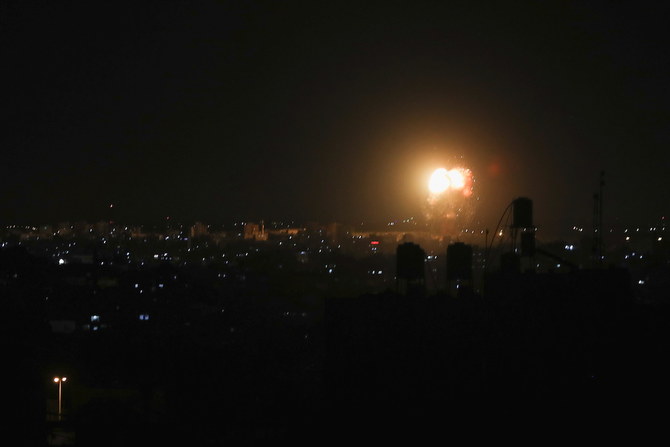

GAZA CITY: Gazans had hardly recovered from the sound of the explosions during the 11-day war between Israel and the Gaza Strip when they returned less than a month later.
The Israeli bombing of Hamas military training sites in the Gaza Strip on Thursday night was in response to incendiary and explosive balloons launched toward neighboring Israeli towns. There were no immediate reports of casualties.
The helium-filled balloons are intended to set fire to farmland and bush surrounding the Gaza enclave.
Tensions have remained high since the ceasefire on May 21.
The explosions in the Gaza Strip brought back fears of a military escalation, especially in light of the Israeli restrictions in place since May.
Israel have kept the two crossings with the Gaza Strip, Kerem Shalom for commerce and Erez for individuals, semi-closed, only allowing food and some other items, as well as medical emergencies.
The closure of the two crossings severely affected the daily lives of Gazans, stopping the flow of goods to shops of all kinds and mail between Gaza and the West Bank and the outside world, including thousands of passports printed in Ramallah, as well as visas, making it hard for merchants to travel.
Iman Shaheen, 33, who suffers from breast cancer, said: “I am waiting to get my passport, the application for which I sent to Ramallah before the war, but the mail has stopped since then, preventing me from completing the process of traveling to Jordan for treatment. I follow the news daily and wait impatiently for the crossing to be re-opened for mail.”
Israel also prevents construction materials from entering the Gaza Strip, which affects the reconstruction process war, prevents fuel from entering the power plant and blocks Qatari grants to poor families.
Hamas and Israel reached an agreement to facilitate the entry of Qatari funds and increase the capacity of the Kerem Shalom crossing, and to allow some materials that it classifies as dual-use in exchange for stopping the demonstrations along the border, known as the Great Return March, which lasted for about two years.
Hamas spokesman Hazim Qassem tweeted that the bombing of the Gaza Strip “is a failed attempt to stop the solidarity of our people and the resistance with the Holy City” (Jerusalem), and to “cover up the unprecedented state of confusion of the Zionist establishment” by organizing the so-called Flags March.
Hamas military wings seem to have limited patience over the Israeli bombing.
Khader Habib, an Islamic Jihad official, said that “the resistance factions informed Egypt in a message that they would respond in kind to any upcoming military attacks, and would not allow the occupation government (Israel) to impose its conditions on the resistance or isolate Gaza.
“The joint operations room of the resistance factions has crystallized a final and unified position to deal with the repetition of Israeli behavior in the coming days, and it will not hesitate to confront it, whatever the results.
“The launching of incendiary and explosive balloons from the Gaza Strip toward Israeli towns is linked to the occupation’s continued imposition of the siege on the Gaza Strip and its closure of the crossings for more than a month and a half.”
However, commentators have said that Hamas and the other factions will not be in a hurry to return to war again.
Mukhaimar Abu Saada, a professor of political science at Al-Azhar University in Gaza, said: “Hamas needs to restore what was destroyed in the last war, whether at the level of its military capabilities or the reconstruction of the Gaza Strip and use this opportunity for funds to enter the Gaza Strip.”
Husam Al-Dajani, a political analyst, said: “The resistance factions do not want to return to military confrontation again, but if the reality remains unchanged on the ground, things may escalate in the Gaza Strip.”
Al-Dajani believes that Hamas’ failure to respond to the Israeli bombardment is “to give the mediators an opportunity to put pressure on Israel and improve living conditions in the Gaza Strip.”


