

Turkey begins construction of fourth warship for Pakistan Navy at Karachi shipyard 

Group photo shows Pakistani Chief of the Naval Staff, Admiral Muhammad Amjad Khan Niazi (eighth from right), with Pakistani and Turkish navy officials in Karachi, Pakistan, on June 15, 2021. (Photo courtesy: Pakistan Navy)
Short Url
Updated 17 June 2021
Follow

Turkey begins construction of fourth warship for Pakistan Navy at Karachi shipyard 

  • Contract for four MILGEM class corvettes was signed with Turkey in 2018
  • Induction of ships will significantly enhance maritime defense, deterrence capability, Pakistan Navy says 

ISLAMABAD: Turkey this week began construction of a Turkey-made small warship called the corvette in the southern port city of Karachi to be supplied to the Pakistan Navy.
On May 10, 2017, Turkey and Pakistan signed a memorandum of understanding for the sale of four Turkish made corvette warships and 52 Pakistan-made training planes for Ankara’s armed forces. Ankara described it as Turkey’s biggest single military export deal and “a very important day” for the defense industry.
Under the deal, the Karachi Shipyard (KS&EW) would buy four corvettes made under Turkey’s MILGEM warship program, aimed at designing and building locally a fleet of multipurpose corvettes and frigates that will replace older ships.
“Pakistan Navy has concluded a contract with M/s ASFAT for construction of 04 x corvettes out of which two are being constructed at Istanbul Naval Shipyard whereas the remaining two at Karachi Shipyard and Engineering Works,” Pakistan Navy said in a statement on June 15.
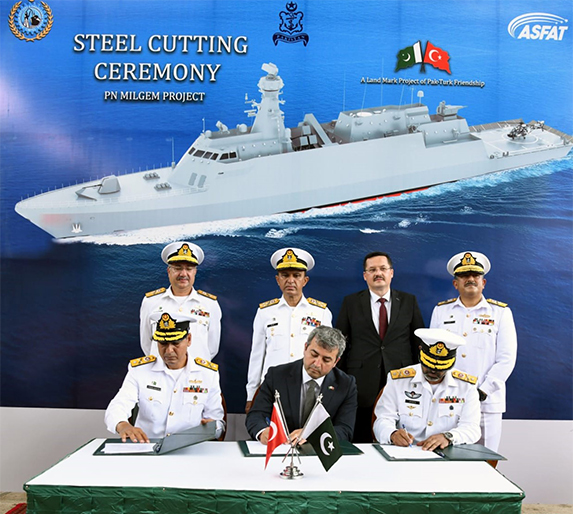


Officials from the Pakistan and Turkish navy sign a memorandum of understanding for the sale of four Turkish-made corvette warships and 52 Pakistan-made training planes in Karachi, Pakistan, on June 15, 2021. (Photo courtesy: Pakistan Navy)

The contract for four MILGEM class corvettes for the Pakistan Navy with transfer of technology was signed with ASFAT Inc, a Turkish state owned defense contractor in 2018.
“These corvettes will be fitted with state-of-art Surface, Sub-Surface and Anti-Air Weapons & Sensors, integrated through an advanced Network Centric Combat Management System,” the navy statement said. “It is a historic occasion as Ministry of Defense Production, Pakistan Navy, Karachi Shipyard and M/s ASFAT of Turkey have joined hands for construction of this Corvette.”
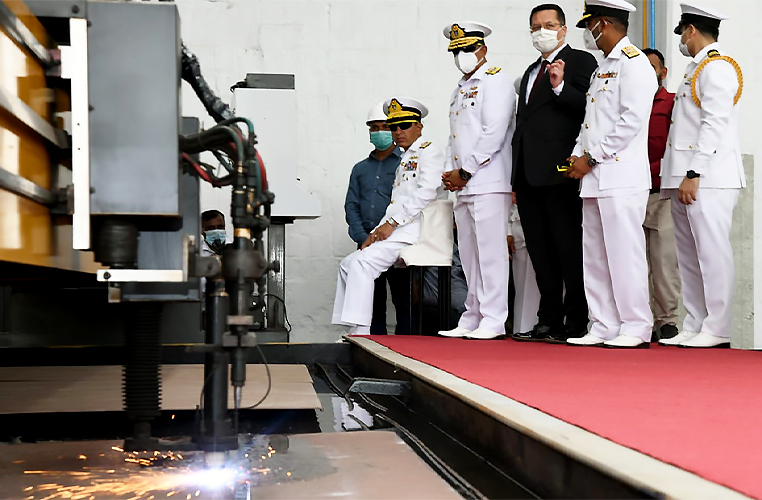


Pakistan's Chief of the Naval Staff, Admiral Muhammad Amjad Khan Niazi (first from left), observes the making of the Turkey-made small warship under the MILGEM program at the Karachi port in Pakistan, on June 15, 2021. (Photo courtesy: Pakistan Navy)

Pakistan Navy said the induction of the corvettes would significantly enhance the force’s maritime defense and deterrence capabilities: “These corvettes will become a core element of PN’s kinetic response to traditional and non-traditional challenges and to maintain balance of power in the Indian Ocean Region.”


Pakistan accuses India of manipulating Chenab flows, seeks clarification under Indus Waters Treaty

Updated 8 sec ago
Follow

Pakistan accuses India of manipulating Chenab flows, seeks clarification under Indus Waters Treaty

  • Foreign office spokesperson says sudden variations in river flows threaten agriculture, food security and livelihoods downstream
  • He also condemns a hijab-removal incident in India, calling it part of a broader pattern of religious intolerance and Islamophobia

ISLAMABAD: Pakistan said on Thursday it had observed abrupt variations in the flow of the River Chenab during the ongoing month, accusing India of manipulating river flows at a critical point in the agricultural cycle and saying it had written to New Delhi seeking clarification.

Local media reported quoted Pakistani officials as saying India released about 58,000 cusecs of water at Head Marala on Dec. 7–8 before sharply reducing flows to roughly 870–1,000 cusecs through Dec. 17, far below the 10-year historical average of 4,000–10,000 cusecs for this period.

Pakistan’s Foreign Office spokesman Tahir Andrabi told a weekly media briefing in Islamabad India had failed to share prior information or operational data on the Chenab flows, a practice he said New Delhi had previously followed under the 1960 Indus Waters Treaty. New Delhi said earlier this year it had put the treaty “in abeyance” following a gun attack in Indian-administered Kashmir that it blamed on Pakistan, a charge Islamabad denied, calling instead for an impartial and transparent international investigation.

Pakistan also described India’s unilateral suspension of the treaty as a violation of international law and an “act of war.”

“Pakistan would like to reiterate that the Indus Waters Treaty is a binding international agreement, which has been an instrument of peace and security and stability in the region,” Andrabi said. “Its breach or violation, on one hand, threatens the inviolability of international treaties in compliance with international law, and on the other hand, it poses serious threats to regional peace, principles of good neighborliness, and norms governing interstate relations.”

Andrabi said Pakistan viewed the sudden variations in the Chenab’s flow with “extreme concern and seriousness,” saying the country’s Indus Waters Commissioner had written to his Indian counterpart seeking clarification in line with procedures outlined in the treaty.

“Any manipulation of river flow by India, especially at a critical time of our agricultural cycle, directly threatens the lives and livelihoods, as well as food and economic security of our citizens,” he continued. “We call upon India to respond to the queries raised by Pakistan.”

He said Pakistan had fulfilled its obligations under the Indus Waters Treaty and urged the international community to take note of India’s “continued disregard” of a bilateral treaty and to counsel New Delhi to act responsibly under international law.

Andrabi maintained Pakistan remained committed to peaceful resolution of disputes with India but would not compromise on its water rights.

In the same briefing, he also condemned an incident in which the chief minister of the Indian state of Bihar was seen in a video forcibly removing the hijab of a Muslim woman during a public interaction, followed by remarks by a minister in Uttar Pradesh who mocked the episode, saying it reflected a broader pattern of religious intolerance and Islamophobia and warranted strong condemnation.