

North American oil service firms’ pricing and hiring on the upswing

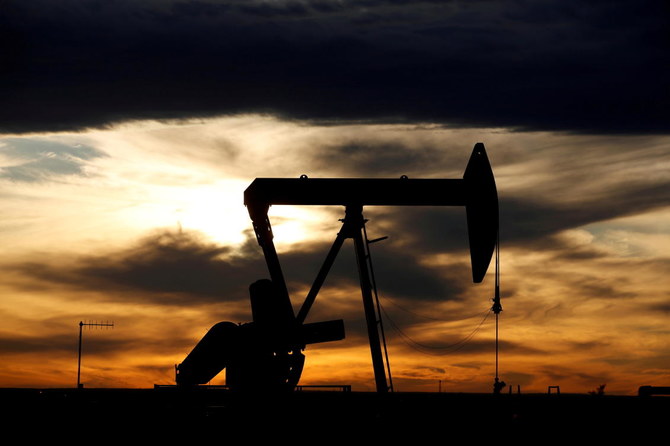
The sun sets behind a crude oil pump jack on a drill pad in the Permian Basin in Loving County. (File/Reuters)
Short Url
Updated 17 June 2021
Follow

North American oil service firms’ pricing and hiring on the upswing

  • US shale output is expected to rise by 38,000 barrels per day next month
  • Some rig day rates have risen by $1,000 a day

DENVER: As oil climbs above $70 a barrel for the first time in almost three years, oilfield firms are reporting prices for their services and equipment have bottomed and many are fielding more calls for jobs.
US crude production, which plummeted during the coronavirus pandemic, is ticking back up, despite generally flat spending by oil and gas producers. US shale output is expected to rise by 38,000 barrels per day next month, halting earlier drops.
Companies report drilling and well completions activity and pricing are edging higher, especially for those with specialized services or more productive equipment. Roughnecks also say they are seeing an increase in job offers, with companies competing for skilled workers.
“We are already beginning to see a positive increase in activity and an upturn in service pricing will hopefully be reflected in the coming months,” said Stuart Wilson, chief executive of service firm Packers Plus Energy Services.
Still, there is a long way to go. The pandemic hammered the industry last year as some were just regaining their pricing power, Wilson said. His company is seeing strong demand for its premium completions equipment for oil and gas wells.

OPTIMISM REBOUNDS
“Operators appear to be a lot more optimistic and considering projects that have lay dormant the previous year,” he said. “We are seeing more orders being confirmed at pricing levels that are more comparable to pre-pandemic levels,” he added.
Providers of advanced drilling rigs, tubular goods and chemicals are gingerly pushing up invoices, according to analysts and market participants.
Pricing power is returning “especially in niches like high-spec onshore drilling rigs,” said Josh Young, chief investment officer of energy investor Bison Interests. There has been a $1,000 per day increase in dayrates for such US rigs with more to come, he said.
Ensign Energy Services forecasts a $2,000 to $3,000 per day increase in rig dayrates in Canada into the autumn as supply and demand tightens, the company said at an RBC Capital Markets conference this month. In the United States, the second quarter will be the bottom for cash margins, the company said.

JOB FAIRS RETURN
The shift is evident in employment with firms hiring again. Oilfield workers are reporting job offers from employers including Schlumberger and Halliburton.
Liberty Oilfield Services this month held a job fair in Henderson, Colorado. It also is hiring wireline operators in Texas, Louisiana, Oklahoma, Wyoming and West Virginia, according to LinkedIn.
US oilfield jobs increased in May by 1.6 percent, or about 9,700 positions, according to trade group Energy Workforce & Technology Council (Council). Some 27,000 oilfield jobs have been regained since February.
To break out of the downturn, service firms need higher pricing to help meet environmental and sustainability goals, according to Leslie Shockley Beyer, of the Council.
“Their margins have to be healthy enough to re-invest,” Beyer said.


First EU–Saudi roundtable on critical raw materials reflects shared policy commitment

Updated 16 January 2026
Follow

First EU–Saudi roundtable on critical raw materials reflects shared policy commitment

RIYADH: The EU–Saudi Arabia Business and Investment Dialogue on Advancing Critical Raw Materials Value Chains, held in Riyadh as part of the Future Minerals Forum, brought together senior policymakers, industry leaders, and investors to advance strategic cooperation across critical raw materials value chains.

Organized under a Team Europe approach by the EU–GCC Cooperation on Green Transition Project, in coordination with the EU Delegation to Saudi Arabia, the European Chamber of Commerce in the Kingdom and in close cooperation with FMF, the dialogue provided a high-level platform to explore European actions under the EU Critical Raw Materials Act and ResourceEU alongside the Kingdom’s aspirations for minerals, industrial, and investment priorities.

This is in line with Saudi Vision 2030 and broader regional ambitions across the GCC, MENA, and Africa.

ResourceEU is the EU’s new strategic action plan, launched in late 2025, to secure a reliable supply of critical raw materials like lithium, rare earths, and cobalt, reducing dependency on single suppliers, such as China, by boosting domestic extraction, processing, recycling, stockpiling, and strategic partnerships with resource-rich nations.

The first ever EU–Saudi roundtable on critical raw materials was opened by the bloc’s Ambassador to the Kingdom, Christophe Farnaud, together with Saudi Deputy Minister for Mining Development Turki Al-Babtain, turning policy alignment into concrete cooperation.

Farnaud underlined the central role of international cooperation in the implementation of the EU’s critical raw materials policy framework.

“As the European Union advances the implementation of its Critical Raw Materials policy, international cooperation is indispensable to building secure, diversified, and sustainable value chains. Saudi Arabia is a key partner in this effort. This dialogue reflects our shared commitment to translate policy alignment into concrete business and investment cooperation that supports the green and digital transitions,” said the ambassador.

Discussions focused on strengthening resilient, diversified, and responsible CRM supply chains that are essential to the green and digital transitions.

Participants explored concrete opportunities for EU–Saudi cooperation across the full value chain, including exploration, mining, and processing and refining, as well as recycling, downstream manufacturing, and the mobilization of private investment and sustainable finance, underpinned by high environmental, social, and governance standards.

From the Saudi side, the dialogue was framed as a key contribution to the Kingdom’s industrial transformation and long-term economic diversification agenda under Vision 2030, with a strong focus on responsible resource development and global market integration.

“Developing globally competitive mineral hubs and sustainable value chains is a central pillar of Saudi Vision 2030 and the Kingdom’s industrial transformation. Our engagement with the European Union through this dialogue to strengthen upstream and downstream integration, attract high-quality investment, and advance responsible mining and processing. Enhanced cooperation with the EU, capitalizing on the demand dynamics of the EU Critical Raw Materials Act, will be key to delivering long-term value for both sides,” said Al-Babtain.

Valere Moutarlier, deputy director-general for European industry decarbonization, and directorate-general for the internal market, industry, entrepreneurship and SMEs at European Commission, said the EU Critical Raw Materials Act and ResourceEU provided a clear framework to strengthen Europe’s resilience while deepening its cooperation with international partners.

“Cooperation with Saudi Arabia is essential to advancing secure, sustainable, and diversified critical raw materials value chains. Dialogues such as this play a key role in translating policy ambitions into concrete industrial and investment cooperation,” she added.