

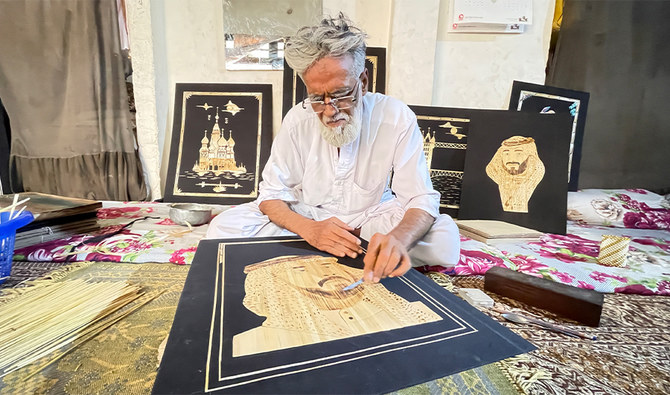

PESHAWAR: Known for his calligraphy and Mughal imagery, a master craftsman from northwestern Pakistan has recently turned to an ancient technique rarely used in portraiture to create an image of Saudi Crown Prince Mohammed bin Salman.
For decades, Syed Abid Shah from Peshawar has been practicing and developing straw painting — a Chinese folk art that dates back at least two thousand years to the Han dynasty. The laborious technique, which today has few practitioners, requires the artist to trim, dye and polish dried wheat stalks and then weave them into an image on a canvas.
Shah learnt the art in Karachi at the age of 12 when he was introduced to a straw painter by an artistically inclined uncle.
After serving two years as the artist’s apprentice, he started introducing innovations to the art, focusing mostly on architecture, Islamic ornaments or stories from the Mughal era. He did not venture into portraiture as the straw medium was rarely used for that.
But for the Saudi crown prince, Shah, now 60, says he has decided to create a detailed straw portrait.
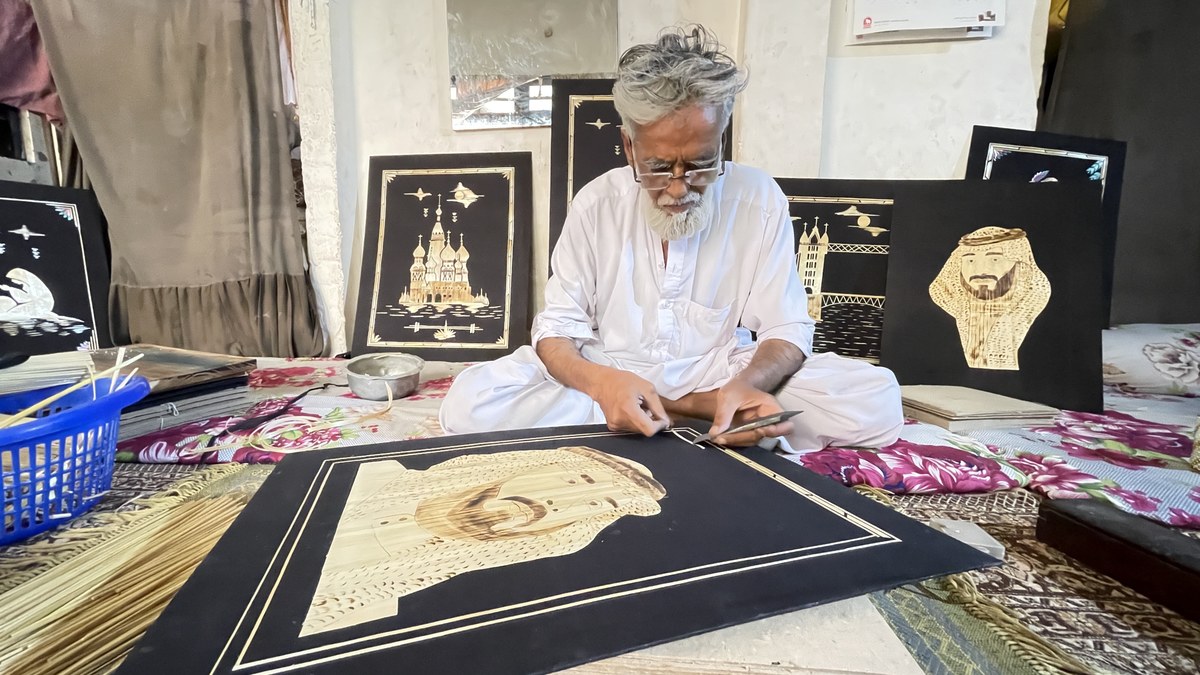
Syed Abid Shah adds final touches to a straw painting of Saudi Crown Prince Mohammed bin Salman in Peshawar, Pakistan, on June 15, 2021. (AN photo)
“I had long wanted to draw a sketch of a Saudi royalty, but it was only recently that I finally decided to draw the image of the prince who rose to fame across the world,” Shah told Arab News at his home in Achar village on the outskirts of Peshawar. “It takes more than 3,000 straws and at least two weeks to create a 30 by 24-inch portrait of a human face. The straws are flattened, made smooth, cut into extremely tiny pieces and glued one by one to the canvas.”
“I pray the prince accepts my gift.”
Shah’s highest-profile work to date was making the family tree of Pakistani Religious Affairs Minister Noor-ul-Haq Qadri, commissioned by the official’s father in 2012. It was also his most expensive piece, selling for Rs50,000 ($320).
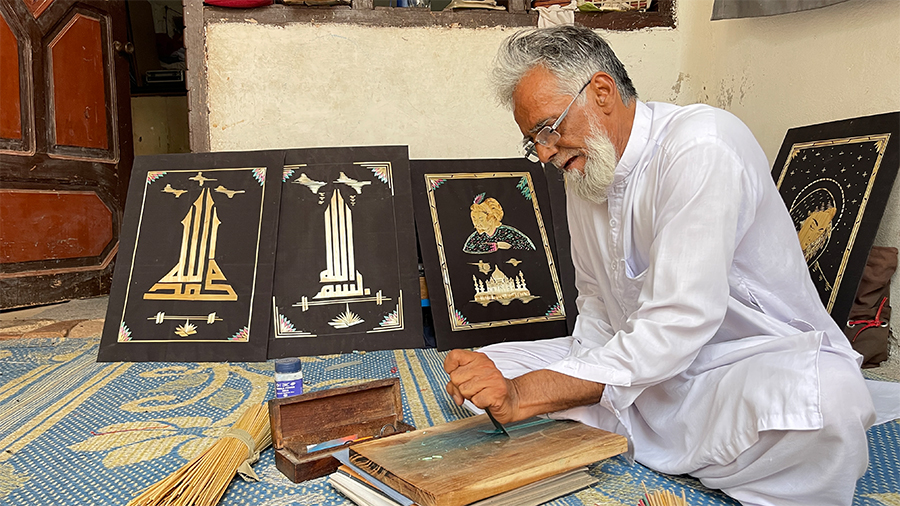
Syed Abid Shah prepares wheat stalks for straw painting at his house in Peshawar, Pakistan, June 15, 2021 (AN photo)
But such orders are rare. Shah normally sells small, 8 by 12-inch paintings on the footpaths of Peshawar’s bustling Saddar market.
“On a lucky day, I manage to sell four or five pieces, which earns the bread and butter for my family,” he said.
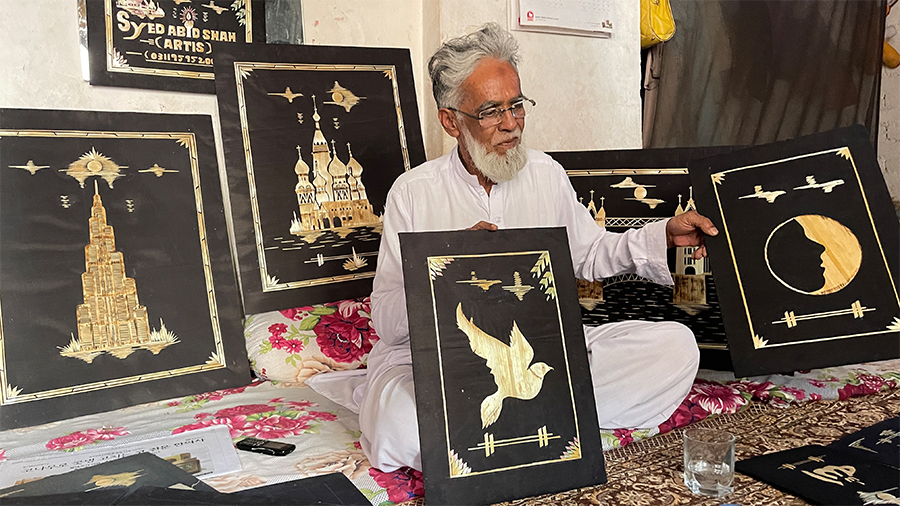
Syed Abid Shah shows his artwork at his house in Peshawar, Pakistan, on June 15, 2021. (AN photo)
One painting costs about Rs450 ($3) and takes him six hours to complete. Preparing the straw takes at least three days.
While Shah says he always knew there would not be big money in straw painting, his 23-year-old son, Shah Fahad, his bigger dreams. He wants to follow in his father’s footsteps and one day open a gallery to display his father’s work, as well as his own.
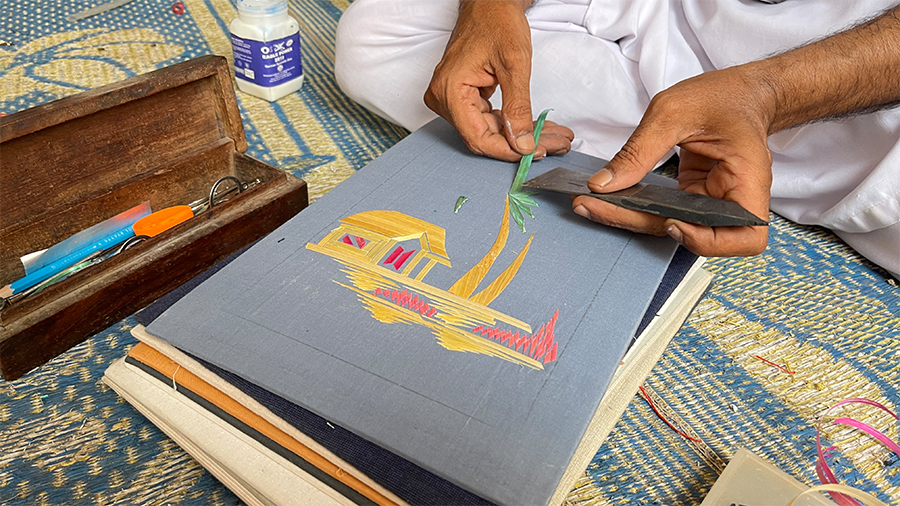
Syed Abid Shah trims a wheat stalk for straw painting at his house in Peshawar, Pakistan, June 15, 2021. (AN photo)
Fahad has been patiently learning the craft for the past four years.
“It is a slow learning process,” he said, “but I am lucky to spend more time with my father.”


