

World Bank, ADB delay $1.1 billion loans to Pakistan over deadlock in IMF talks

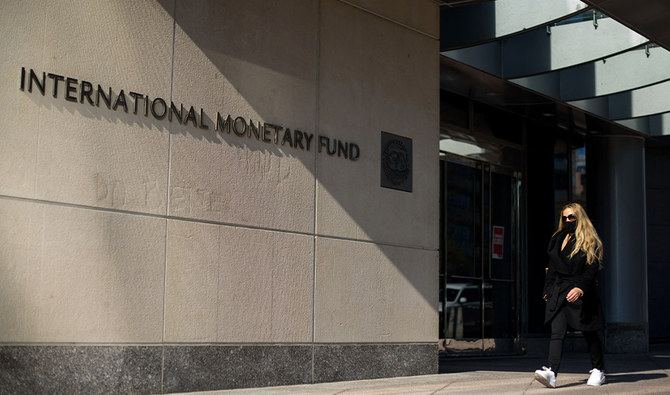
A woman walks past an International Monetary Fund headquarters(IMF) building in Washington, DC on April 5, 2021. (AFP)
Short Url
Updated 17 June 2021
Follow

World Bank, ADB delay $1.1 billion loans to Pakistan over deadlock in IMF talks

  • Economic experts say two international lenders likely to wait for outcome of Pakistan-IMF talks before releasing the money
  • Pakistan expects $800 million for budgetary support from World Bank, $300 million from Asian Development Bank 

Pakistan faces a delay of $1.1 billion in project loans from the World Bank and the Asian Development Bank, officials at the multilateral institutions said on Wednesday, as the government prepares to renegotiate conditions imposed by the International Monetary Fund to approve the remaining tranches of a $6 billion loan program which began in 2019.

Apart from the delay, the World Bank has cut down the size of its Securing Human Investments to Foster Transformation (SHIFT-II) program and the Program for Affordable and Clean Energy (PACE) from $500 million to $400 million and postponed the approval of a loan under the Resilient Institutions for Sustainable Economy (RISE-II) program.
“The amounts for SHIFT-II and PACE, at $400 million each, were jointly agreed upon by the Government of Pakistan and the World Bank,” Mariam Sara Altaf, the bank’s spokesperson in Pakistan, told Arab News on Tuesday.
Asked about the delay in the approval of RISE-II, she said it was due to process requirements.
The program supports reforms to broaden the tax base, strengthen debt management and transparency, and implement urgently needed reforms to achieve financial viability of the power sector.
“RISE-II has been delayed to accommodate the processes required by the government to implement the reforms outlined in the program,” Altaf said, adding: “SHIFT-II and PACE are scheduled for the board’s consideration on June 28.”
Pakistan is also facing delayed approval of the second tranche of a $300 million loan from the Asian Development Bank for the Energy Sector Reforms and Financial Sustainability Program.
“We will continue to work closely with other international financial institutions to ensure consistency and complementarity in the policy dialogue with the government,” F. Cleo Kawawaki, acting country director of the ADB in Pakistan, told Arab News. “An energy sector policy-based loan is in the pipeline for 2021. The ADB has been working in partnership with the Government of Pakistan in the energy sector and in infrastructure investment and reforms.”
Pakistan is also trying to negotiate with the IMF to get some relaxation in the conditions attached to the $6 billion loan program.
Pakistan’s newly appointed finance minister Shaukat Tarin has consistently called for the review of the IMF conditions which primarily focus on power tariffs and tax hikes.
“The World Bank and the Asian Development Bank have linked their lending to the IMF review for at least the last two years,” Dr. Vaqar Ahmed, joint executive director at the Sustainable Development Policy Institute, told Arab News on Wednesday. “If the program review goes smoothly, their lending to Pakistan will also happen more easily since they have linked their documents with the macroeconomic stability.”
Ahmed said the World Bank and the Asian Development Bank would wait for the outcome of the Pakistan-IMF renegotiations.
Pakistan’s finance ministry did not respond to Arab News queries by the time this story was filed.


World Bank approves $700 million for Pakistan’s economic stability

Updated 20 December 2025
Follow

World Bank approves $700 million for Pakistan’s economic stability

  • Of this, $600 million will go for federal programs and $100 million will ⁠support a provincial program in Sindh
  • The results-based design ensures that resources are only disbursed once program objectives are achieved

ISLAMABAD: The World Bank has approved $700 million in ​financing for Pakistan under a multi-year initiative aimed at supporting the country’s macroeconomic stability and service delivery, the bank said on Friday.

The funds will be released under the bank’s Public ‌Resources for Inclusive ‌Development — Multiphase ‌Programmatic ⁠Approach (PRID-MPA) that ‌could provide up to $1.35 billion in total financing, according to the lender.

Of this amount, $600 million will go for federal programs and $100 million will ⁠support a provincial program in ‌the southern Sindh province. The results-based design ensures that resources are only disbursed once program objectives are achieved.

“Pakistan’s path to inclusive, sustainable growth requires mobilizing more domestic resources and ensuring they are used efficiently and transparently to deliver results for people,” World Bank country director Bolormaa Amgaabazar said in a statement.

“Through this MPA, we are working with the Federal and Sindh governments to deliver tangible impacts— more predictable funding for schools and clinics, fairer tax systems, and stronger data for decision‑making— while safeguarding priority social and climate investments and strengthening public trust.”

The approval ‍follows a $47.9 ‍million World Bank grant ‍in August to improve primary education in Pakistan’s most populous Punjab province.

In November, an IMF-World Bank ​report, uploaded by Pakistan’s finance ministry, said Pakistan’s fragmented ⁠regulation, opaque budgeting and political capture are curbing investment and weakening revenue.

Regional tensions may surface over international financing for Pakistan. In May, Reuters reported that India would oppose World Bank funding for Pakistan, citing a senior government ‌source in New Delhi.

“Strengthening Pakistan’s fiscal foundations is essential to restoring macroeconomic stability, delivering results and strengthening institutions,” said Tobias Akhtar Haque, Lead Country Economist for the World Bank in Pakistan.

“Through the PRID‑MPA, we are launching a coherent nationwide approach to support reforms that expand fiscal space, bolster investments in human capital and climate resilience, and strengthen revenue administration, budget execution, and statistical systems. These reforms will ensure that resources reach the frontline and deliver better outcomes for people across Pakistan with greater efficiency and accountability.”

In Sindh, the program is expected to increase provincial revenues, enhance the speed and transparency of payments, and broaden the use of data to guide provincial decision making. The program will directly support the increase of public resources for inclusive development, including more equitable and responsive financing for primary health care facilities and more funding for schools.