First female police station in Pakistan's southwest gives women hope for justice

Station House Officer Zarghoona Tareen, second left, stands in front of the first female police station in Pakistan's southwest Balochistan province which was launched in Quetta on June 16, 2021. (AN photo by Saadullah Akhter)
Short Url
Updated 16 June 2021
Follow

First female police station in Pakistan's southwest gives women hope for justice

  • Station in Quetta has 19 female police personnel and all facilities needed to assist women who seek help
  • Female officers say cultural barriers have long prevented women in the region from seeking police help on their own

QUETTA: Pakistan's southwest Balochistan province on Wednesday launched its first female police station, in hopes of expanding women's access to justice in a region where they had been traditionally deprived of it.
Being Pakistan’s most impoverished province, Balochistan has some of the worst development indicators in the country and the lowest literacy rate — less than 27 percent among women. Cultural barriers have long prevented girls and women in the region from seeking police help on their own.
With the station run by 19 female police officers in Quetta, the provincial capital, officials hope women will be able to access all police services, and personally file complaints over all kinds of cases, including domestic violence and sexual abuse. 
“Now our women can visit the first Women Smart Police Station anytime without any hesitation and they will be welcomed and treated well by the women police staff deployed inside the Women Police Station,” Balochistan Inspector General of Police Muhammad Tahir Raye told reporters while inaugurating the station.
“We have installed a modern digitalized system and trained the female police staff to keep connected the Women Police Station with other Police Station from across the province in order to receive complaints from every corner of Balochistan,” he said.
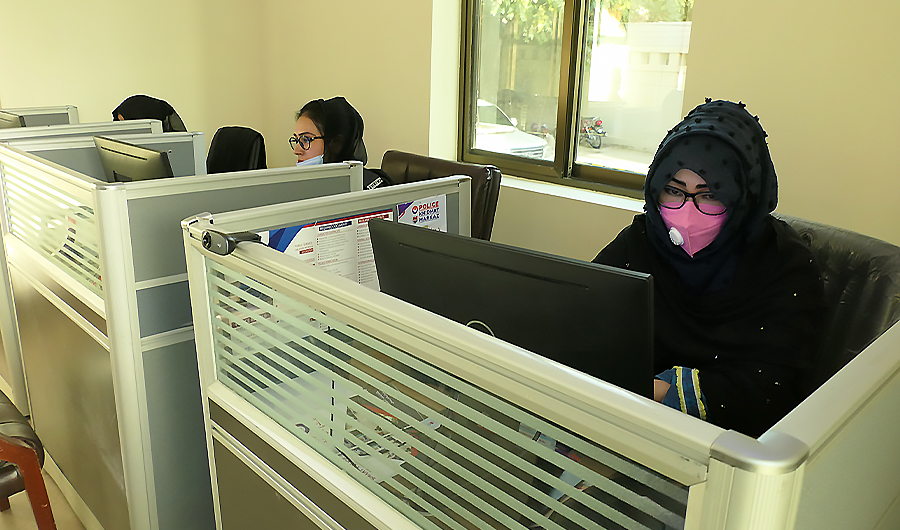


Female police officers are working on their stations at the first female police station in Quetta, Pakistan, on June 16, 2021. (AN photo by Saadullah Akhter)

Station House Officer Zarghoona Tareen told Arab News the police center is a milestone for women in Balochistan.
“Following cultural and tribal barriers, women in Balochistan were barred from visiting police stations. But now we are able to provide them shelter under one roof and our staff would utilize all efforts to solve their problems immediately,” Tareen said.
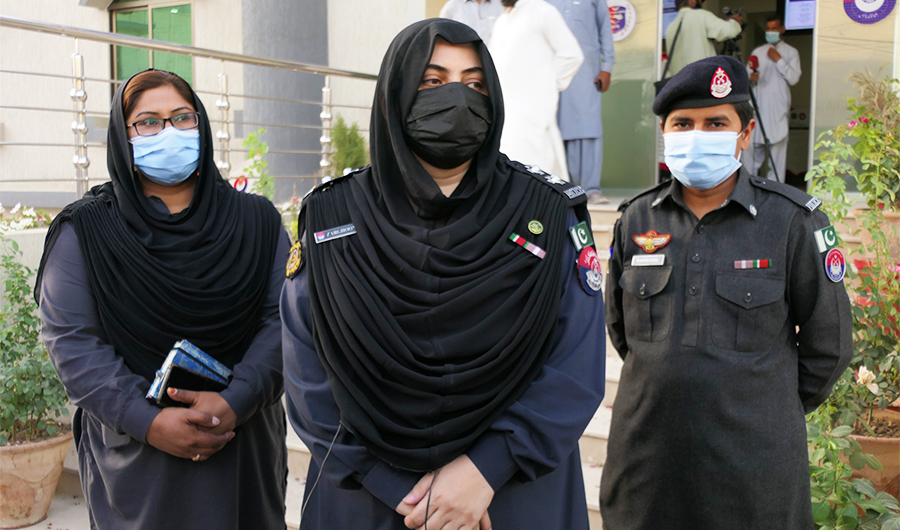


Female police officers pose for a picture outside the first female police station in Quetta, Pakistan, on June 16, 2021. (AN photo by Saadullah Akhter)

Fiza Khuda Buksh, who has been posted as a friend-desk officer, said in the women-run station female officers will also be able to work more effectively.
“We are posted here to ensure quick action on complaints registered by women complainants across the province,” she said. “Now we will be more comfortable working with female staff members, under female police officers.”


Pakistan urges concessional finance for developing nations to boost clean energy security

Updated 6 sec ago
Follow

Pakistan urges concessional finance for developing nations to boost clean energy security

  • Pakistan has emerged as one of world’s fastest growing solar markets, with 12GWs of off-grid and 6GWs of net-metered capacity in 2025
  • PM’s aide says Islamabad remains committed to Paris Agreement, looks for continued support in building a resilient and low-carbon future

ISLAMABAD: Pakistan has urged international partners to scale up concessional financing for developing countries, the country’s Press Information Department (PID) said on Sunday, citing an aide to Prime Minister Shehbaz Sharif.

The call was made by Sharif’s coordinator on climate change, Romina Khurshid Alam, while delivering Pakistan’s national statement at the 16th International Renewable Energy Agency (IRENA) Assembly in Abu Dhabi.

Pakistan has emerged as one of the world’s fastest growing solar markets, with 12 gigawatts (GWs) of off-grid and over 6GWs of net-metered solar capacity by the end of 2025. Last fiscal year, renewables accounted for a historic 53 percent of total electricity generation, according to Alam.

The prime minister’s aide stressed that affordable funding for developing nations is critical to accelerating their transition to clean energy and strengthening energy security amid rising climate and economic challenges.

“Alam reaffirmed Pakistan’s target of achieving 60 percent renewables in the power mix by 2030,” the PID said in a statement.

“In her call to action, she urged IRENA and Member States to increase concessional finance for developing nations, treat technologies such as energy storage and green hydrogen as global public goods, and strengthen regional cooperation for shared energy security.”

IRENA is a global intergovernmental agency for energy transformation that serves as the principal platform for international cooperation, supports countries in their energy transition, and provides state of the art data and analyzes on technology, innovation, policy, finance and investment. Its membership comprises 170 countries and the European Union (EU).

The 16th session of the IRENA Assembly is taking place on Jan. 10-12 in Abu Dhabi and focuses on the theme of “Powering Humanity: Renewable Energy for Shared Prosperity.” The session has gathered global leaders and energy decision-makers to discuss strategies and underline necessary actions for the acceleration of renewable energy across countries, regions, and the world, driving economic inclusion, equity, and human well-being.

Alam shared that Pakistan is taking action against energy poverty through initiatives like the Punjab Solar Panel Scheme 2026, which provides free or subsidized systems to low-income households.

She highlighted how distributed solar kits have restored power and livelihoods in flood-affected communities and offer a replicable model for climate-resilient recovery.

“Pakistan remains fully committed to the Paris Agreement and looks to IRENA for continued technical and financial support in building a resilient, inclusive, and low-carbon future,” Alam said.

Adopted in 2015 to combat climate change, the Paris Agreement binds nations to hold “the increase in the global average temperature to well below 2°C above pre-industrial levels” and pursue efforts “to limit the temperature increase to 1.5°C above pre-industrial levels.”