

Rights groups urge EU to protect life on sea route from Libya

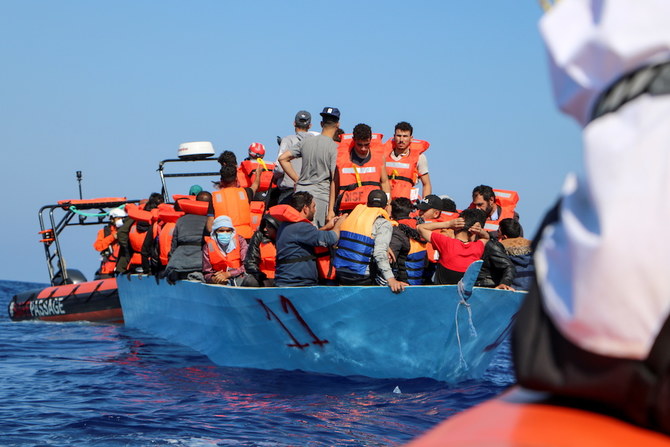
Members of Doctors Without Borders (MSF) rescue migrants from a boat off the coast of Libya, in the Mediterranean Sea, June 11, 2021. (Reuters)
Short Url
Updated 16 June 2021
Follow

Rights groups urge EU to protect life on sea route from Libya

  • Estimated 20,000 people have died or disappeared in central Mediterranean in last decade
  • Human Rights Watch: ‘People are drowning while European leaders squabble’

LONDON: Leading rights groups have called on the EU to protect lives on the main Mediterranean route between Libya and Europe. 

Human Rights Watch (HRW), Amnesty International and the European Council on Refugees and Exiles (ECRE) on Wednesday published an action plan to promote safe pathways on the precarious route from North Africa.

The 20-point plan gives guidance on how the EU could ensure safe and predictable disembarking opportunities and relocation responses for people rescued. 

“It is shameful and tragic that EU countries can’t agree on something as fundamental as saving lives at sea,” said Judith Sunderland, HRW’s associate Europe and Central Asia director. “People are drowning while European leaders squabble.”

An estimated 20,000 people have died or disappeared in the central Mediterranean in the last decade. According to the UN, some 664 people have died or gone missing so far this year. 

HRW accused the EU of “withdrawing responsibility,” noting that the bloc has since March 2019 been withdrawing its ships from areas where unseaworthy boats carrying migrants and refugees are most likely to be. 

Libya’s Coast Guard has intercepted and returned to the country more than 11,700 people this year, with up to 1,000 migrants returned on June 12 alone.

People recovered and returned to Libya face being detained in “nightmarish detention centers and experiencing abysmal conditions, violence, and forced labor,” HRW said.

It added that the EU should abandon its policy of assisting the return of migrants and refugees to Libya, and urgently adopt one that ensures migrants are relocated to a safe place. 

HRW called for new relocation arrangements so EU member states can share the responsibility of migration from Libya more equally.

EU heads of state are expected to discuss migration policy at the next European Council meeting on June 24-25 in Brussels.


The UN says Al-Hol camp population has dropped sharply as Syria moves to relocate remaining families

Updated 15 February 2026
Follow

The UN says Al-Hol camp population has dropped sharply as Syria moves to relocate remaining families

  • Forces of Syria’s central government captured the Al-Hol camp on Jan. 21 during a weekslong offensive against the SDF, which had been running the camp near the border with Iraq for a decade

DAMASCUS: The UN refugee agency said Sunday that a large number of residents of a camp housing family members of suspected Daesh group militants have left and the Syrian government plans to relocate those who remain.
Gonzalo Vargas Llosa, UNHCR’s representative in Syria, said in a statement that the agency “has observed a significant decrease in the number of residents in Al-Hol camp in recent weeks.”
“Syrian authorities have informed UNHCR of their plan to relocate the remaining families to Akhtarin camp in Aleppo Governorate (province) and have requested UNHCR’s support to assist the population in the new camp, which we stand ready to provide,” he said.
He added that UNHCR “will continue to support the return and reintegration of Syrians who have departed Al-Hol, as well as those who remain.”
The statement did not say how residents had left the camp or how many remain. Many families are believed to have escaped either during the chaos when government forces captured the camp from the Kurdish-led Syrian Democratic Forces last month or afterward.
There was no immediate statement from the Syrian government and a government spokesperson did not respond to a request for comment.
At its peak after the defeat of IS in Syria in 2019, around 73,000 people were living at Al-Hol. Since then, the number has declined with some countries repatriating their citizens. The camp’s residents are mostly children and women, including many wives or widows of IS members.
The camp’s residents are not technically prisoners and most have not been accused of crimes, but they have been held in de facto detention at the heavily guarded facility.
Forces of Syria’s central government captured the Al-Hol camp on Jan. 21 during a weekslong offensive against the SDF, which had been running the camp near the border with Iraq for a decade. A ceasefire deal has since ended the fighting.
Separately, thousands of accused IS militants who were held in detention centers in northeastern Syria have been transferred to Iraq to stand trial under an agreement with the US
The US military said Friday that it had completed the transfer of more than 5,700 adult male IS suspects from detention facilities in Syria to Iraqi custody.
Iraq’s National Center for International Judicial Cooperation said a total of 5,704 suspects from 61 countries who were affiliated with IS — most of them Syrian and Iraqi — were transferred from prisons in Syria. They are now being interrogated in Iraq.