


RIYADH: US climate envoy John Kerry has praised the Saudi Green Initiative as “a very important step,” adding that it is “the kind of initiative we need on a global basis — planting trees, beginning to move to different kinds of innovative solutions that reduce the level of emissions, to deal with waste more effectively.”
Aimed at reversing environmental degradation and climate change, the combination of the Saudi Green Initiative and the Middle East Green Initiative was announced by Crown Prince Mohammed bin Salman in April. The step has put the Kingdom at the heart of regional efforts to meet international targets on environmental projects.
“I think it’s an extremely important initiative, together with the Middle East Green Initiative, when you put them together,” Kerry said during a special interview with Arab News in Riyadh on Wednesday.
The former top US diplomat was in Abu Dhabi en route to Riyadh, his second visit to the UAE capital where attended the first Regional Dialogue Conference on Climate Change in April. That conference focused on preparations for the 26th UN Climate Change Conference (COP26), to be held later this year to accelerate efforts to achieve the goals of the 2015 Paris Agreement and the UN Framework Convention on Climate Change.
Referring to the participants - “11 different mostly producer countries including Morocco, Iraq, Egypt and others – he said: “They are all committed to moving in this direction. Now what we need to do is harmonize the global understanding of the goals and the different standards that are being applied to ‘green’ and the definition of ‘green’ and so forth.
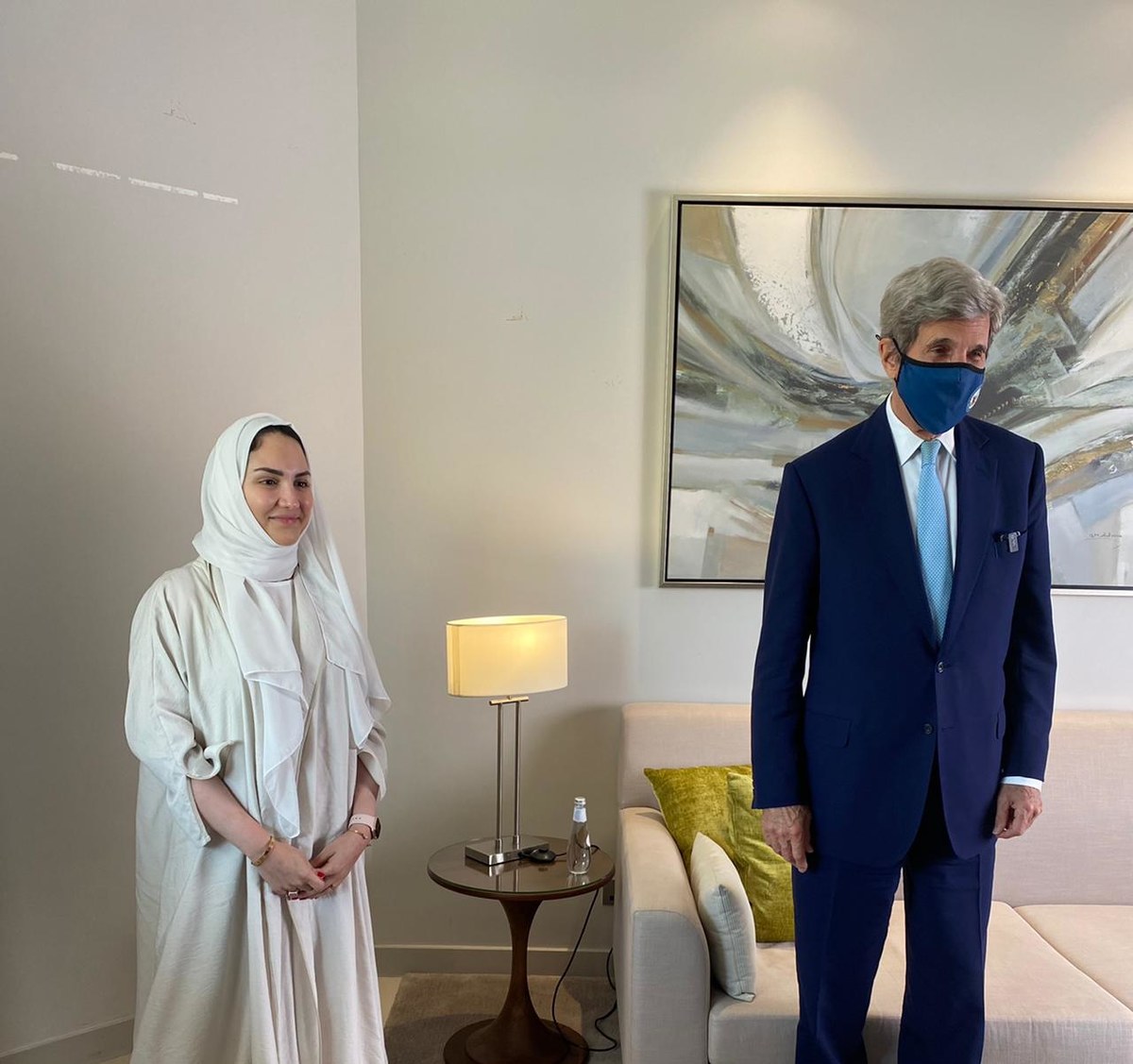
Arab News Assistant Editor in Chief, Noor Nugali, (L) and US climate envoy John Kerry.
“But we could do these things and that’s my mission as special envoy to help us to stay focused as we move to Glasgow, where the world will come together as we did in Paris and renew ambition. We have to raise our ambition to get this job done, and I think the Green initiative is a good step towards helping to do that.”
For months now, Kerry has been crisscrossing the globe, meeting heads of government, kings, crown princes and ministers and senior officials, seeking to increase ambition in the lead-up to the COP26, to be held in Glasgow, Scotland, in November.
Kerry’s latest foray into the Middle East brought him to Riyadh on Tuesday for talks with Saudi ministers, officials and CEOs on the gamut of climate-related issues.
He said his meeting with Saudi Arabia’s environment minister included “the whole group of CEOs who are leading different initiatives in different sectors of the economy to begin to ‘green’ the way we are doing things.”
“We had a very good series of meetings that covered everything possible. Also, Energy Minister Prince Abdul Aziz pulled together his experts and we spent a lot of time really going through every aspect of what Saudi Arabia is doing currently and what it can and will do,” he added.
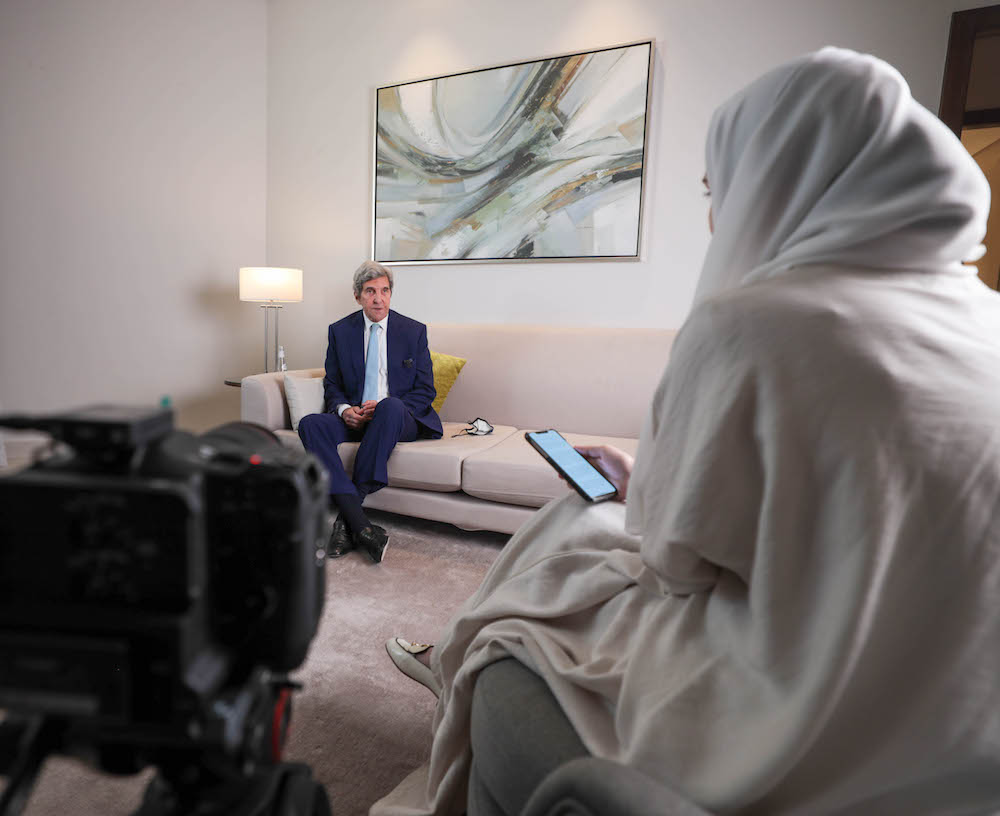
Arab News Assistant Editor in Chief, Noor Nugali, (L) and US climate envoy John Kerry.
Kerry said he was “very impressed by the depth of the (Saudi) analyses and the commitment going forward, which clearly is beginning to grapple in a serious way with this challenge,” acknowledged that “it’s a big challenge and getting more urgent,” and added that President Biden is “equally committed to moving forward.”
“We believe that Saudi Arabia could be one of the principal agents of change because Saudi Arabia has such an extraordinary opportunity with solar and green hydrogen and the possibility is very real,” Kerry said.
Among the goals of the Saudi Green Initiative and Middle East Green Initiative are cutting carbon dioxide emissions in the region by 60 percent; using renewables to produce 50 percent of the Kingdom’s energy by 2030; and eliminating more than 130 million tons of carbon emissions using clean hydrocarbon technology.
“I think what Crown Prince Mohammed bin Salman put forward as a concept is in fact both challenging and exciting at the same time, and has the ability to speed up the transition for all of us by providing alternative fuel,” Kerry said, who met with the Crown Prince later on Wednesday to discuss international efforts to combat climate change and Saudi Arabia’s initiatives in this regard.
“Many people in the world are looking for the hydrogen solution now, and I am, I think that out of our meetings has come a commitment to work together to try to accelerate that, so I am very hopeful.”

Arab News Assistant Editor in Chief, Noor Nugali, (C) and US climate envoy John Kerry.
The administration of Donald Trump withdrew from the Paris agreement but President Biden signed an executive order to have the US rejoin the Paris climate agreement within hours of being sworn in in January. The policy U-turns have prompted some questioning about the future consistency of America’s own climate policy.
But Kerry dismissed such concerns emphatically. “No, absolutely not and I will tell you why not. The reason is that the private sector is moving in an extraordinary way all across the planet and trillions of dollars are going to be invested in this transition,” he said.
“We have six major banks in the US that have committed about $4.16 trillion over the next 10 years for climate investment. That’s without even getting to the development banks or the asset managers. And thanks to the work of a number of people around the world who are helping to put together an alliance, there are many other financial institutions in other countries that are completely committed to the same goal — net zero by 2050 or earlier.”
Explaining why the policy clock cannot be put back, Kerry said: “I believe there’s so much technology, innovation and so much new product development and new fuel development, the marketplace is going to be a powerful force that no politician in any one country is going to be able to change that. They wouldn’t want to because it is going to be millions of jobs for our citizens even as it transitions the world to sustainable and renewable energy sources.”
Kerry said the same logic applies “with respect to carbon obviously because a place like Saudi Arabia is a producer which is deeply concerned.”
“As long as the emissions are going down at the rate we need to, as long as we are able to even capture those emissions and put them to use in one way or another, then there will be a combination of different approaches and different fuels,” he told Arab News.
“So I think the future is really very, very promising. This is the biggest economic transformation facing all of us since the Industrial Revolution and I think it’s filled with opportunity. Whoever discovers battery storage of two weeks or one week, or whoever is the person, or country or company that comes up with a way to suck CO2 out of the atmosphere, store it or put it to use, they are going to make a lot of money because these are things the whole world needs, and will want.”
The UN has warned that nations must redouble their climate efforts if they are to reach the Paris Agreement’s goal of limiting global temperature rise by 2C - ideally 1.5C - by the end of the century. Climate science has called for a transformation that must start early and result in deep emission reductions even before 2030.
However, developing countries want richer countries to make good on their Paris negotiations pledges to mobilize $100 billion a year in public and private financing to aid the energy-transition effort. Kerry said progress has been made on this contentious issue.
“About $81 billion of the total $100 billion is now accountable. It is not just direct giving of the money but it is also mobilizing money so you can push some of the development banks or you can bring other people to the table and mobilize a certain amount of money,” he said.
“We have to get there. It is very, very important for the developed world to produce the $100 billion that has been promised and we are already working very hard on it. I have talked personally to President Biden about it and he is well aware of it. It was discussed at the G7 (summit held over the weekend in Cornwall in the UK). In the next four months, it is critical for us to bring it together and get the job done.”
Kerry is confident that funds can be found for the necessary energy transitions by the governments that were compelled to respond with significant monetary and fiscal policy changes to limit the COVID-19 pandemic’s shock to the economy.
“Some of the money will have to come from countries, because we need money that is what we call ‘concessionary money,’ money that is there to though public budget to help pay for things that the private sector will not be interested in doing because it does not have a return on investment,” he said.
“But the vast majority of this money is going to come from the private sector all around the world because they have the money to invest and because the different sectors of our economy produce products such as in transportation. If you have a train or a high-speed rail or a clean public transport, those are areas where you have revenue. And if you have revenue, then you have the ability to be able to attract investment.
“The same is true for energy use. People will pay for the energy they use for their air conditioning, for their heating, for their lights and so that’s a revenue stream. That means you can actually invest in that and make some money so the private sector will see economic opportunity in many of the choices that we need to make and that’s why those banks I talked about put $4.16 trillion on the table.
“There will be more than that, much more than that, around the world. And that’s what’s going to drive this — the ability of people to seek solutions, through technologies and individual use, products that people use and are willing to pay for.”


