

Egypt and Sudan will confront any unilateral Ethiopian action on the Renaissance Dam — FM

Egypt’s Minister of Foreign Affairs Sameh Shoukry speaks during a joint press conference following a meeting on the Middle East Peace process. (File/AFP)
Short Url
Updated 13 June 2021
Follow

Egypt and Sudan will confront any unilateral Ethiopian action on the Renaissance Dam — FM

  • Shoukry said Cairo is working with Israel to advance the peace process and achieve the aspirations of the Palestinian people

AMMAN: Egypt’s Foreign Minister Sameh Shoukry said on Saturday that he anticipates negotiations with Ethiopia over the Grand Renaissance Dam will continue to falter.
Speaking during a television program on Sada El-Balad channel, Shoukry said that the Nile waters concern every Egyptian, and the government deals with transparency and informs its people on all the negotiations that take place.
Shoukry said that his recent visit to Sudan came to confirm the close link between the two countries and to coordinate to assess the filling status of the dam, the pace of construction, and review all data related to this issue.
He said his country and Sudan will politically and decisively confront any unilateral action by Ethiopia on the dam, adding that the second filling of the dam will affect the course of negotiations and that Addis Ababa’s actions are contrary to international standards.
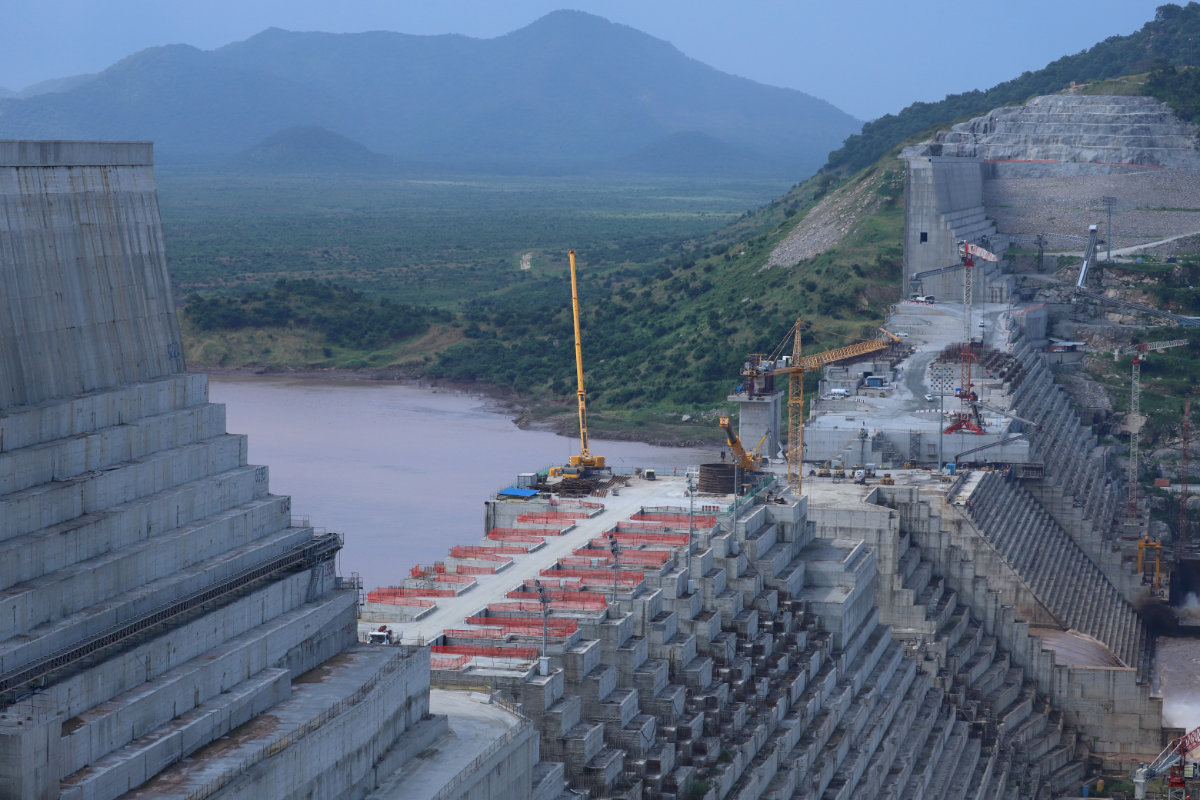


Ethiopia's Grand Renaissance Dam is seen as it undergoes construction work on the river Nile in Guba Woreda, Benishangul Gumuz Region, Ethiopia, on Sept. 26, 2019. (REUTERS/File Photo) 

Ethiopia began the second phase of filling the reservoir behind its giant Grand Renaissance Dam in early May, a process expected to accelerate in July and August after seasonal rains.
Further construction work on the dam had already allowed for the second phase to start. Ethiopia began filling the reservoir behind the dam, which is still under construction on the Blue Nile close to the border with Sudan, last year.
“We hope that a breakthrough will be reached in the negotiations, but this depends on the Ethiopian political administration, and we affirm that the downstream countries will not compromise or give up their rights, in the event of serious damage occurring when filling and operating the Renaissance Dam,” he said.
Earlier on Saturday, Shoukry addressed a letter to the UN Security Council to explain the developments of the Grand Ethiopian Renaissance Dam issue, and affirmed Egypt’s objection to Ethiopia’s announcement of its intention to continue filling the dam during the upcoming flood season.
On Palestine, Shoukry said Cairo is working with Israel to advance the peace process and achieve the aspirations of the Palestinian people, which is the establishment of a Palestinian state and the two-state solution.
“Egypt is committed to the need to establish a Palestinian state, and we will continue to work with the new Israeli government and international partners led by the United States to implement the goals of the Palestinian people.”
He also said President Abdel Fattah El-Sisi has approved providing $500 million in aid, and they are coordinating with the Palestinian and Israeli sides to set appropriate frameworks that provide for reconstruction and speed up the provision of support to the Palestinian people.
(With Reuters)


Gaza death toll far higher than initially reported: Lancet study

Updated 12 sec ago
Follow

Gaza death toll far higher than initially reported: Lancet study

  • Israel killed 25,000 more people by start of 2025 than was reported by authorities
  • ‘It will be a long time before we get to a full accounting of all the people killed in Gaza, if we ever get there’

LONDON: The war in Gaza saw 25,000 more deaths in its first 16 months than authorities announced at the time, according to the Lancet.

Research published by the medical journal estimated that 75,000 deaths occurred between Oct. 7, 2023, and Jan. 5, 2025, including 42,200 women, children and elderly people.

The authors of the study published on Wednesday said: “The combined evidence suggests that, as of 5 January 2025, 3-4% of the population of the Gaza Strip had been killed violently and there have been a substantial number of non-violent deaths caused indirectly by the conflict.”

Last month, an Israeli security officer told Israeli media that casualty figures published by Gaza’s health authorities were largely accurate, having previously downplayed or questioned their size, adding that around 70,000 people were thought to have been killed in Israeli assaults since Oct. 7, 2023.

Gaza’s health authorities say 71,660 people are confirmed to have died, including 570 since the singing of a ceasefire last October.

The new research suggests that those figures are below the reality. Using trained Palestinians on the ground in the enclave, it surveyed 2,000 Gazan families who were asked to provide details about members killed in the conflict.

One of the report’s authors, Prof. Michael Spagat of Royal Holloway, University of London, said the research found that 8,200 people also died in the surveyed period from “indirect” causes such as disease and hunger.

Despite covering the most intense period of the conflict, the study does not analyze anything beyond January 2025. In August, famine was declared in Gaza by UN-backed experts.

In November, a study conducted by researchers at the Max Planck Institute for Demographic Research suggested that 78,318 people had been killed in the enclave by Dec. 31, 2024.

Its higher casualty rate was ascribed to a larger number of indirect fatalities, which contributed to life expectancy in Gaza dropping by 44 percent in 2023 and 47 percent in 2024.

“It will be a long time before we get to a full accounting of all the people killed in Gaza, if we ever get there,” said Spagat, who has studied conflict zones for 20 years.