

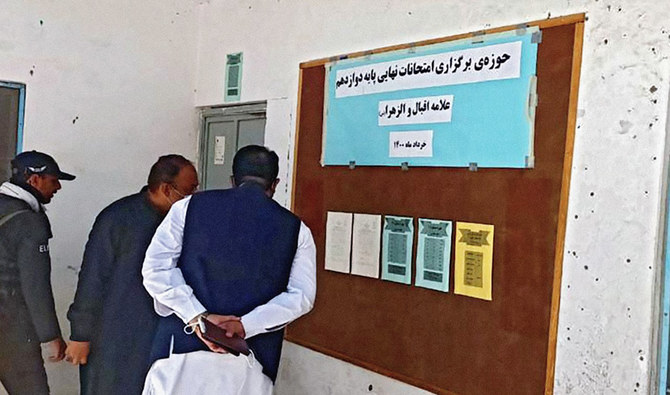
Authorities shut down six ‘illegal’ Iranian schools in southwest Pakistan

1 / 3
Photo/Quetta Assistant Commissioner
2 / 3
Photo/Quetta Assistant Commissioner
3 / 3
Photo/Quetta Assistant Commissioner
Short Url
Updated 12 June 2021
Follow

Authorities shut down six ‘illegal’ Iranian schools in southwest Pakistan

  • Schools were teaching foreign curriculum in violation of Pakistani law, officials say
  • Management and faculty of the schools consisted of Iranian nationals

KARACHI: Pakistani authorities have closed six Iranian schools operating illegally in southwestern Balochistan province, officials said on Saturday.
All six schools shut on Friday were run by Iranian nationals in Quetta, the capital of the province bordering Iran.
“We have sealed six schools, which were being illegally run by Iranian nationals and where a foreign syllabus was being taught in violation of the country law,” Quetta Assistant Commissioner Muhammad Zuhaib-ul-Haq told Arab News.
Shabbir Ahmed, monitoring and evaluation director of the provincial government’s Balochistan Education Foundation, said that four more schools are being investigated for teaching a foreign curriculum.
“It’s likely that the remaining four schools will also be sealed since they don’t fulfil requirements,” Ahmed said. “Foreign-funded schools with foreign faculty and foreign syllabus are unacceptable.”
Both the management and faculty of the schools consisted of Iranian nationals, he added.
It remains unclear when the schools were established. All the schools had 1992 “no objection” certificates on display, Ahmed said, but this was not sufficient for them to operate as they had failed to register with the provincial home and education departments.
The schools attracted the attention of local authorities five months ago and were asked to register properly.
“A form was handed to them to get themselves registered, but registration was declined after they failed to fulfil requirements,” Ahmed said.
“If you are teaching in Pakistan, which is a sovereign state, you have to teach Pakistani syllabus,” he added. “It is not possible to teach a foreign curriculum in a sovereign state.”


Kosovo, Serbia ‘need to normalize’ relations

Updated 5 sec ago
Follow

Kosovo, Serbia ‘need to normalize’ relations

  • Kosovo, which hopes to join NATO, has also been cultivating relations with Washington in recent months, by removing tariffs on American products

PRISTINA: Kosovo and Serbia need to “normalize” their relations, Kosovo’s Prime Minister Albin Kurti said, several days before legislative elections where he is seeking to extend his term with more solid backing.

Kurti has been in office since 2021 and previous accords signed with Serbia — which does not recognize the independence of its former province — have yet to be respected.

“We need to normalize relations with Serbia,” said Kurti. “But normalizing relations with a neighboring authoritarian regime that doesn’t recognize you, that also doesn’t admit to the crimes committed during the war, is quite difficult,” he added.

Tensions between the two neighbors are regularly high.

“We do have a normalization agreement,” Kurti said, referring to the agreement signed under the auspices of the EU in 2023.

“We must implement it, which implies mutual recognition between the countries, at least de facto recognition.”

But to resume dialogue, Serbia “must hand over Milan Radoicic,” a Serb accused of plotting an attack in northern Kosovo in 2023, Kurti asserted, hoping that “the EU, France, and Germany will put pressure” on Belgrade to do so.

Kosovo, which hopes to join NATO, has also been cultivating relations with Washington in recent months, by removing tariffs on American products and agreeing to accept up to 50 migrants from third countries extradited by the US. So far, only one has arrived.

“We are not asking for any financial assistance in return,” Kurti emphasized. “We are doing this to help the US, which is a partner, an ally, a friend,” added the prime minister, who did not rule out making similar agreements with European countries.

Unable to secure enough seats in the February 2025 parliamentary elections, Kurti was forced to call early elections on Sunday, after 10 months of political deadlock during which the divided parliament failed to form a coalition.

“We need a decisive victory. In February, we won 42.3 percent, and this time we want to exceed 50 percent,” he said.