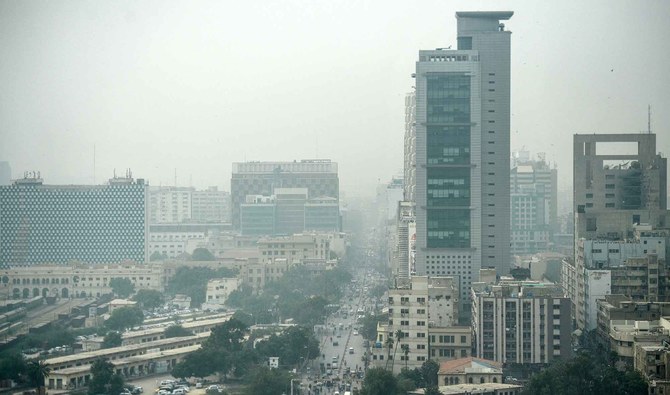
KARACHI: The provincial administration of Sindh initiated several development projects for Karachi in the last couple of years to improve the quality of life of its residents, Chief Minister Murad Ali Shah told Arab News on Thursday.
“Public investments on development projects in Karachi have been scaled up since the last 5 years (2015 to 2020), focusing on infrastructure and human development,” he said in a WhatsApp message. “Overall, the security and investment environment has been improved significantly.”
The chief minister issued the statement only a day after the Economist Intelligence Unit (EIU) published its Global Livability Index of 140 cities, counting Karachi among the least livable places in the world.
The EIU considers various factors, such as stability, infrastructure, education and access to healthcare, while preparing the index.
The COVID-19 pandemic, which first emerged toward the end of 2019, played a critical role in its recent assessment this year as several European cities were downgraded on the list.
Karachi, Pakistan’s seaside metropolis of 15 million people, improved its overall ranking to the seventh least livable city from fourth in 2018 and fifth in 2019. However, it could not escape the unfavorable ranking owing to a multitude of challenges.
Zia Ur Rehman, a Karachi-based journalist and researcher, blamed the city’s complex division of governance for the failure to resolve its civic issues.
“The ruling Pakistan Tehreek-e-Insaf party won the majority of national and provincial assembly seats from Karachi,” he said. “However, the provincial assembly is dominated by the Pakistan Peoples Party. The Muttahida Qaumi Movement-Pakistan, meanwhile, ran Karachi’s city government and four out of six districts for four years until its dissolution last year.”
“Now instead of resolving the civic issues in the city by reaching a consensus on a doable and long-lasting division of power between the provincial and local governments, all three major political parties have been playing politics on these issues and trying to embarrass one another,” Rehman continued.
Arif Hasan, a Pakistani architect, planner and researcher, agreed with the assessment while advocating for local representation.
“To resolve the problems of the city, a truly representative local government must be put in place,” he said.
However, the Sindh chief minister listed his administration’s accomplishments in his messages to Arab News.
He noted that a $98 million Karachi Neighborhood Improvement Project was being executed to improve public spaces in targeted neighborhoods along with urban road infrastructure.
“Competitive and Livability City of Karachi (CLICK) is another project under which US$240 million will be spent on the institutional strengthening and infrastructure financing of local councils in Karachi,” he said, adding it would overhaul urban immoveable property tax and support ease of doing business.
“US$105 million are being spent for focusing on long-term strengthening of the KW&SB [Karachi Water and Sewerage Board] through multiple reforms under the Karachi Water Supply & Sanitation Improvement Project (KWSSIP),” he continued.
The Bus Rapid Transport (BRT) Yellow (US$438 million) and Red Line (US$561 million) were mega transportation interventions for the city, the chief minister added.
“In the next financial year, about $438 million will be budgeted for various development projects for Karachi in Annual Development Program 2021-22 in order to provide robust living standard for people of Karachi City,” Shah said.


Pakistan's Sindh province defends against global survey calling Karachi most unlivable city
https://arab.news/5d9ma
Pakistan's Sindh province defends against global survey calling Karachi most unlivable city

- Sindh Chief Minister Murad Ali Shah says his administration has launched several projects to improve quality of life in the megacity
- Experts say the city's complex and fragmented governance system responsible for the failure to resolve its civic issues

Pakistan, Türkiye military chiefs discuss defense cooperation amid Middle East tensions
- Field Marshal Asim Munir reaffirms Pakistan’s commitment to deepening military-to-military ties with Türkiye
- Turkish officials said this month they were in talks to join the Pakistan-Saudi defense alliance formed last year
ISLAMABAD: Pakistan’s top military commander, Field Marshal Asim Munir, met the Chief of the Turkish General Staff, General Selcuk Bayraktaroglu, on Friday to discuss deepening defense cooperation, as regional security concerns intensify amid the ongoing tensions in the Middle East.
The meeting comes against the backdrop of widening geopolitical uncertainty following the Gaza war, which has heightened the risk of broader regional escalation involving Iran and the United States, and as Ankara explores closer defense coordination with partners beyond NATO.
Earlier this month, Turkish Foreign Minister Hakan Fidan said Türkiye was in talks to join a defense alliance established between Pakistan and Saudi Arabia last September, signaling a possible expansion of security cooperation among key regional players.
The Turkish general called on Pakistan’s chief of defense forces at the General Headquarters in Rawalpindi, according to the military’s media wing, Inter-Services Public Relations (ISPR).
“During the meeting, besides dilating upon matters of mutual interest, prevailing regional and global security landscape, and prospects for strengthening bilateral defense and military cooperation were also discussed,” the ISPR said in a statement.
It added that both sides “expressed satisfaction on current trajectory of Pakistan-Türkiye relations while underscoring the requirement of maintaining close coordination and enhancing defense collaboration.”
Munir welcomed the support of the Turkish Armed Forces and reaffirmed Pakistan’s commitment to strengthening military-to-military ties, according to the statement.
It said that Bayraktaroglu praised the professionalism of Pakistan’s armed forces and expressed Türkiye’s intent to deepen defense cooperation through training, joint exercises and capacity-building initiatives.
Pakistan and Türkiye maintain close diplomatic, economic and defense relations, with military cooperation forming a major pillar of their partnership.
Last month, a high-level delegation of Turkish aerospace and defense manufacturers visited Pakistan to explore joint ventures, co-production and technology-sharing opportunities. In August 2025, the navies of both countries conducted their first bilateral amphibious exercise to strengthen maritime coordination.
Turkish defense firms have played a key role in modernizing Pakistan’s Agosta 90B-class submarines and have supplied Islamabad with advanced military hardware, including drones.
The two countries also regularly conduct joint military drills. Their most recent exercise, Ataturk-XIII in February 2025, brought together special forces units for combat training aimed at improving their ability to operate effectively together in the field.


