

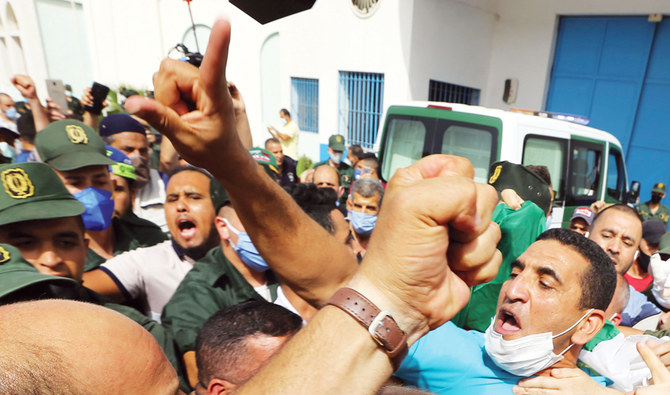
Two Algerian opposition figures held ahead of vote, capital sealed

Karim Tabbou was imprisoned from September 2019 to July 2020, and spent more than a month under judicial supervision, which grounded him politically. (AFP)
Short Url
Updated 12 June 2021
Follow

Two Algerian opposition figures held ahead of vote, capital sealed

  • Decree opens new avenue for prosecution of Hirak activists by changing definition of terror

ALGIERS: A politician and a journalist who are prominent opposition figures in Algeria have been arrested days ahead of the country’s parliamentary election, according to a group of lawyers defending jailed activists of the pro-democracy movement.

The Algerian League for the Defense of Human Rights said seven leading protest movement figures had been arrested on Thursday evening, five in Algiers and two in other parts of the country. “We do not know the grounds for these arrests,” its vice president, Said Salhi,  said.
Among those detained in Algiers were leading opposition figure Karim Tabbou and independent journalist Khaled Drareni, as well the director of a pro-reform radio station, Ihsane El-Kadi.
Drareni was being held in a barracks on the outskirts of the capital. His only contact with his family was a 1:30 a.m. phone call, his lawyer Zoubida Assoul said.
The journalist, who was only released on bail in February after being detained while covering a mass demonstration in the capital in March last year was expected to face a new trial.
Tabbou and Ihsane El-Kadi were being held in the same barracks, their lawyers said.
Algerian Communication Minister Ammar Belhimer accused El-Kadi of “divulgating information likely to be detrimental to the national unity.”
El-Kadi was placed under judicial supervision on May 18 with orders to present himself at a police station once a week. His passport was confiscated.
Since last month, the government has clamped down on the weekly protests of the Hirak reform movement, detaining hundreds of activists who have defied new restrictions on public gatherings.

FASTFACT

On Saturday, Algeria is set to hold its first legislative election since former President Abdelaziz Bouteflika was forced from office in 2019 after 20 years in power.

Prior approval is now required from the Interior Ministry, an impossible demand for a movement that prides itself on having no formal leadership, making all of its demonstrations effectively illegal.
A presidential decree published in the official gazette on Thursday opens a new avenue for the prosecution of Hirak activists by changing the penal code’s definition of acts of terrorism.
It establishes an official blacklist of individuals and entities suspected of terrorism that could be used against activists, opposition leaders or journalists.
Police were out in force in Algiers to preempt any attempt by the Hirak to protest.
“This repressive atmosphere and the restrictions placed on human rights and freedoms mean these elections have no democratic value,” Salhi said.
Hirak supporters have vowed to boycott the election, which President Abdelmadjid Tebboune called as part of his pledge to tackle corruption and build a “new Algeria,” as they denounce a crackdown on opposition and increased repression of protests.
Police sealed off the Algerian capital on Friday to prevent protesters gathering on the eve of the election.
Algeria’s president and the generals backing him hope Saturday’s parliamentary election will mark an end to two years of upheaval, but in the capital’s steep, winding streets few people seemed enthused.
While thousands of candidates rallied supporters at official campaign events for an election that moderate Islamist parties aim to win, the low turnout in recent national votes has underscored public skepticism for the process.
“I won’t vote because nothing will change. Nothing at all,” said Khadidja, a woman in a facemask and pink headscarf speaking near a wall plastered with election posters.
The establishment believes replacing the old president, parliament and constitution, coupled with the jailing of numerous Bouteflika cronies, is the best way to end the biggest crisis in decades, said a former senior official.
“The election is another effort to gain some popular legitimacy with the aim of building a new political map,” said Abdelhak Bensadi, a political science professor at Algiers university.
Supporters of the leaderless “Hirak”  protest movement point to an increasing security crackdown on dissent and dismiss Saturday’s election as a charade. They want a more thorough purge of the ruling elite and the army to quit politics.


Trump weighs Iran strikes to inspire renewed protests, sources say

Updated 58 min 41 sec ago
Follow

Trump weighs Iran strikes to inspire renewed protests, sources say

  • Trump’s options include targeting leaders and security forces, US sources say
  • Iran prepares for military confrontation, seeks diplomatic channels, Iranian official says

DUBAI: US President Donald Trump is weighing options against Iran that include targeted strikes on security forces and leaders to inspire protesters, multiple sources said, even as Israeli and Arab officials said air power alone would not topple the clerical rulers. Two US sources familiar with the discussions said Trump wanted to create conditions for “regime change” after a crackdown crushed a nationwide protest movement earlier this month, killing thousands of people.
To do so, he was looking at options to hit commanders and institutions Washington holds responsible for the violence, to give protesters the confidence that they could overrun government and security buildings, they said.
One of the US sources said the options being discussed by Trump’s aides also included a much larger strike intended to have lasting impact, possibly against the ballistic missiles that can reach US allies in the Middle East or its nuclear enrichment programs.
The other US source said Trump has not yet made a final decision on a course of action including whether to take the military path. The arrival of a US aircraft carrier and supporting warships in the Middle East this week has expanded Trump’s capabilities to potentially take military action, after he repeatedly threatened intervention over Iran’s crackdown.
Four Arab officials, three Western diplomats and a senior Western source whose governments were briefed on the discussions said they were concerned that instead of bringing people onto the streets, such strikes could weaken a movement already in shock after the bloodiest repression by authorities since the 1979 Islamic Revolution.
Alex Vatanka, director of the Iran Program at the Middle East Institute, said that without large-scale military defections Iran’s protests remained “heroic but outgunned.”
The sources in this story requested anonymity to talk about sensitive matters. Iran’s foreign office, the US Department of Defense and the White House did not respond to requests for comment. The Israeli Prime Minister’s office declined to comment. Trump urged Iran on Wednesday to ⁠come to the table and make a deal on nuclear weapons, warning that any future US attack would be more severe than a June bombing campaign against three nuclear sites. He described the ships in the region as an “armada” sailing to Iran.
A senior Iranian official said that Iran was “preparing itself for a military confrontation, while at the same time making use of diplomatic channels.” However, Washington was not showing openness to diplomacy, the official said.
Iran, which says its nuclear program is civilian, was ready for dialogue “based on mutual respect and interests” but would defend itself “like never before” if pushed, Iran’s mission to the United Nations said in a post on X on Wednesday.
Trump has not publicly detailed what he is looking for in any deal. His administration’s previous negotiating points have included banning Iran from independently enriching uranium and restrictions on long-range ballistic missiles and on Tehran’s network of armed proxies in the Middle East.
Limits of air power
A senior Israeli official with direct knowledge of planning between Israel and the United States said Israel does not believe airstrikes alone can topple the Islamic Republic, if that is Washington’s goal.
“If you’re going to topple the regime, you ⁠have to put boots on the ground,” he said, noting that even if the United States killed Supreme Leader Ayatollah Ali Khamenei, Iran would “have a new leader that will replace him.”
Only a combination of external pressure and an organized domestic opposition could shift Iran’s political trajectory, the official said.
The Israeli official said Iran’s leadership had been weakened by the unrest but remained firmly in control despite the ongoing deep economic crisis that sparked the protests. Multiple US intelligence reports reached a similar conclusion, that the conditions that led to the protests were still in place, weakening the government, but without major fractures, two people familiar with the matter said.
The Western source said they believed Trump’s goal appeared to be to engineer a change in leadership, rather than “topple the regime,” an outcome that would be similar to Venezuela, where US intervention replaced the president without a wholesale change of government.
Khamenei has publicly acknowledged several thousand deaths during the protests. He blamed the unrest on the United States, Israel and what he called “seditionists.”
US-based rights group HRANA has put the unrest-related death toll at 5,937, including 214 security personnel, while official figures put the death toll at 3,117. Reuters has been unable to independently verify the numbers.
Khamenei retains control but less visible
At 86, Khamenei has retreated from daily governance, reduced public appearances and is believed to be residing in secure locations after Israeli strikes last year decimated many of Iran’s senior military leaders, regional officials said.
Day-to-day management has shifted to figures aligned with the Islamic Revolutionary Guard Corps (IRGC), including senior adviser Ali Larijani, they said. The powerful Guards dominate Iran’s security network and big parts of the economy. However, Khamenei retains final authority over war, succession and nuclear strategy — meaning political change is very difficult until he exits the scene, they said. Iran’s foreign ministry did not respond ⁠to questions about Khamenei.
In Washington and Jerusalem, some officials have argued that a transition in Iran could break the nuclear deadlock and eventually open the door to more cooperative ties with the West, two of the Western diplomats said.
But, they cautioned, there is no clear successor to Khamenei. In that vacuum, the Arab officials and diplomats said they believe the IRGC could take over, entrenching hardline rule, deepening the nuclear standoff and regional tensions.
Any successor seen as emerging under foreign pressure would be rejected and could strengthen, not weaken the IRGC, the official said.
Across the region, from the Gulf to Turkiye, officials say they favor containment over collapse — not out of sympathy for Tehran, but out of fear that turmoil inside a nation of 90 million, riven by sectarian and ethnic fault lines, could unleash instability far beyond Iran’s borders.
A fractured Iran could spiral into civil war as happened after the 2003 US invasion of Iraq, two of the Western diplomats warned, unleashing an influx of refugees, fueling Islamist militancy and disrupting oil flows through the Strait of Hormuz, a global energy chokepoint.
The gravest risk, analyst Vatanka warned, is fragmentation into “early-stage Syria,” with rival units and provinces fighting for territory and resources.
Regional blowback
Gulf states — long-time US allies and hosts to major American bases – fear they would be the first targets for Iranian retaliation that could include Iranian missiles or drone attacks from the Tehran-aligned Houthis in Yemen. Saudi Arabia, Qatar, Oman and Egypt have lobbied Washington against a strike on Iran. Saudi Crown Prince Mohammed bin Salman has told Iranian President Masoud Pezeshkian that Riyadh will not allow its airspace or territory to be used for military actions against Tehran.
“The United States may pull the trigger,” one of the Arab sources said, “but it will not live with the consequences. We will.”
Mohannad Hajj-Ali of the Carnegie Middle East Center said the US deployments suggest planning has shifted from a single strike to something more sustained, driven by a belief in Washington and Jerusalem that Iran could rebuild its missile capabilities and eventually weaponize its enriched uranium.
The most likely outcome is a “grinding erosion — elite defections, economic paralysis, contested succession — that frays the system until it snaps,” analyst Vatanka said.