

Pakistan to present anti-Islamophobia resolution at UNGA amid resistance from India, others

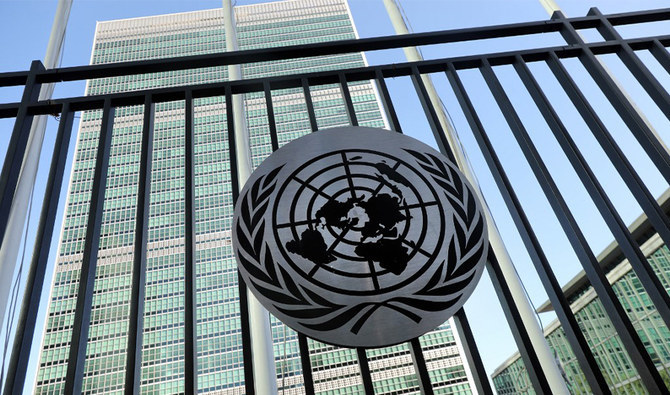
The United Nations headquarters stands in Manhattan on September 19, 2019 in New York City. (AFP/File)
Short Url
Updated 11 June 2021
Follow

Pakistan to present anti-Islamophobia resolution at UNGA amid resistance from India, others

  • Special representative to UN gives exclusive interview to Arab News, supports government decision not to expel French envoy over blasphemous cartoons
  • Pakistan has been lobbying the cause of Islamophobia internationally since PM Khan came to power in 2018

ISLAMABAD: Pakistan plans to present a resolution against Islamophobia at the United Nations General Assembly, the country’s permanent representative to the UN, Ambassador Munir Akram, told Arab News on Thursday.

A renewed resolve to push for the resolution comes after the killings of a Pakistan-origin Muslim family in Canada earlier this week, which local police said was motivated by anti-Muslim hatred. Top Pakistani officials have condemned the killings as an “act of terrorism,” with the Pakistani prime minister saying it revealed growing Islamophobia in Western countries.

“We are seeking and in negotiations for a resolution at the general assembly on this issue [Islamophobia],” Akram said, without specifying when Pakistan would present the resolution. “This will take some time. We need to do a lot of convincing at the UN General Assembly with certain countries which are resisting it, including both some western countries and India but we are trying to secure it at the general assembly of UN.”

“Hopefully we will be able to build consensus,” he added. “I am very hopeful we will get it in there.”

Akram said while most people in the international community realized that Islamophobia was a reality, some nations were opposed to a resolution because it would oblige them to act on anti-Muslim hate crimes.

“There are governments which do not wish to allow the recognition of Islamophobia because it will create obligation for them to take action for the protection of Muslim minorities, communities and these are the governments which are resisting it,” Akram said.

Pakistan has been lobbying the cause on the international level, especially among Muslim countries, since the government of Prime Minister Imran Khan came to power in 2018. 

Despite opposition from the European Union and other western nations and India, the UN General Assembly last December adopted a Pakistan and Philippines sponsored resolution on inter-religious dialogue that emphasized the need to respect “sacred religious symbols.”

Together with the Organization of Islamic Cooperation (OIC), Pakistan organized the International Day to Combat Islamophobia at the UNGA on March 16.

“OIC has done some very good things. They have recognized and propagated the recognition of Islamophobia,” Akram said. “Several resolutions at OIC Foreign Ministers summit level were adopted denouncing Islamophobic actions against Muslims.”

“Islamic commission on human rights has adopted several action oriented resolutions on this,” he said, listing OIC actions. “They have established in the OIC a registry of all actions against Muslims, which is put into a composite report every year.”

In April, PM Khan met Islamabad-based ambassadors of countries belonging to the OIC and briefed them about Pakistan’s efforts at the international level to create awareness against Islamophobia.

Last October, Khan also wrote a letter to leaders of Muslim countries calling for collective action.

“It’s a common cause and all Muslim countries have to do it together,” Akram said, adding that Pakistan was closely cooperating with Saudi Arabia and other Muslim-majority states on the issue.

Acts of discrimination against Muslims abroad often lead to popular reactions in Pakistan, including violent protests by the Tehreek-e-Labbaik Pakistan religious party in April to expel the French envoy to Islamabad over cartoons of the Prophet Muhammad (peace be upon him) published in France last year. 

The Pakistan government did not succumb to pressure to expel the ambassador, which Akram said was the right decision. 

“Confrontation will neither help the anti-Islamophobia movement nor help Muslims in France and the European Union,” he said. “We have to adopt the cooperative persuasive approach,” he added, saying the main task was to change mindsets.

“It’s in the hearts and minds of the people. We have to convert hearts and minds of the people who are anti-Muslim and Islamophobic,” he said. “This is a process, and this process can only be promoted when we serve our cause through values, tolerance, by the principles of harmony and cooperation, which are the principles of our religion.”


At Islamabad conference, Pakistan pitches agriculture as next frontier for Chinese investment

Updated 6 sec ago
Follow

At Islamabad conference, Pakistan pitches agriculture as next frontier for Chinese investment

  • Hundreds of Chinese and Pakistani firms attended the event focusing on fertilizers, seeds, smart farming and irrigation techniques
  • PM Sharif urges Pakistani farmers, businesses and universities to engage with Chinese institutions and experts to modernize agriculture

ISLAMABAD: Prime Minister Shehbaz Sharif on Monday pitched Pakistan’s agriculture sector as the next major frontier for Chinese investment, highlighting opportunities in agri-business, food processing and farming technologies.

The prime minister said this while addressing the Pakistan-China Agriculture Investment Conference, which brought together Chinese and Pakistani agriculturists, entrepreneurs, experts, academicians and government officials.

Hundreds of Chinese and Pakistani firms attended the event that focused on fertilizers, seed varieties, machinery, precision farming and smart irrigation systems, according to the organizers.

Sharif said China had never shied away from providing Pakistan with best possible expertise and technologies, and both sides had signed several memorandums of understanding (MoUs) at similar summits in Shandong and Beijing in last two years.

“I was very happy to express my satisfaction over the progress we are making in terms of converting these MOUs into agreements,” he said. “Today’s conference is a clear indication that Chinese business houses are more than willing to shake hands with Pakistani business houses.”

The conference was billed by Pakistan’s Ministry of National Food Security and Research as a platform for deepening bilateral agricultural ties and supporting broader economic engagement between the two countries.

Sharif called on Pakistani farmers, agribusinesses and universities to actively engage with Chinese institutions and experts to modernize the agriculture sector, which accounts for 24 percent of Pakistan’s GDP and employs over 37 percent of its labor force.

“Chinese experts are there to assist us and support us all the way to achieve this wonderful target [of becoming a surplus agricultural economy],” he said. “Now it’s up to us to generate this trade surplus through higher yields, comparative cost and, of course, highest quality.”

Pakistan and China have been expanding cooperation in agriculture under the China-Pakistan Economic Corridor framework, with a focus on mechanization, high-yield seeds, livestock development and value-added food processing.

Officials say stronger agricultural ties could help Pakistan boost exports, ensure food security and create jobs, while offering Chinese companies access to a large farming market and new investment opportunities.

The prime minister noted that Pakistan’s policy rate was down to 10.5 percent down from 22 percent two years ago, exports were gradually increasing and macroeconomic indicators were stable.

“Now we have to move toward growth,” he said. “But then it requires solid, hard work, untiring efforts, blood and sweat. Without that, you will not be able to achieve your targets.”

The Pakistan-China Agriculture Investment Conference focused on technology transfer and joint ventures in farming, food processing and agricultural research.

“I would urge upon Pakistani farmers, Pakistani agri-houses, experts, professors, technicians, that please come forward and show your best to your [Chinese] brothers and sisters,” Sharif said.

“China is ready, ladies and gentlemen, to support Pakistan like always in the past. Let us make use of this opportunity. Let us stand up and accept this challenge and make Pakistan great through untiring efforts, through hard work.”