

British Museum shines spotlight on MENA artists in new exhibition

‘Untitled (2005)’ by Monir Shahroudy Farmanfarmaian. (Supplied)
Short Url
Updated 12 June 2021
Follow

British Museum shines spotlight on MENA artists in new exhibition

  • Highlights from ‘Reflections: contemporary art of the Middle East and North Africa,’ which runs until August 15 in London


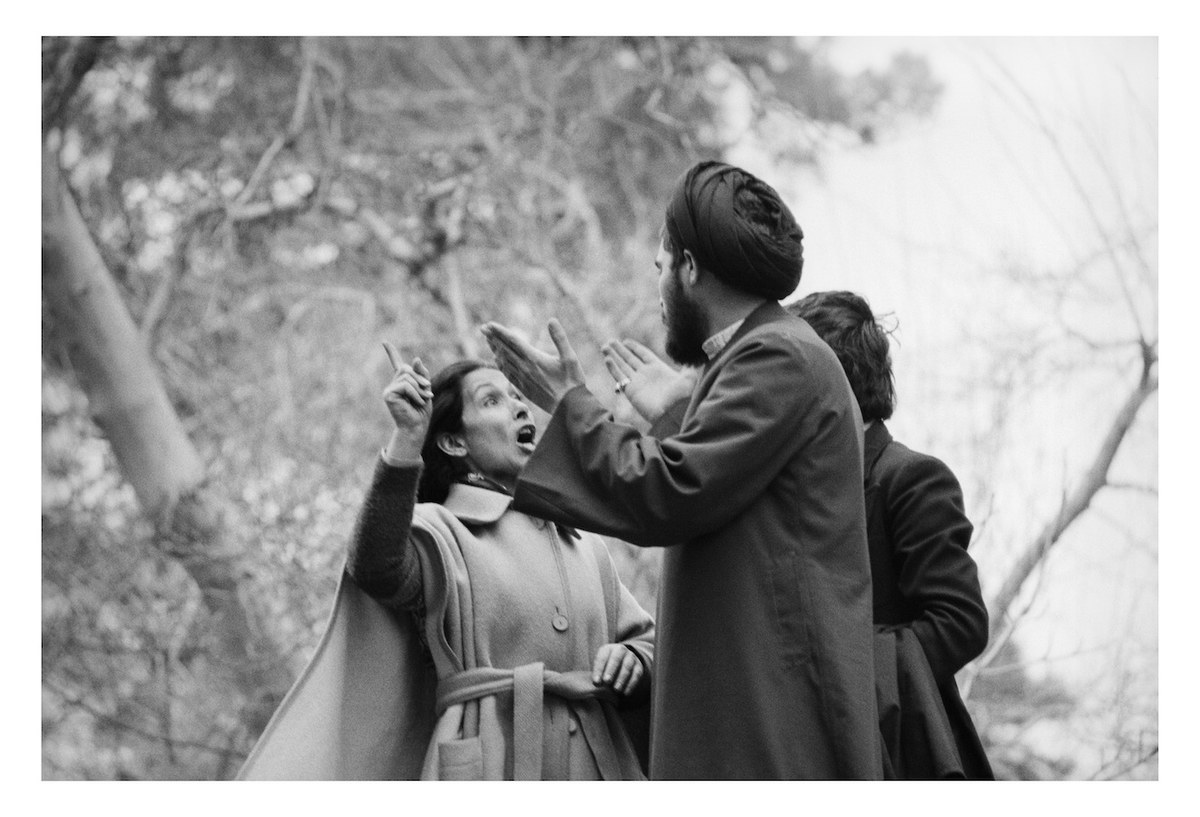
Hengameh Golestan

‘Untitled (1979)’

This image comes from the self-taught photographer’s “Witness ’79” series, which documented a demonstration by more than 100,000 women on the streets of Tehran protesting the recently issued post-revolution ruling that women had to wear the hijab. “The mood was one of anticipation and excitement, and a bit of fear,” she has said of the protest. “We were actively taking part in shaping our future through actions rather than words and that felt amazing.” Even though Golestan developed the film at the time, the photos were not printed until 2015.

Hayv Kahraman
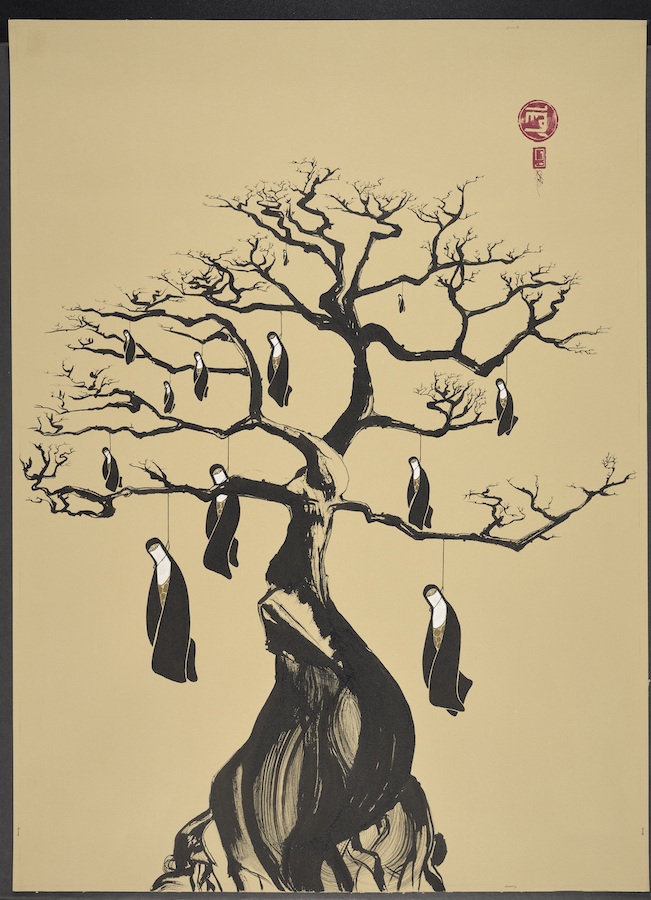
‘Honor Killing’
The Kurdish-American artist — who fled Iraq with her mother and sister at the end of the First Gulf War — incorporates international influences into her work, from European renaissance art to Japanese woodblock prints via Middle Eastern techniques. “Through her distinct vocabulary she evokes her home in Baghdad, exile and war, and wider issues affecting women,” the museum notes state. In 2017, Kahraman told Glass Magazine: “I am concerned with the multitude, not the self. This is not only my story.” This 2006 work — containing hints of calligraphy — in which women wearing the hijab hand from a tree, “tackles a subject that continues to affect women … across the world,” the museum says. “It refers to the killing of a woman because she is considered to have dishonored the family by transgressing social conventions governing gender relations.”

Monir Shahroudy Farmanfarmaian
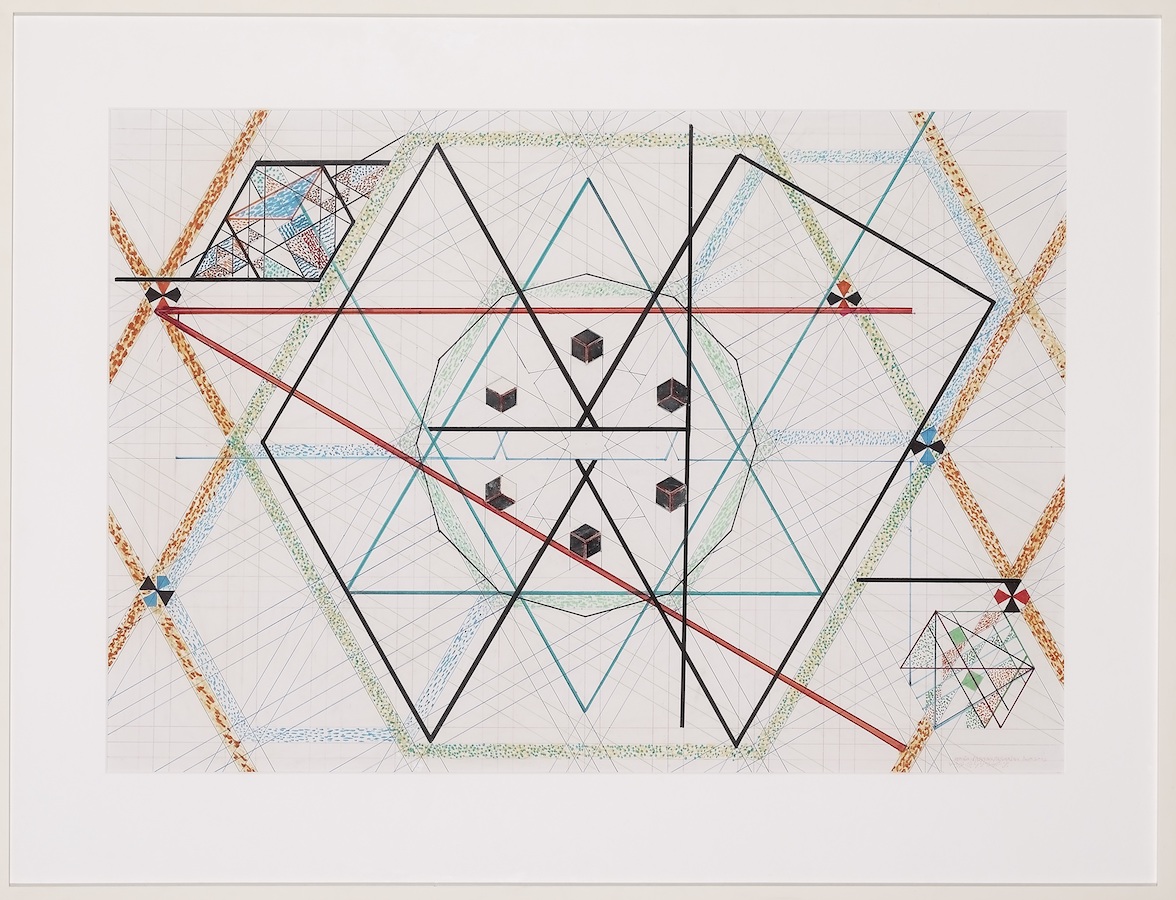
‘Untitled (2005)’

Farmanfarmaian became internationally famous for her minimalist, geometrical works (Andy Warhol, with whom she became friends while studying at Parsons School of Design in New York, reportedly kept one of her famed mirror balls on his desk), and though she is best known for her mirrored sculptures, she also produced minimalist, abstract drawings such as this one, in which, the museum notes state, “the central dodecagon is punctuated by cubes of mirror, with multiple triangular grid patterns emanating from the central point.”

Khalil Joreije and Joanna Hadjithomas
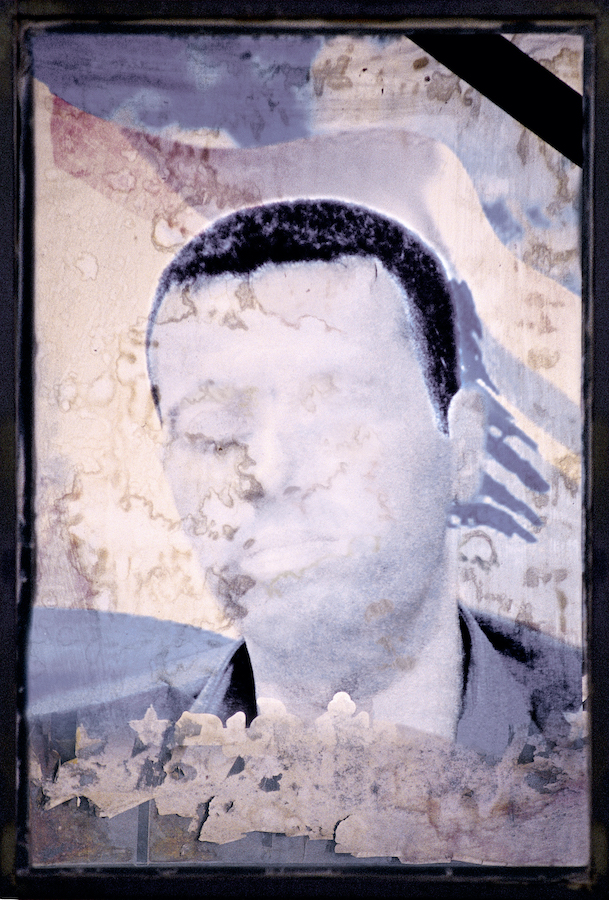
‘Faces’

Much of the Lebanese multimedia artists’ work focuses on the 15-year Civil War, the aftereffects of which continue to shape their homeland. The project from which this 2009 work is taken focuses on the victims of that violence — the ‘martyrs’ whose framed images adorn the streets. Traveling throughout Lebanon, the museum says, “they sought out posters of ‘martyrs from all confessions and political backgrounds,’ particularly choosing those that had been left in place for a long time and that had deteriorated, with the features gradually disappearing so that ‘all that remains is an outline of the face, a sketched and mostly unrecognizable shadow. … They intervened in the image, enhancing the shape of an eye or a mouth with graphite as though reclaiming the figures from the shadows of disappearance.”

Rafa Nasiri
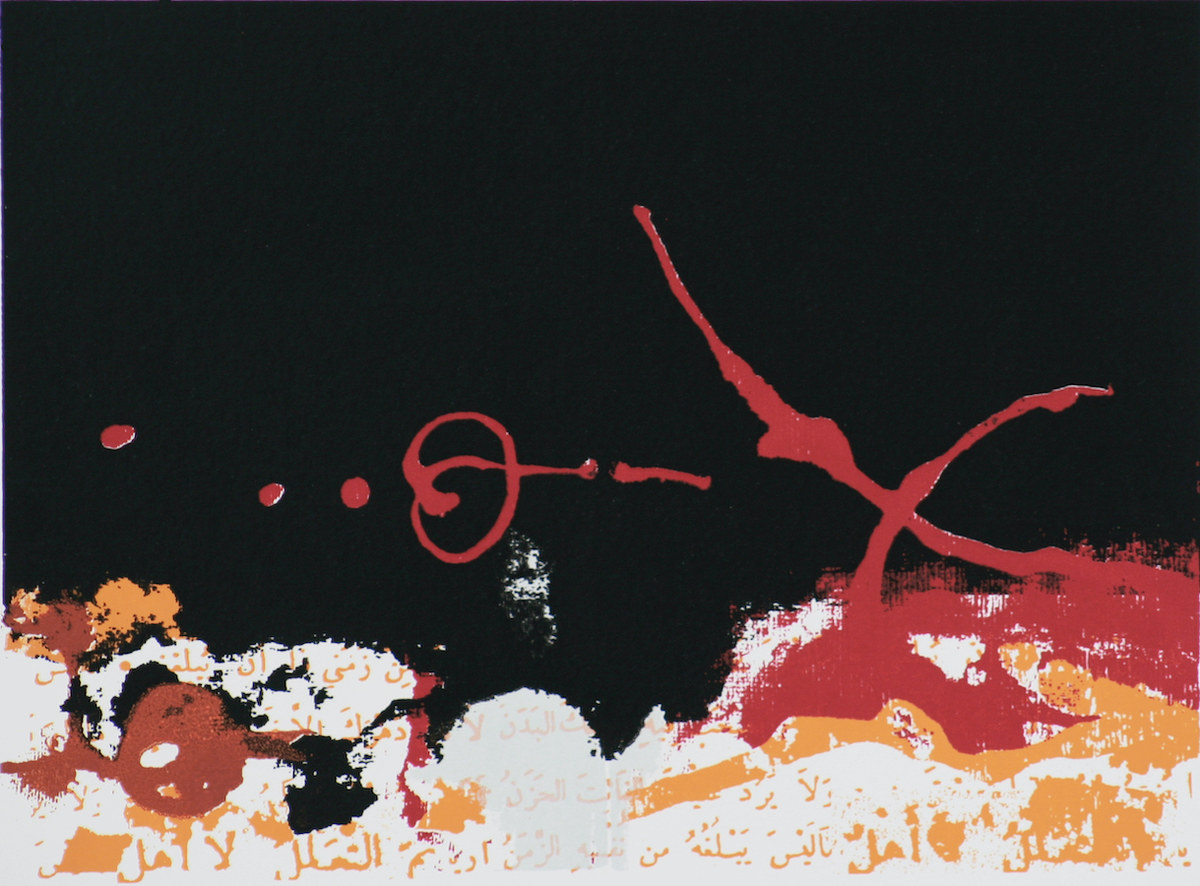
‘A Library Set On Fire’

The influential Iraqi artist made this 2008 silkscreen — one of a series of six — to mark the burning of Iraq’s National Library, one of the many losses to afflict his homeland in the Iraq War of 2003. Each of the silkscreens includes an extract from Al-Mutanabbi’s poem “On Hearing in Egypt that his Death had been Reported to Saif Al-Dawla in Aleppo.” This one contains the lines: “Unhappy I, friendless, homeless/Solitary, cheerless, comfortless.” The words are, the museum says, “placed within a dark abstract composition, the colours echoing the orange and red flames of a fire.” The notes continue: “As the Iraqi writer May Muzaffar has commented, ‘The burning of books and manuscripts is paralleled with the burning of the mystic al-Hallaj, a human body, and announces not only the death of the book as a social thing/being but also the end of civilization and humanity.’”

Sulafa Hijazi
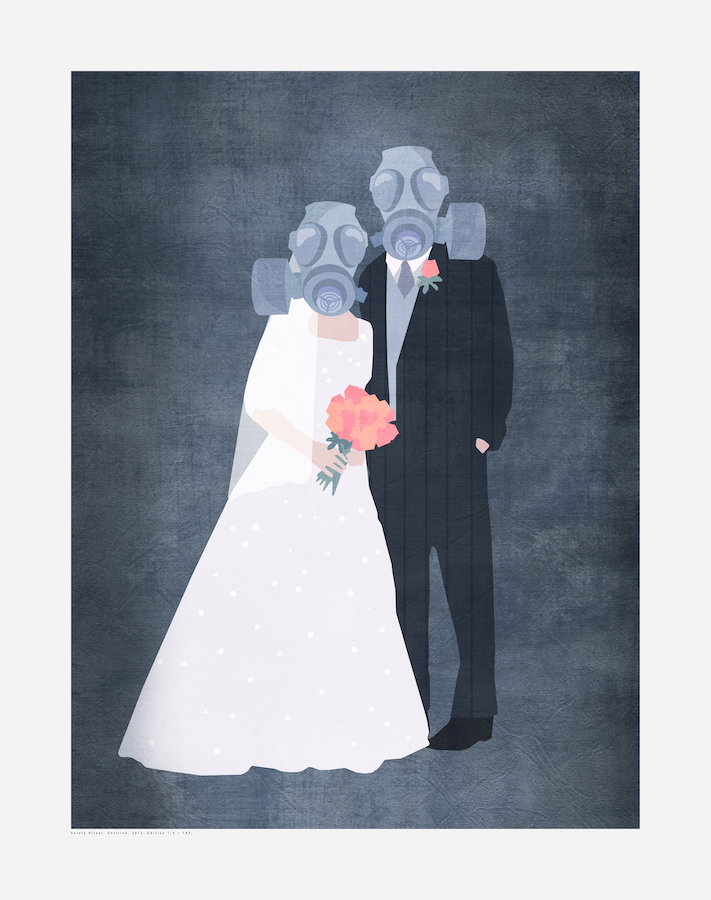
‘Untitled (2012)’
The Syrian artist began his “Ongoing” series — of which this image is part — in 2011, originally publishing the pieces on social media, which, as the museum notes, “became an increasingly significant platform through which artists in Syria were able to share their work.” In Malu Halasa’s 2012 work “Culture in Defiance: Continuing Traditions of Satire, Art and the Struggle for Freedom in Syria,” she quotes Hijazi as saying: “Before I left the country in 2012, people were still trying to do something positive. We had great hopes about the prospect of changing our country through peaceful means. There was still a space in our society for us to do this. Then it started to become violent; … (now) the sound of weapons drowns out the voices of peaceful activism.”

Taysir Batniji
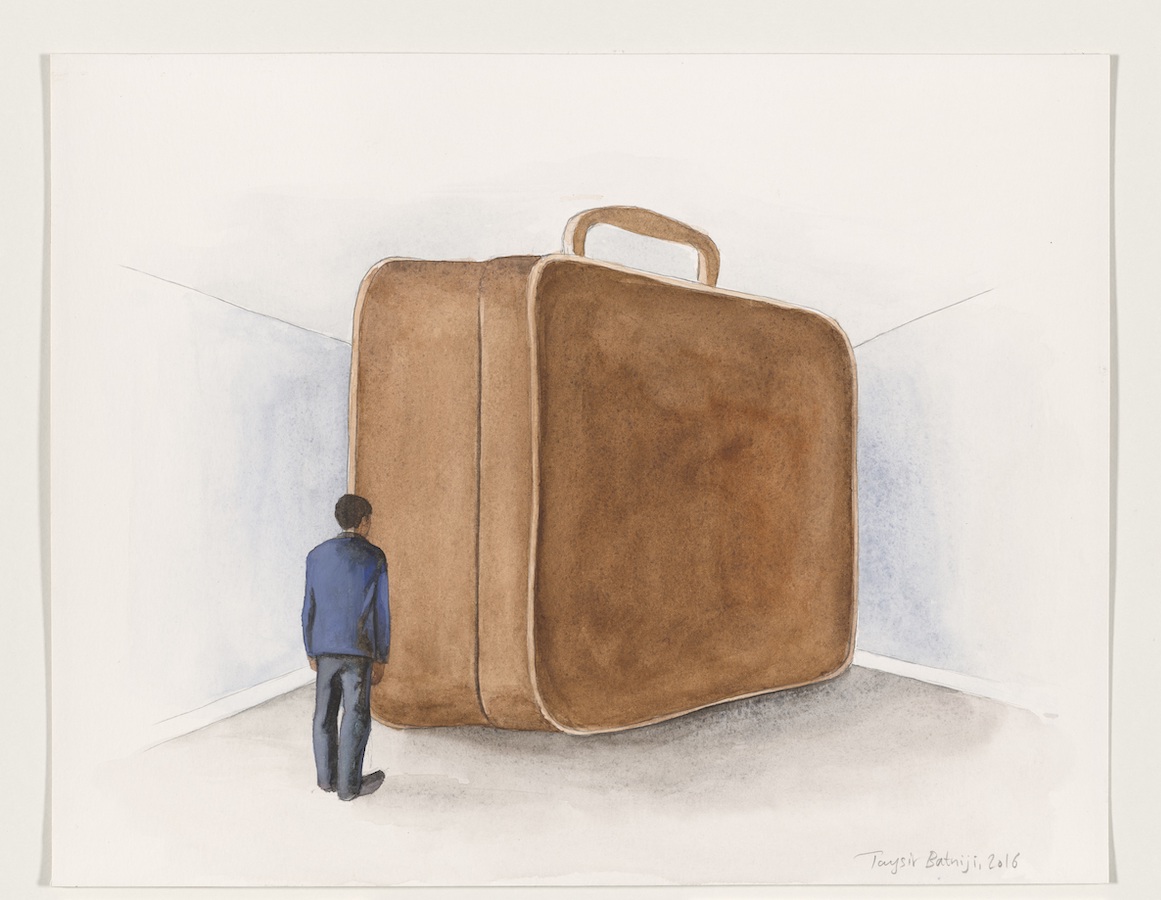
‘Untitled (2016)’

Movement and exile are predominant themes in Batniji’s work, and the suitcase is a recurring symbol of them. “In this watercolor, the suited male figure, dwarfed by the sheer size of the suitcase, can be considered as an insertion of the artist himself,” the museum notes say, adding that the Palestinian artist’s work explores “the notion of being between worlds — in his case the world he lives in, France, and his home, Gaza, which he has not been able to visit since 2012.”


From historic desert landscapes to sound stages: AlUla’s bid to become the region’s film capital

Updated 07 February 2026
Follow

From historic desert landscapes to sound stages: AlUla’s bid to become the region’s film capital

DUBAI: AlUla is positioning itself as the center of cinema for the MENA region, turning its dramatic desert landscapes, heritage sites and newly built studio infrastructure into jobs, tourism and long‑term economic opportunity.

In a wide‑ranging interview, Zaid Shaker, executive director of Film AlUla, and Philip J. Jones, chief tourism officer for the Royal Commission for AlUla, laid out an ambitious plan to train local talent, attract a diverse slate of productions and use film as a catalyst for year‑round tourism.

“We are building something that is both cultural and economic,” said Shaker. “Film AlUla is not just about hosting productions. It’s about creating an entire ecosystem where local people can come into sustained careers. We invested heavily in facilities and training because we want AlUla to be a place where filmmakers can find everything they need — technical skill, production infrastructure and a landscape that offers limitless variety. When a director sees a location and says, ‘I can shoot five different looks in 20 minutes,’ that changes the calculus for choosing a destination.”

At the core of the strategy are state‑of‑the‑art studios operated in partnership with the MBS Group, which comprises Manhattan Beach Studios — home to James Cameron’s “Avatar” sequels. “We have created the infrastructure to compete regionally and internationally,” said Jones. “Combine those studios with AlUla’s natural settings and you get a proposition that’s extremely attractive to producers; controlled environment and unmatched exterior vistas within a short drive. That versatility is a real selling point. We’re not a one‑note destination.”

The slate’s flagship project, the romantic comedy “Chasing Red,” was chosen deliberately to showcase that range. “After a number of war films and heavy dramas shot here, we wanted a rom‑com to demonstrate the breadth of what AlUla offers,” said Shaker. “‘Chasing Red’ uses both our studio resources and multiple on‑location settings. It’s a story that could have been shot anywhere — but by choosing AlUla we’re showing how a comical, intimate genre can also be elevated by our horizons, our textures, our light.

“This film is also our first under a broader slate contract — so it’s a proof point. If ‘Chasing Red’ succeeds, it opens the door for very different kinds of storytelling to come here.”

Training and workforce development are central pillars of the program. Film AlUla has engaged more than 180 young Saudis in training since the start of the year, with 50 already slated to join ongoing productions. “We’re building from the bottom up,” said Shaker. “We start with production assistant training because that’s often how careers begin. From there we provide camera, lighting, rigging and data-wrangling instruction, and we’ve even launched soft‑skill offerings like film appreciation— courses that teach critique, composition and the difference between art cinema and commercial cinema. That combination of technical and intellectual training changes behavior and opens up real career pathways.”

Jones emphasized the practical benefits of a trained local workforce. “One of the smartest strategies for attracting productions is cost efficiency,” he said. “If a production can hire local, trained production assistants and extras instead of flying in scores of entry‑level staff, that’s a major saving. It’s a competitive advantage. We’ve already seen results: AlUla hosted 85 productions this year, well above our initial target. That momentum is what we now aim to convert into long‑term growth.”

Gender inclusion has been a standout outcome. “Female participation in our training programs is north of 55 percent,” said Shaker. “That’s huge. It’s not only socially transformative, giving young Saudi women opportunities in an industry that’s historically male-dominated, but it’s also shaping the industry culture here. Women are showing up, learning, and stepping into roles on set.”

Looking to 2026, their targets are aggressive; convert the production pipeline into five to six feature films and exceed 100 total productions across film, commercials and other projects. “We want private-sector partners to invest in more sound stages so multiple productions can run concurrently,” said Jones. “That’s how you become a regional hub.”

The tourism case is both immediate and aspirational. “In the short term, productions bring crews who fill hotels, eat in restaurants and hire local tradespeople,” said Shaker. “In the long term, films act as postcards — cinematic invitations that make people want to experience a place in person.”

Jones echoed that vision: “A successful film industry here doesn’t just create jobs; it broadcasts AlUla’s beauty and builds global awareness. That multiplies the tourism impact.”

As “Chasing Red” moves into production, Shaker and Jones believe AlUla can move from an emerging production destination to the region’s filmmaking epicenter. “We’re planting seeds for a cultural sector that will bear economic fruit for decades,” said Shaker. “If we get the talent, the infrastructure and the stories right, the world will come to AlUla to film. And to visit.”