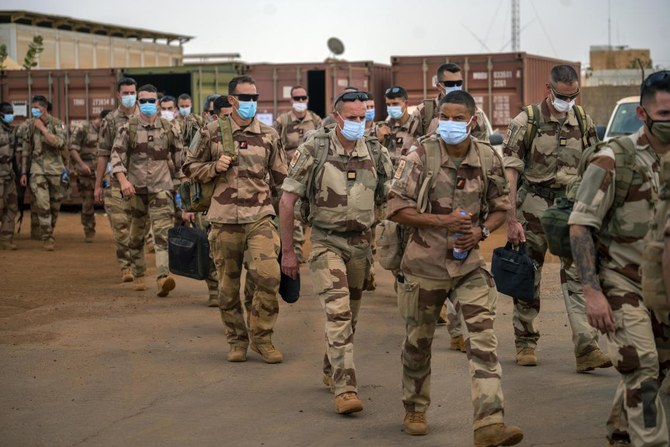
PARIS: President Emmanuel Macron on Thursday announced a major drawdown of France’s military presence in the Sahel and the end of the existing Barkhane operation.
“The time has come: Our commitment in the Sahel will not continue in the same way,” Macron told a press conference.
“We will undertake a profound transformation of our military presence in the Sahel,” he added. “The framework will be made clear in the weeks to come.”
He said that he saw France’s future presence as being part of the so-called Takuba international task force in the Sahel in which “hundreds” of French soldiers would form the “backbone.”
It would mean the closure of French bases and the use of special forces who would be focused on anti-terror operations and military training, he added.
France currently has 5,100 troops in the arid and volatile Sahel region, which stretches across Africa south of the Sahara desert and spans half a dozen countries.
The Barkhane operation dates back to an initial deployment undertaken from January 2013 as Paris intervened to stop the advance of extremists in Mali.
Macron said the French drawdown had been decided because the “longstanding presence of France... cannot be a substitute for political stability.”
For years Macron has tried to get Western allies to help shoulder the burden of an anti-terror fight in the Sahel where France, the former colonial power in the region, is the lead foreign presence.
The killing in April of the veteran leader of Chad, a close Paris ally, and a coup in Mali last month have also underlined the threat posed by continued political instability in the region.

Macron announces Sahel troop drawdown, calls for new force
https://arab.news/mgqe4
Macron announces Sahel troop drawdown, calls for new force
- France’s future presence will be as part of the Takuba international task force in the Sahel in which ‘hundreds’ of French soldiers will form the ‘backbone’
- It will mean the closure of French bases and the use of special forces who will be focused on anti-terror operations and military training
US quits global organization dedicated to preventing violent extremism
- With other international agencies scaling back following mass US foreign aid cuts last year, GCERF said it now carries much of the global prevention burden alone, and that its $50 million annual budget had not risen to fill the growing gaps
GENEVA: A global organization dedicated to preventing violent extremism said on Friday the US had made a mistake in withdrawing its support while the risk of militant attacks surges in the Middle East and Africa’s Sahel.
The Global Community Engagement and Resilience Fund, which supports prevention programs across dozens of countries with communities vulnerable to extremism — appeared on Wednesday in a White House memo announcing a US pullout from 35 international agencies and 31 UN entities it said rejected US interests.
Dr. Khalid Koser, head of the Geneva-based GCERF, said the decision came as a surprise and without explanation and that it reflected a deeper ideological shift under US President Donald Trump’s administration away from multilateral prevention programs toward security-focused counterterrorism measures.
“I think it’s a mistake to take out that fundamental piece of prevention. But I don’t think this administration believes in prevention,” Koser told Reuters.
The White House did not immediately respond to a Reuters request for comment.
Koser said risks of extremist violence were higher than at any point since the 2011 Arab Spring uprisings, citing as examples Afghanistan, the Sahel and camps in northeast Syria that hold tens of thousands of Daesh family members — and a new generation at risk of radicalization after the Gaza war.
“If you don’t work on prevention, then in 10 years time, you’re going to have lots of terrorists and lots of problems.”
Further underlining a US repudiation of multilateral cooperation bodies under Trump’s “America First” policy, the White House also announced it was quitting the 30-nation Global Counterterrorism Forum.
The US helped establish GCERF’s program in northeast Syria that helps reintegrate families from former Daesh militant circles. Koser said that while GCERF’s work would go on, it was losing a major player in the US, and that Washington’s decision was perplexing given GCERF’s agenda remained relevant to US national interests.
With other international agencies scaling back following mass US foreign aid cuts last year, GCERF said it now carries much of the global prevention burden alone, and that its $50 million annual budget had not risen to fill the growing gaps.
The 2025 Global Terrorism Index issued by the Institute for Economics and Peace showed the number of countries recording a terrorist attack increased from 58 to 66 in 2024, reversing nearly a decade of improvements.


