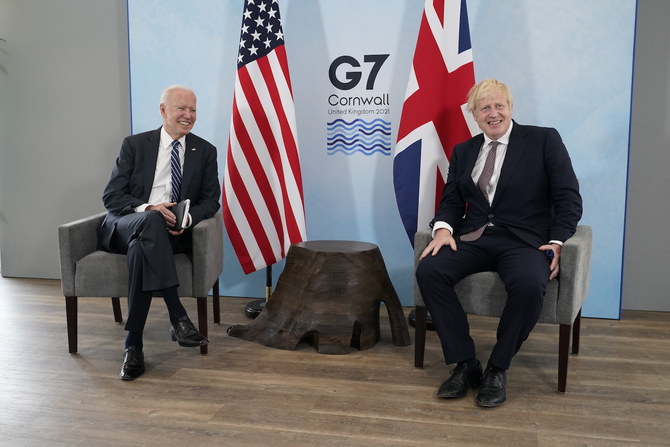
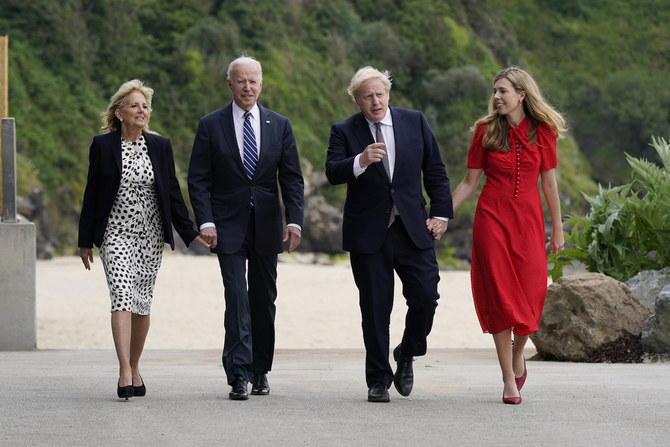
CARBIS BAY, England: US President Joe Biden and British Prime Minister Boris Johnson looked back on illustrious wartime predecessors as they met ahead of a Group of Seven summit in England.
At their first meeting in the seaside resort of Carbis Bay, the two leaders inspected documents Thursday related to the Atlantic Charter, a declaration signed by British Prime Minister Winston Churchill and US President Franklin D. Roosevelt in August 1941 setting out common goals for the world after World War II. Those goals included freer trade, disarmament and the right to self-determination of all people.
Johnson noted that the charter laid the foundation for the United Nations and NATO. “Yeah, I know,” Biden said.
At their meeting, the two leaders plan to sign what they’re calling a new Atlantic Charter, pledging to “defend the principles, values, and institutions of democracy and open societies.”
The original charter is often cited as a cornerstone of the trans-Atlantic “special relationship.”
Johnson’s predecessor, Theresa May, gave a copy of the charter to Donald Trump in 2019 as part of efforts to charm the volatile then-president. It had little success; Trump publicly disparaged May and derided international bodies such as the UN.


Biden, Johnson seek to sign new Atlantic charter
https://arab.news/bn54g
Biden, Johnson seek to sign new Atlantic charter

- At their meeting, the two leaders plan to sign what they’re calling a new Atlantic Charter
- The charter pledges to “defend the principles, values, and institutions of democracy and open societies”


Canada PM Carney says can’t rule out military participation in Iran war
- Carney had said the US-Israeli strikes on Iran were “inconsistent with international law”
- However, he supports the efforts to stop Iran from obtaining a nuclear weapon
CANBERRA, Australia: Canadian Prime Minister Mark Carney said Thursday that he couldn’t rule out his country’s military participation in the escalating war in the Middle East.
Carney’s visit to Australia this week has been overshadowed by expanding war in the Middle East, sparked by a massive US-Israeli strike on Iran that killed its supreme leader, Ayatollah Ali Khamenei.
Speaking alongside local counterpart Anthony Albanese in Canberra, Carney was asked whether there was a situation in which Canada would get involved.
“One can never categorically rule out participation,” he said, while stressing the question was a “hypothetical” one.
“We will stand by our allies,” said Carney, adding that “we will always defend Canadians.”
Carney had said the US-Israeli strikes on Iran were “inconsistent with international law.”
However, he supports the efforts to stop Iran from obtaining a nuclear weapon — a position that Canada takes “with regret” as it represented “another example of the failure of the international order.”
The Canadian leader reiterated on Thursday his call for a “de-escalation” of the conflict.
Carney’s trip is part of a multi-country tour of the Asia-Pacific aimed at reducing reliance on the United States — a hedge against what he has described as a fading US-led global order.
The Australia leg of the tour is aimed at bringing in investment and deepening ties with a like-minded “middle power” partner.
‘Middle power’ rallying cry
On Thursday morning he issued a rallying cry in Australia’s parliament to “middle powers,” urging them to work together in an increasingly hegemonic world order.
Nations like Australia and Canada faced a stark choice — work together to help write the “new rules” of the global order or have great powers do it for them, he said.
“In this brave new world, middle powers cannot simply build higher walls and retreat behind them. We must work together,” he said.
“Great powers can compel, but compulsion comes with costs, both reputational and financial,” the former central banker added.
“Middle powers like Australia and Canada hold this rare convening power because others know we mean what we say and we will match our values with our actions.”
The Canadian leader also said the two countries would together as “strategic collaborators” to pool their vast combined rare earth mineral resources.
And he detailed renewed cooperation in areas from defense to artificial intelligence.
“We know we must work with others who share our values to build solid capabilities,” he told parliament.
Otherwise, he warned, they risked being “caught between the hyperscalers and the hegemons.”
The Canadian leader has frequently clashed with US President Donald Trump, who has repeatedly threatened to annex Canada and slapped swingeing tariffs on the country.
In a speech to political and financial elites at the World Economic Forum in January, Carney warned the US?led global system of governance was enduring “a rupture.”


